

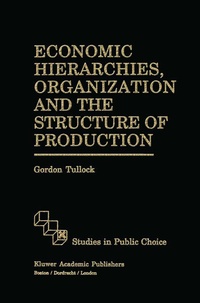
Economic Hierarchies, Organization and the Structure of Production
Published on 30. April 1992
Book
Hardback
IX, 196 pages
978-0-7923-9168-5 (ISBN)
Description
Economics has been basically a study of the interactions between organizations, with some organizations being so small we only have one person in them. The internal organization of the largest hierarchies has indeed been looked at, but a good reason for working less on these organizations is that the internal reactions are much harder to understand. It is sensible to solve the problems we can solve and put the others off until later. The author's basic purpose here is to look at these larger hierarchical organizations, and develop a scientific account of them.
In Economic Hierarchies, Organization and the Structure of Production Gordon Tullock examines the internal functioning and organization of the corporation. In the author's personal tradition, the book relies on narrative analysis rather than mathematical complexity to convey insights into the functioning of the corporation.
In Economic Hierarchies, Organization and the Structure of Production Gordon Tullock examines the internal functioning and organization of the corporation. In the author's personal tradition, the book relies on narrative analysis rather than mathematical complexity to convey insights into the functioning of the corporation.
More details
Series
Edition
1992 ed.
Language
English
Place of publication
Dordrecht
Netherlands
Target group
Professional and scholarly
Research
Illustrations
IX, 196 p.
Dimensions
Height: 241 mm
Width: 160 mm
Thickness: 17 mm
Weight
486 gr
ISBN-13
978-0-7923-9168-5 (9780792391685)
DOI
10.1007/978-94-011-2948-0
Schweitzer Classification
Other editions
Additional editions
E-Book
12/2012
Springer
€149.79
Available for download
Book
09/2012
Springer
€160.49
Shipment within 15-20 days
Content
1 Introduction.- 2 Why Hierarchical Organizations? Why Not?.- 3 Parallel Problems.- 4 In the Belly of the Beast.- 5 Life in the Interior.- 6 Structural Reform.- 7 Termites.- 8 A General Picture.- 9 Random Allocation.- 10 Rent Seeking and the Importance of Disorganization.- 11 Restricted Scope.- 12 Incentives.- 13 Summing Up.