

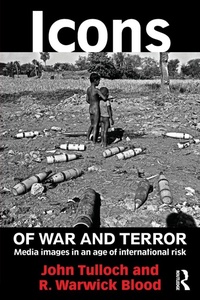
Icons of War and Terror
Media Images in an Age of International Risk
1st Edition
Published on 19. June 2012
Book
Paperback/Softback
232 pages
978-0-415-69805-4 (ISBN)
Description
This book explores the ideas of key thinkers and media practitioners who have examined images and icons of war and terror.
Icons of War and Terror explores theories of iconic images of war and terror, not as received pieties but as challenging uncertainties; in doing so, it engages with both critical discourse and conventional image-making. The authors draw on these theories to re-investigate the media/global context of some of the most iconic representations of war and terror in the international 'risk society'. Among these photojournalistic images are:
Nick Ut's Pulitzer Prize winning photograph of a naked girl, Kim Phuc, running burned from a napalm attack in Vietnam in June 1972;
a quintessential 'ethnic cleansing' image of massacred Kosovar Albanian villagers at Racak on January 15, 1999, which finally propelled a hesitant Western alliance into the first of the 'new humanitarian wars';
Luis Simco's photograph of marine James Blake Miller, 'the Marlboro Man', at Fallujah, Iraq, 2004;
the iconic toppling of the World Trade Centre towers in New York by planes on September 11, 2001; and the 'Falling Man' icon - one of the most controversial images of 9/11;
the image of one of the authors of this book, as close-up victim of the 7/7 terrorist attack on London, which the media quickly labelled iconic.
This book will be of great interest to students of media and war, sociology, communications studies, cultural studies, terrorism studies and security studies in general.
Icons of War and Terror explores theories of iconic images of war and terror, not as received pieties but as challenging uncertainties; in doing so, it engages with both critical discourse and conventional image-making. The authors draw on these theories to re-investigate the media/global context of some of the most iconic representations of war and terror in the international 'risk society'. Among these photojournalistic images are:
Nick Ut's Pulitzer Prize winning photograph of a naked girl, Kim Phuc, running burned from a napalm attack in Vietnam in June 1972;
a quintessential 'ethnic cleansing' image of massacred Kosovar Albanian villagers at Racak on January 15, 1999, which finally propelled a hesitant Western alliance into the first of the 'new humanitarian wars';
Luis Simco's photograph of marine James Blake Miller, 'the Marlboro Man', at Fallujah, Iraq, 2004;
the iconic toppling of the World Trade Centre towers in New York by planes on September 11, 2001; and the 'Falling Man' icon - one of the most controversial images of 9/11;
the image of one of the authors of this book, as close-up victim of the 7/7 terrorist attack on London, which the media quickly labelled iconic.
This book will be of great interest to students of media and war, sociology, communications studies, cultural studies, terrorism studies and security studies in general.
Reviews / Votes
"There is much to admire in this book. It covers a range of wars that have taken place over the past few decades - Bangladesh, Kosovo, 9/11 and the the Gulf Wars. I found Icons of War and Terror extremely worthwhile. It was very readable and an intelligent analysis of complex problems. It is certainly a book that should be coupled with Susan Sontag's work and the range of other quality analyses of the current incarnation of warfare and lethal violence." - Jeff Lewis, Professor of Media and Cultural Politics at RMIT University, e-IR, December 2012More details
Series
Language
English
Place of publication
London
United Kingdom
Publishing group
Taylor & Francis Ltd
Target group
College/higher education
Professional and scholarly
Illustrations
14 s/w Photographien bzw. Rasterbilder
14 Halftones, black and white
Dimensions
Height: 234 mm
Width: 156 mm
Thickness: 13 mm
Weight
363 gr
ISBN-13
978-0-415-69805-4 (9780415698054)
Copyright in bibliographic data and cover images is held by Nielsen Book Services Limited or by the publishers or by their respective licensors: all rights reserved.
Schweitzer Classification
Other editions
Additional editions
E-Book
07/2012
1st Edition
Routledge
€61.99
Available for download
E-Book
07/2012
1st Edition
Routledge
€61.99
Available for download
Book
06/2012
Routledge
€206.30
Shipment within 15-20 days
Persons
John Tulloch is Professor of Communication, University of Newcastle, Australia. He is the author of 18 books in media and television studies, film history and theory, literary and theatre studies, and the sociology of risk. His books include the widely cited Risk and Everyday Life (with Deborah Lupton, Routledge, 2003) and monographs on Doctor Who (1984), A Country Practice (1986) and Trevor Griffiths (2007).
R. Warwick Blood is Professor of Communication, Faculty of Arts and Design, University of Canberra, Australia. Previously, he was a reporter, foreign correspondent and producer for the Australian Broadcasting Corporation. He has published on risk, and news reporting and portrayal of health issues.
R. Warwick Blood is Professor of Communication, Faculty of Arts and Design, University of Canberra, Australia. Previously, he was a reporter, foreign correspondent and producer for the Australian Broadcasting Corporation. He has published on risk, and news reporting and portrayal of health issues.
Content
Introduction Image: Nedia 1. Guernica: Icon of State Terror Image: Simon Schama and Guernica 2. Ways of Seeing the Napalmed Girl: Icons of Agony and Beauty Image: The Napalmed Girl 3.Two Bangladeshi Boys and Public Culture: Iconic or Absent Images: Two Boys in Bangladesh; the Shamed One 4. 'The Gulf War Did Not Take Place': Smart-Weapon Imaging Images: Carnage at Amiryah Shelter 5. Picturing Kosovo: Virtual, New or Old War? Image: The Serbian massacre of Kosovar Albanian villagers at Racak. 6.'Change Everything'? Icons out of a Clear Blue Sky Images: the second of the Twin Towers attacked by a plane on 9/11 7. Shock Doctrine in Iraq: the 'Marlboro Marine' and 'Shock and Awe' Images: 'Shock and Awe'; the Marlboro Marine 8. Abu Ghraib, Regimes of Looking and Risk: Icons, Index and Symbol Images: Abu Ghraib - the hooded man 9. Witnessing Terrorism in New York and London: Trauma Icons Images: the 'Falling Man'; iconic image of John Tulloch after the 7/7 terrorist attack 10. Culture Warriors: Images of the Colonial, Then and Now Image: Julie Dowling's 'Walyer' Conclusion: Walls and Borders