

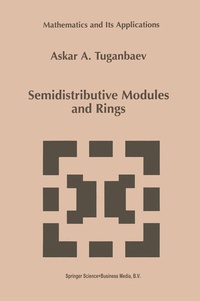
Semidistributive Modules and Rings
Published on 15. October 2012
Book
Paperback/Softback
X, 357 pages
978-94-010-6136-0 (ISBN)
Description
A module M is called distributive if the lattice Lat(M) of all its submodules is distributive, i.e., Fn(G + H) = FnG + FnH for all submodules F,G, and H of the module M. A module M is called uniserial if all its submodules are comparable with respect to inclusion, i.e., the lattice Lat(M) is a chain. Any direct sum of distributive (resp. uniserial) modules is called a semidistributive (resp. serial) module. The class of distributive (resp. semidistributive) modules properly cont.ains the class ofall uniserial (resp. serial) modules. In particular, all simple (resp. semisimple) modules are distributive (resp. semidistributive). All strongly regular rings (for example, all factor rings of direct products of division rings and all commutative regular rings) are distributive; all valuation rings in division rings and all commutative Dedekind rings (e.g., rings of integral algebraic numbers or commutative principal ideal rings) are distributive. A module is called a Bezout module or a locally cyclic module ifevery finitely generated submodule is cyclic. If all maximal right ideals of a ring A are ideals (e.g., if A is commutative), then all Bezout A-modules are distributive.
More details
Series
Edition
Softcover reprint of the original 1st ed. 1998
Language
English
Place of publication
Dordrecht
Netherlands
Target group
Professional and scholarly
Research
Illustrations
X, 357 p.
Dimensions
Height: 240 mm
Width: 160 mm
Thickness: 21 mm
Weight
594 gr
ISBN-13
978-94-010-6136-0 (9789401061360)
DOI
10.1007/978-94-011-5086-6
Schweitzer Classification
Other editions
Additional editions
A.A. Tuganbaev
Semidistributive Modules and Rings
Book
09/1998
1st Edition
Kluwer Academic Publishers
€115.50
Article exhausted; check different version
Person
Askar Tuganbaev
received his Ph.D. at the Moscow State University in 1978 and has been a professor at Moscow Power Engineering Institute (Technological University) since 1978. He is the author of three other monographs on ring theory and has written numerous articles on ring theory.
Content
1 Radicals, local and semisimple modules.- 1.1 Maximal submodules and the Jacobson radical.- 1.2 Local and uniserial modules.- 1.3 Semisimple and Artinian modules.- 1.4 The prime radical.- 2 Projective and injective modules.- 2.1 Free and projective modules.- 2.2 Injective modules.- 2.3 Injective hull.- 3 Bezout and regular modules.- 3.1 Regular modules.- 3.2 Unit-regular rings.- 3.3 Semilocal rings and distributivity.- 3.4 Strongly regular rings.- 3.5 Bezout rings.- 4 Continuous and finite-dimensional modules.- 4.1 Closed submodules.- 4.2 Continuous modules.- 4.3 Finile-dimensional modules.- 4.4 Nonsingular ?-injective modules.- 5 Rings of quotients.- 5.1 Ore sets.- 5.2 Denominator sets and localizable rings.- 5.3 Maximal rings of quotients.- 6 Flat modules and semiperfect rings.- 6.1 Characterizations of flat modules.- 6.2 Submodules of flat modules.- 6.3 Semiperfect and perfect rings.- 7 Semihereditary and invariant rings.- 7.1 Coherent and reduced rings.- 7.2 Invariant rings.- 7.3 Rings with integrally closed factor rings.- 8 Endomorphism rings.- 8.1 Modules over endomorphism rings and quasi injective modules.- 8.2 Nilpotent endomorphisms.- 8.3 Strongly indecomposable modules.- 9 Distributive rings with maximum conditions.- 9.1 Arithmetics of ideals.- 9.2 Noel.herian rings.- 9.3 Classical rings of quotients of distributive rings.- 9.4 Rings algebraic over their centre.- 10 Self-injective and skew-injective rings.- 10.1 Quasi-frobenius rings and direct sums of injective modules.- 10.2 Cyclic ?-injective modules.- 10.3 Integrally closed Noetherian rings.- 10.4 Cyclic skew-injective modules.- 10.5 Countably injective rings.- 11 Semidistributive and serial rings.- 11.1 Semidistributive modules.- 11.2 Semidistributive rings.- 11.3 Serial modules and rings.- 12 Monoidrings and related topics.- 12.1 Series and polynomial rings.- 12.2 Quaternion algebras.- 12.3 Subgroups, submonoids, and annihilators.- 12.4 Regular group rings.- 12.5 Cancellative monoids.- 12.6 Semilattices and regular monoids.