

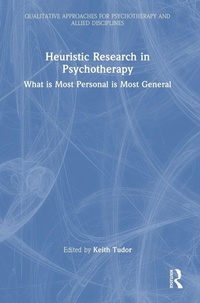
Heuristic Research in Psychotherapy
What is Most Personal is Most General
1st Edition
Will be published approx. on 24. June 2026
Book
Hardback
182 pages
978-1-041-16694-8 (ISBN)
Description
Heuristic Research in Psychotherapy showcases the power of heuristic enquiry to deepen through discovery, critique, create, and reimagine psychotherapy research.
Building on the interdisciplinary foundation of previous volumes in the Qualitative Research Approaches in Psychotherapy and Allied Disciplines series, this book focuses specifically on heuristic methodology-a form of research grounded in personal experience, reflexivity, and embodied insight. Across 11 chapters, contributors explore phenomena including aesthetics, colonisation, cultural hybridity, motherhood, obsessive-compulsive disorder, and spiritual transformation. Each chapter exemplifies how lived experience and rigorous methodology intersect, offering readers a richly textured and intellectually provocative resource. Edited by Keith Tudor, the volume brings together psychotherapists, researchers, and practitioners across diverse cultural and theoretical contexts. This book challenges medicalised, positivist research models, foregrounding relational, critical, and situated approaches to therapeutic enquiry.
It will be essential reading for postgraduate students, practitioner-researchers, and psychotherapy educators seeking alternatives to conventional methods.
Building on the interdisciplinary foundation of previous volumes in the Qualitative Research Approaches in Psychotherapy and Allied Disciplines series, this book focuses specifically on heuristic methodology-a form of research grounded in personal experience, reflexivity, and embodied insight. Across 11 chapters, contributors explore phenomena including aesthetics, colonisation, cultural hybridity, motherhood, obsessive-compulsive disorder, and spiritual transformation. Each chapter exemplifies how lived experience and rigorous methodology intersect, offering readers a richly textured and intellectually provocative resource. Edited by Keith Tudor, the volume brings together psychotherapists, researchers, and practitioners across diverse cultural and theoretical contexts. This book challenges medicalised, positivist research models, foregrounding relational, critical, and situated approaches to therapeutic enquiry.
It will be essential reading for postgraduate students, practitioner-researchers, and psychotherapy educators seeking alternatives to conventional methods.
Reviews / Votes
'At a time in contemporary research when we are becoming increasingly concerned with issues of relationality, Keith Tudor's timely Heuristic Research in Psychotherapy makes a valuable contribution to how we think about the nature of personal experience, the experience of others, self-reflection, honesty, discovery, and authentic expression.The book is significant because it challenges over-categorisation that has resulted from assumptions that heuristic inquiry is predicated on a framework with fixed processes. In this work Tudor draws together a range of perspectives and offers useful insight into differentiations between method, methodology, principles, and stance. Heuristic Research in Psychotherapy is a thoughtful, coherent, and astutely edited work. It presents a careful, scholarly understanding of the nature and agency of a researcher's internal frame of reference.'
Welby Ings, Professor of Design, Auckland University of Technology
'This ground-breaking book addresses a gap in the existing literature by gathering together a body of qualitative heuristic research which illuminates varied and intimate areas of human experience. It therefore further establishes the importance of heuristic enquiry as a research method and methodology and adds to Keith Tudor's impressive body of work.
Conducting heuristic research can be challenging due to a possible confusion between methodology and method in the literature, but this book begins with a clarification of heuristic concepts and an explanation and expansion of heuristic research methodology. This demonstrates that 'the concepts that form its methodology have well-established roots' and should prove invaluable for future researchers in psychotherapy and indeed across all disciplines. The principles that underpin heuristic methodology are further explored and clarified in studies on unintentional racial microaggressions, conversion to Islam, and the impact of time on heuristic research. Further chapters focus on method and then on both methodology and method, exploring diverse areas of human experiencing including a Samoan sense of self, the experience of chronic pain, and abrupt endings. Every study in this book movingly foregrounds the range of human experience and embodies 'the importance of self-reflection, honesty, and authenticity'.
This book focuses not only on the concepts that Moustakas and his colleagues defined, but also on Sela-Smith's critique and development of heuristic research. Her concepts of resistance and surrender give rise to a rich and engaging account of the researcher's process in many of the studies presented in this book. These studies illustrate well the interplay between psychotherapeutic practice and psychotherapy research. This focus on the interior life of the researcher in order to reveal something to themselves about themselves mirrors the psychotherapeutic endeavour. Therefore, each of the book's chapters has implications for clinical practice and should be of interest to anyone in the talking therapies field. This book will be an essential resource for any would-be psychotherapeutic researcher, but it has a wider value for researchers across disciplines who wish to understand the practical application of heuristics.'
Elizabeth Nicholl, Psychotherapist, United Kingdom
'The contributions in this volume on Heuristic Research in Psychotherapy honour the depth of personal experience as a valid and vital source of knowledge, masterfully showcasing both 'head' and 'heart', cognition and emotion, taha hinengaro and taha wairua. My experience in reading, and re-reading, each chapter mirrored the heuristic approach to research - initial engagement, immersion, incubation, illumination, explication, and creative synthesis - drawing me into my own processes of self-reflection and discovery. The volume's emphasis on reflexivity, relationality, and embodied inquiry resonates with Indigenous worldviews that centre story, connection, and a respect for the rhythms and timing of relational knowledge. I welcome this work as part of a growing movement to enrich and bring diversity to therapeutic practice, research, and supervision.'
Maria Haenga-Collins (Ngati Porou, Te Aitanga a Mahaki, Ngai Tahu), Lecturer, Auckland University of Technology 'At a time in contemporary research when we are becoming increasingly concerned with issues of relationality, Keith Tudor's timely Heuristic Research in Psychotherapy makes a valuable contribution to how we think about the nature of personal experience, the experience of others, self-reflection, honesty, discovery, and authentic expression.
The book is significant because it challenges over-categorisation that has resulted from assumptions that heuristic inquiry is predicated on a framework with fixed processes. In this work Tudor draws together a range of perspectives and offers useful insight into differentiations between method, methodology, principles, and stance. Heuristic Research in Psychotherapy is a thoughtful, coherent, and astutely edited work. It presents a careful, scholarly understanding of the nature and agency of a researcher's internal frame of reference.'
Welby Ings, Professor of Design, Auckland University of Technology
'This ground-breaking book addresses a gap in the existing literature by gathering together a body of qualitative heuristic research which illuminates varied and intimate areas of human experience. It therefore further establishes the importance of heuristic enquiry as a research method and methodology and adds to Keith Tudor's impressive body of work.
Conducting heuristic research can be challenging due to a possible confusion between methodology and method in the literature, but this book begins with a clarification of heuristic concepts and an explanation and expansion of heuristic research methodology. This demonstrates that 'the concepts that form its methodology have well-established roots' and should prove invaluable for future researchers in psychotherapy and indeed across all disciplines. The principles that underpin heuristic methodology are further explored and clarified in studies on unintentional racial microaggressions, conversion to Islam, and the impact of time on heuristic research. Further chapters focus on method and then on both methodology and method, exploring diverse areas of human experiencing including a Samoan sense of self, the experience of chronic pain, and abrupt endings. Every study in this book movingly foregrounds the range of human experience and embodies 'the importance of self-reflection, honesty, and authenticity'.
This book focuses not only on the concepts that Moustakas and his colleagues defined, but also on Sela-Smith's critique and development of heuristic research. Her concepts of resistance and surrender give rise to a rich and engaging account of the researcher's process in many of the studies presented in this book. These studies illustrate well the interplay between psychotherapeutic practice and psychotherapy research. This focus on the interior life of the researcher in order to reveal something to themselves about themselves mirrors the psychotherapeutic endeavour. Therefore, each of the book's chapters has implications for clinical practice and should be of interest to anyone in the talking therapies field. This book will be an essential resource for any would-be psychotherapeutic researcher, but it has a wider value for researchers across disciplines who wish to understand the practical application of heuristics.'
Elizabeth Nicholl, Psychotherapist, United Kingdom
'The contributions in this volume on Heuristic Research in Psychotherapy honour the depth of personal experience as a valid and vital source of knowledge, masterfully showcasing both 'head' and 'heart', cognition and emotion, taha hinengaro and taha wairua. My experience in reading, and re-reading, each chapter mirrored the heuristic approach to research - initial engagement, immersion, incubation, illumination, explication, and creative synthesis - drawing me into my own processes of self-reflection and discovery. The volume's emphasis on reflexivity, relationality, and embodied inquiry resonates with Indigenous worldviews that centre story, connection, and a respect for the rhythms and timing of relational knowledge. I welcome this work as part of a growing movement to enrich and bring diversity to therapeutic practice, research, and supervision.'
Maria Haenga-Collins (Ngati Porou, Te Aitanga a Mahaki, Ngai Tahu), Lecturer, Auckland University of Technology
More details
Series
Language
English
Place of publication
London
United Kingdom
Publishing group
Taylor & Francis Ltd
Target group
College/higher education
Professional and scholarly
Postgraduate and Professional Practice & Development
Illustrations
17 s/w Photographien bzw. Rasterbilder, 1 s/w Zeichnung, 6 s/w Tabellen, 18 s/w Abbildungen
6 Tables, black and white; 1 Line drawings, black and white; 17 Halftones, black and white; 18 Illustrations, black and white
Dimensions
Height: 246 mm
Width: 174 mm
Weight
520 gr
ISBN-13
978-1-041-16694-8 (9781041166948)
Copyright in bibliographic data and cover images is held by Nielsen Book Services Limited or by the publishers or by their respective licensors: all rights reserved.
Schweitzer Classification
Other editions
Additional editions
Book
approx. 06/2026
1st Edition
Routledge
€52.50
Not yet published
E-Book
approx. 06/2026
Routledge
€55.49
Available for download
E-Book
approx. 06/2026
Routledge
€55.49
Available for download
Person
Keith Tudor is Professor of Psychotherapy at Auckland University of Technology (AUT), Aotearoa New Zealand, where he is also a co-lead of the AUT Moana Nui Psychological Therapies Research Group. A qualified social worker and psychotherapist, he is also a certified and teaching and supervising transactional analyst and a supervisor and trainer of supervisors. Keith has authored or edited over 400 peer-reviewed publications and currently co-edits the Advancing Theory in Therapy series (Routledge) and Qualitative Research Approaches in Psychotherapy and Allied Disciplines series, and edits the Ancestors of the Mind series (Karnac). His work blends scholarly rigour with political and clinical insight, and he is widely recognised as a leading voice in critical psychotherapy research.
Content
Introduction Part I Methodology Chapter 1. Explicating and expanding heuristic research methodology Keith Tudor and Luke Oram Chapter 2. Explicating heuristic methodology through enquiry into unintentional racial microaggressions Keith Tudor and Malik McCann Chapter 3. Resistance and surrender: Explication and synthesis from a heuristic enquiry into conversion to Islam Keith Tudor and Georgina Cardo Chapter 4. In (my own) time: The implicit and inevitable context of time on heuristic research methodology Luke Oram and Keith Tudor Part II Method Chapter 5. Gestating discovery: The heuristic journey, from conception to birth and beyond Alana West and Keith Tudor Chapter 6. A self-search heuristic enquiry into racial microaggressions Malik McCann Chapter 7. Heuristic method and a Samoan sense of self Karlene Schwenche and Julia Ioane Part III Method and methodology Chapter 8. The heurism of help-seeking: Disclosing and concealing obsessive-compulsive disorder Chris Lorigan Chapter 9. The burden of chronic pain on heuristic methodology and method Tzach Maya-Chipman and Keith Tudor Chapter 10. Allowing time and space for heuristic and aesthetic enquiry: A psychotherapy trainee's self-search Sian Haydon and Keith Tudor Chapter 11. A heuristic self-search enquiry into abrupt endings: An unwavering search for what feels true Dana Chue and Keith Tudor