

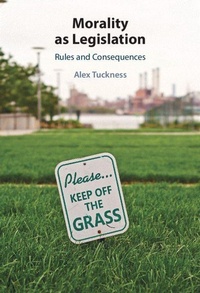
Morality as Legislation
Rules and Consequences
Published on 12. August 2021
Book
Hardback
244 pages
978-1-316-51140-4 (ISBN)
Description
'What would happen if everyone acted that way?' This question is often used in everyday moral assessments, but it has a paradoxical quality: it draws not only on Kantian ideas of a universal moral law but also on consequentialist claims that what is right depends on the outcome. In this book, Alex Tuckness examines how the question came to be seen as paradoxical, tracing its history from the theistic approaches of the seventeenth century to the secular accounts of the present. Tuckness shows that the earlier interpretations were hybrid theories that included both consequentialist and non-consequentialist elements, and argues that contemporary uses of this approach will likewise need to combine consequentialist and non-consequentialist commitments.
More details
Language
English
Place of publication
Cambridge
United Kingdom
Target group
Professional and scholarly
Illustrations
Worked examples or Exercises
Dimensions
Height: 235 mm
Width: 157 mm
Thickness: 18 mm
Weight
510 gr
ISBN-13
978-1-316-51140-4 (9781316511404)
Copyright in bibliographic data and cover images is held by Nielsen Book Services Limited or by the publishers or by their respective licensors: all rights reserved.
Schweitzer Classification
Other editions
Additional editions
Book
08/2023
Cambridge University Press
€33.00
Shipment within 15-20 days
E-Book
08/2021
Cambridge University Press
€79.49
Available for download
Person
Alex Tuckness is Professor of Political Science at Iowa State University. He is the author of Locke and the Legislative Point of View (2002), The Decline of Mercy in Public Life (with John Michael Parrish, Cambridge University Press, 2014) and This is Political Philosophy (with Clark Wolf, 2016).
Content
Introduction; Part I. The Emergence of the Rule-consequentialist Paradox: 1. God and consequences: the path to Locke; 2. Legislators, architects, and spectators: the path to David Hume; 3. The great divide: Bentham and Paley; 4. Moral expression as legislation: J. S. Mill and Sidgwick; 5. Secular heterodoxy: twentieth century rule-utilitarianism; Part II. Contemporary Approaches to the Rule-consequentialist Paradox: 6. Four contemporary options for resolving the paradox; 7. A hybrid defense of the legislative perspective; Works cited; Index.