

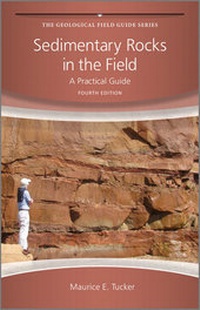
Sedimentary Rocks in the Field
A Practical Guide
4th Edition
Published on 14. January 2011
Book
Paperback/Softback
288 pages
978-0-470-68916-5 (ISBN)
Description
This fourth edition builds on the success of previous editions and for the first time is produced in full colour throughout with improved photos and diagrams. It retains its popular pocket size and is an essential buy for all students working in the field.
The text shows how sedimentary rocks are tackled in the field and has been written for all those with a geological background. It describes how the features of sedimentary rocks can be recorded in the field particularly through the construction of graphic logs. In succeeding chapters the various sedimentary rock types, textures and structures are discussed and shown how they can be described and measured in the field. There are expanded sections on trace fossils and volcaniclastics along with updated reference list. Finally a concluding section deals briefly with facies identification and points the ways towards facies interpretations, and the identification of sequences and cycles.
Key Features:
* Full colour throughout with improved photos, figures and diagrams in a modern layout.
* Complete revision and update of best selling textbook which is part of the highly successful Field Guide series.
* Expanded sections on trace fossils and volcaniclastics along with updated reference list.
* Handy pocket size with laminated cover.
* Includes supplementary website with downloadable logging sheets for fieldwork activities.
Reviews / Votes
"All in all, this is a fine and improved field guide for the geoscientist, befitting a fourth edition." (Environmental & Engineering Geoscience, 4 November 2012)More details
Other editions
Additional editions
E-Book
06/2011
4th Edition
Wiley
€34.99
Available for download
E-Book
12/2010
4th Edition
Wiley
€34.99
Available for download
Previous edition
Maurice E. Tucker
Sedimentary Rocks in the Field
Book
03/2003
3rd Edition
Wiley
€28.90
Article exhausted; check for reprint
Person
Maurice Edwin Tucker is a leading British sedimentologist, specialising in the field of carbonate sedimentology, more commonly known as limestones. From 1993 to 2011 he held the position of Professor of Geological Sciences at the University of Durham, and from 1998 to 2011 was Master of University College, Durham.
Content
Preface.
Acknowledgements.
1 Introduction.
1.1 Tools of the Trade.
1.2 Other Tools for the Field.
1.3 Use of GPS (Global Positioning System) in Sedimentary Studies.
1.4 Safety in the Field and General Guidance for Fieldwork.
2 Field Techniques.
2.1 What to Look For.
2.2 The Approach.
2.3 Field Notes.
2.4 Graphic Logs.
2.5 The Logging of Cores.
2.6 Lithofacies Codes.
2.7 Collecting Specimens.
2.8 Presentation of Results.
2.9 The Way-Up of Sedimentary Strata.
2.10 Stratigraphic Practice.
3 Sedimentary Rock Types.
3.1 Principal Lithological Groups.
3.2 Sandstones.
3.3 Conglomerates and Breccias.
3.4 Mudrocks.
3.5 Limestones.
3.6 Evaporites.
3.7 Ironstones.
3.8 Cherts.
3.9 Phosphate Deposits (Phosphorites).
3.10 Organic-Rich Deposits.
3.11 Volcaniclastic Deposits.
4 Sedimentary Rock Texture.
4.1 Introduction.
4.2 Sediment Grain-Size and Sorting.
4.3 Grain Morphology.
4.4 Sediment Fabric.
4.5 Textural Maturity.
4.6 Texture of Conglomerates and Breccias.
4.7 Induration and Degree of Weathering.
4.8 Colour of Sedimentary Rocks.
5 Sedimentary Structures and Geometry of Sedimentary Deposits.
5.1 Introduction.
5.2 Erosional Structures.
5.3 Depositional Structures.
5.4 Depositional Structures of Limestones (Including Dolomites).
5.5 Post-Depositional Sedimentary Structures.
5.6 Biogenic Sedimentary Structures.
5.7 The Geometry of Sedimentary Deposits and Lateral Facies Changes.
6 Fossils in the Field.
6.1 Introduction.
6.2 Fossil Distribution and Occurrence.
6.3 Fossil Associations and Diversity.
6.4 Skeletal Preservation (Taphonomy) and Diagenesis.
7 Palaeocurrent Analysis.
7.1 Introduction.
7.2 Palaeocurrent Measurements.
7.3 Structures for Palaeocurrent Measurement.
7.4 Presentation of Results and Calculation of Vector Means.
7.5 Interpretation of the Palaeocurrent Pattern.
8 What Next? Facies Identification and Sequence Analysis.
8.1 Introduction.
8.2 Facies Analysis.
8.3 Facies, Facies Models and Depositional Environments.
8.4 Cycle Stratigraphy and Sequence Stratigraphy.
Recommended Reading.
Index.