

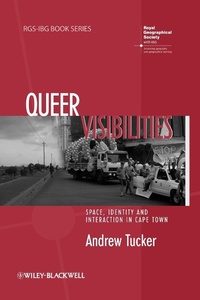
Queer Visibilities
Space, Identity and Interaction in Cape Town
1st Edition
Published on 19. December 2008
Book
Paperback/Softback
258 pages
978-1-4051-8302-4 (ISBN)
Description
Combining current theory and original fieldwork, Queer Visibilities explores the gap between liberal South African law and the reality for groups of queer men living in Cape Town.
Explores the interface between queer sexuality, race, and urban space to show links between groups of queer men
Focuses on three main 'population groups' in Cape Town-white, coloured, and black Africans
Discusses how HIV remains a key issue for queer men in South Africa
Utilizes new research data-the first comprehensive cross-community study of queer identities in South Africa
Explores the interface between queer sexuality, race, and urban space to show links between groups of queer men
Focuses on three main 'population groups' in Cape Town-white, coloured, and black Africans
Discusses how HIV remains a key issue for queer men in South Africa
Utilizes new research data-the first comprehensive cross-community study of queer identities in South Africa
Reviews / Votes
"This attention to the materiality of the city, as well as the relational complexities of historical and contemporary interactions between queer men from different racialised backgrounds is one of the major strengths of this book. Queer Visibilities offers valuable lessons for sexual geographers and urban geographers alike and deserves to be widely read." (Area, 2011) "Tucker successfully resists closing down debate, carefully qualifying his points without qualifying them out of existence. His assessments are many, detailed and well substantiated by interview quotations. One is unable to comprehensively review the many valuable insights he brings here. Read the book." (Book Southern Africa, September 2010)"Queer Visibilities is a much-needed intervention in the geographies of sexualities. Drawing upon extensive ethnographic and archival work, it provides a theoretically sophisticated examination of the interconnected politics of class and race in the production of sexualised space within contemporary Cape Town."-Jon Binnie, Manchester Metropolitan University
"How can we understand the closet if we do not understand our visibilities? Tucker has provided an impressive study driven by intellectual parley between geography, queer theory, postcolonial and development studies. This book adds to the already powerful queer geographies on a fascinating place as well as to debates around queer globalisations."
-Michael Brown, University of Washington
More details
Series
Language
English
Place of publication
Hoboken
United Kingdom
Publishing group
John Wiley and Sons Ltd
Target group
Professional and scholarly
Product notice
Paperback (trade)
Unsewn / adhesive bound
Dimensions
Height: 229 mm
Width: 152 mm
Thickness: 14 mm
Weight
379 gr
ISBN-13
978-1-4051-8302-4 (9781405183024)
Copyright in bibliographic data and cover images is held by Nielsen Book Services Limited or by the publishers or by their respective licensors: all rights reserved.
Schweitzer Classification
Other editions
Additional editions
E-Book
07/2011
Wiley-Blackwell
€25.99
Available for download
E-Book
03/2009
Wiley-Blackwell
€25.99
Available for download
Book
12/2008
1st Edition
Wiley
€91.50
Shipment within 3-4 weeks
Person
Andrew Tucker lectures at the Department of Geography, University of Cambridge. He earned his PhD from the department and has also held an Economic and Social Research Council of the UK Postdoctoral Research Fellowship there. He has spent several extended periods of time in South Africa for research.
Content
List of Figures and Tables. Series Editors' Preface.
Acknowledgements.
1 Queer Visibilities in Cape Town.
Part I Visibilities.
2 Legacies and Visibilities among White Queer Men.
3 Coloured Visibilities and the Raced Nature of Heteronormative Space.
4 How to be a Queer Xhosa Man in the Cape Town Townships.
Part II Interactions.
5 Social Invisibilities.
6 Political Invisibilities (and Visibilities).
7 The Costs of Invisibility.
Notes.
Bibliography.
Index.
Acknowledgements.
1 Queer Visibilities in Cape Town.
Part I Visibilities.
2 Legacies and Visibilities among White Queer Men.
3 Coloured Visibilities and the Raced Nature of Heteronormative Space.
4 How to be a Queer Xhosa Man in the Cape Town Townships.
Part II Interactions.
5 Social Invisibilities.
6 Political Invisibilities (and Visibilities).
7 The Costs of Invisibility.
Notes.
Bibliography.
Index.