

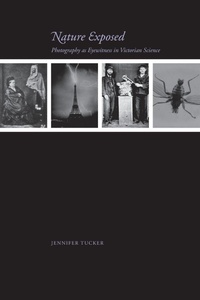
Nature Exposed
Photography as Eyewitness in Victorian Science
Will be published approx. on 10. October 2013
Book
Paperback/Softback
312 pages
978-1-4214-1093-7 (ISBN)
Description
In Nature Exposed, Jennifer Tucker studies the intersecting trajectories of photography and modern science in late Victorian Britain. She examines the role of photograph as witness in scientific investigation and explores the interplay between photography and scientific authority. Almost immediately after the invention of photography in 1839, photographs were characterized as offering objective access to reality-unmediated by human agency, political ties, or philosophy. This mechanical objectivity supposedly eliminated judgment and interpretation in reporting and picturing scientific results. But photography is a labor-intensive process that allows for, and sometimes requires, manipulation. In the late nineteenth century, the nature of this new technology sparked a complex debate about scientific practices and the value of the photographic images in the production and dissemination of scientific knowledge.
Recovering the controversies and commentary surrounding the early creation of scientific photography and drawing on a wide range of new sources and critical theories, Tucker establishes a greater understanding of the rich visual culture of Victorian science and alternative forms of knowledge, including psychical research.
Recovering the controversies and commentary surrounding the early creation of scientific photography and drawing on a wide range of new sources and critical theories, Tucker establishes a greater understanding of the rich visual culture of Victorian science and alternative forms of knowledge, including psychical research.
Reviews / Votes
The strength of the book lies in Tucker's analysis of the broad historical context in which scientific photography emerged in Victorian Britain. Science Tucker's book is a challenging exploration of how, when, and under what conditions photography came to be seen as an enhanced representational tool for a range of scientific practices in Victorian Britain. -- Ian Burney American Historical Review Nature Exposed tells us about our past, but has current resonance in our visually based culture and is a timely, interesting, and valuable book. -- Frances Robertson Technology and Culture A useful book. -- Daniel M. Fox Nuncius Tucker's brilliant study enlarges traditional concepts of photographic evidence by tying together the social processes and institutions that created the scientific photograph to the shift in the professional development of science itself. -- Marta Braun Victorian Studies The premise and the methodology of the book are sound, and its conclusions important. -- Kelley Wilder History and Philosophy of the Life Sciences Meticulous at every turn, Nature Exposed on nearly every page contains a paragraph that would, on its own, be a superb subject for a doctoral thesis-postgraduates take notes. For the rest of us, it is an impressive, long-overdue critical companion to the early history of scientific photography in Britain that leaves few stones unturned. It is also an enjoyable read, as it delves into some of the quirkier and more entertaining chapters in photographic history. British Journal for the History of Science By examining a wide range of books, articles, and photographs, Tucker writes a history of photography that skilfully maps out the social and professional networks that connected science and photographic practices. -- Mary Hunter Oxford Art Journal As Jennifer Tucker argues in this densely researched book, evaluating evidence involves social values-class, gender, and race-as well as scientific protocols. -- Patrizia Di Bello Bulletin of the History of Medicine A solid and very readable work of scholarship, drawing widely upon periodicals and other neglected print sources, and happily enhanced with reproductions of the many compelling and curious images that it has uncovered and analyzes. -- Daniel Brown Journal of British StudiesMore details
Language
English
Place of publication
Baltimore, MD
United States
Target group
Professional and scholarly
Product notice
Paperback (trade)
Illustrations
68 s/w Photographien bzw. Rasterbilder
68 Halftones, black and white
Dimensions
Height: 234 mm
Width: 156 mm
Thickness: 18 mm
Weight
527 gr
ISBN-13
978-1-4214-1093-7 (9781421410937)
DOI
10.1353/book.26474
Copyright in bibliographic data and cover images is held by Nielsen Book Services Limited or by the publishers or by their respective licensors: all rights reserved.
Schweitzer Classification
Other editions
Additional editions
E-Book
10/2013
Johns Hopkins University Press
€28.49
Available for download

Book
04/2006
Johns Hopkins University Press
€81.90
Article exhausted; check different version
Person
Jennifer Tucker is an associate professor of history, science in society, and gender studies at Wesleyan University. Her work has been published in the New York Times, Wall Street Journal, and Boston Globe.
Content
Acknowledgments
Introduction
1. Constructing Science and Brotherhood in Photographic Culture
2. Testing the Unity of Science and Fraternity
3. Acquiring a Scientific Eye
4. Photography of the Invisible
5. Photographic Evidence and Mass Culture
Epilogue: Photographic Evidence and Mass Culture
Notes
Essay on Sourcess
Index
Introduction
1. Constructing Science and Brotherhood in Photographic Culture
2. Testing the Unity of Science and Fraternity
3. Acquiring a Scientific Eye
4. Photography of the Invisible
5. Photographic Evidence and Mass Culture
Epilogue: Photographic Evidence and Mass Culture
Notes
Essay on Sourcess
Index