

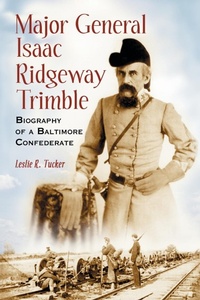
Major General Isaac Ridgeway Trimble
Biography of a Baltimore Confederate
Published on 15. July 2005
Book
Paperback/Softback
272 pages
978-0-7864-2131-2 (ISBN)
Description
Major General Isaac Ridgeway Trimble, one of the oldest and more eccentric officers involved in the Civil War, made himself a favorite of Stonewall Jackson through his courage and stubborn energy. Born to a Quaker family, Trimble spent his childhood on the American frontier. After graduating from West Point, he served in the Old Army and then involved himself with the growing railroad industry of the 1830s, living at the forefront of American modernization. As the war began, he sided with the South, burning railroad bridges north of Baltimore to deny Washington the support of Union troops, and then moving to Virginia. He enlisted in the Engineers and constructed battery emplacements. Commissioned brigadier general in late 1861, Trimble distinguished himself at Cross Keys, Gaines's Mill, Manassas, and Gettysburg; was involved in the Baltimore riots; and spent time as a prisoner on Johnson's Island.
This biography covers Trimble's personal life and career with both the railroad and the military. Simultaneously, it serves as a case study of an American who chose to side with the South. Before the war, Trimble traveled freely between states and showed no early indication of a regional attachment. The work uses Abraham Maslow's motivation model, the hierarchy of needs, to reconcile Trimble's self-interest with his need to belong to a community. It also raises various questions related to Southern history, including community identity, modernization, and the concept of the "New South."
This biography covers Trimble's personal life and career with both the railroad and the military. Simultaneously, it serves as a case study of an American who chose to side with the South. Before the war, Trimble traveled freely between states and showed no early indication of a regional attachment. The work uses Abraham Maslow's motivation model, the hierarchy of needs, to reconcile Trimble's self-interest with his need to belong to a community. It also raises various questions related to Southern history, including community identity, modernization, and the concept of the "New South."
Reviews / Votes
"insightful...fascinating...an important step toward filling in a gap in Confederate biography"-The Civil War News; "a good read"-The Civil War Courier; "recommended"-Curledup.com.More details
Language
English
Place of publication
Jefferson, NC
United States
Target group
College/higher education
Professional and scholarly
Interest Age: From 18 years
Product notice
Paperback (trade)
Illustrations
photos, notes, bibliography, index
Dimensions
Height: 229 mm
Width: 152 mm
Thickness: 16 mm
Weight
446 gr
ISBN-13
978-0-7864-2131-2 (9780786421312)
Copyright in bibliographic data and cover images is held by Nielsen Book Services Limited or by the publishers or by their respective licensors: all rights reserved.
Schweitzer Classification
Person
Adjunct professor Leslie R. Tucker lives in Edmond, Oklahoma.
Content
Table of Contents
Preface
Introduction
1. From the Wilds of Kentucky to West Point
2. Army Life: Toward a New Identity
3. A New Profession: Railroad Man
4. Becoming a Modern Businessman
5. A Time for Decision
6. Into the Valley
7. The Second Round at Manassas
8. From Gettysburg to Surrender
9. Unreconstructed Rebel
10. Conclusion
Bibliographic Essay
Notes
Bibliography
Index
Preface
Introduction
1. From the Wilds of Kentucky to West Point
2. Army Life: Toward a New Identity
3. A New Profession: Railroad Man
4. Becoming a Modern Businessman
5. A Time for Decision
6. Into the Valley
7. The Second Round at Manassas
8. From Gettysburg to Surrender
9. Unreconstructed Rebel
10. Conclusion
Bibliographic Essay
Notes
Bibliography
Index