

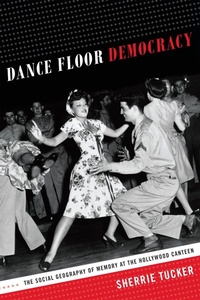
Dance Floor Democracy
The Social Geography of Memory at the Hollywood Canteen
Published on 23. October 2014
Book
Hardback
408 pages
978-0-8223-5742-1 (ISBN)
Description
Open from 1942 until 1945, the Hollywood Canteen was the most famous of the patriotic home front nightclubs where civilian hostesses jitterbugged with enlisted men of the Allied Nations. Since the opening night, when the crowds were so thick that Bette Davis had to enter through the bathroom window to give her welcome speech, the storied dance floor where movie stars danced with soldiers has been the subject of much U.S. nostalgia about the "Greatest Generation." Drawing from oral histories with civilian volunteers and military guests who danced at the wartime nightclub, Sherrie Tucker explores how jitterbugging swing culture has come to represent the war in U.S. national memory. Yet her interviewees' varied experiences and recollections belie the possibility of any singular historical narrative. Some recall racism, sexism, and inequality on the nightclub's dance floor and in Los Angeles neighborhoods, dynamics at odds with the U.S. democratic, egalitarian ideals associated with the Hollywood Canteen and the "Good War" in popular culture narratives. For Tucker, swing dancing's torque-bodies sharing weight, velocity, and turning power without guaranteed outcomes-is an apt metaphor for the jostling narratives, different perspectives, unsteady memories, and quotidian acts that comprise social history.
Reviews / Votes
"Dance Floor Democracy is a model for what we might call embodied social and cultural history: works that takes the body (including that of the researcher herself) as a site of knowledge. ... Dance Floor Democracy reveals scholarly practice as its own kind of dancing." - Gayle Wald (Journal of Popular Music Studies) "With its beautiful and clear writing style, this book would be of interest to an audience of general readers, as well as to specialists in dance and jazz. Tucker's research methodology in this book is applicable to a wide range of interdisciplinary fields, including jazz studies, American studies, African American studies, ethnomusicology, and anthropology." - Yoko Suzuki (Women and Music) "More than just a straightforward history of the Canteen, Tucker's smart and sophisticated analysis utilizes this unique wartime institution to understand the variety of ways in which WWII is remembered and memorialized in the present day. ... Dance Floor Democracy makes for a thoughtful, eye-opening account of the complexities of the World War II generation, especially given Tucker's masterful skills as an oral historian." - Elizabeth R. Escobedo (Western Historical Quarterly) "Tucker contributes here not only to the fields of history, jazz, and American studies but also to the burgeoning field of critical dance studies. Reckoning with dance, in Tucker's work, is a way to think differently about politics." - Danielle Goldman (Journal of American History) "Dance Floor Democracy is a valuable and exceptionally well-researched revisionist history of the Hollywood Canteen, critiquing not only the dominant paradigm of a friendly, democratic site, but also giving voice to the 'others' whose stories have been eclipsed by the feel-good memory of whom we wish we had been." - Rebecca A. Bryant (Ethnomusicology)More details
Language
English
Place of publication
North Carolina
United States
Target group
College/higher education
Product notice
Cloth over boards
Illustrations
36 illustrations
Dimensions
Height: 234 mm
Width: 157 mm
Thickness: 28 mm
Weight
703 gr
ISBN-13
978-0-8223-5742-1 (9780822357421)
Copyright in bibliographic data and cover images is held by Nielsen Book Services Limited or by the publishers or by their respective licensors: all rights reserved.
Schweitzer Classification
Other editions
Additional editions
E-Book
11/2014
1st Edition
Duke University Press Books
€208.99
Available for download
Person
Sherrie Tucker is Professor of American Studies at the University of Kansas. She is the author of Swing Shift: "All-Girl" Bands of the 1940s and coeditor of Big Ears: Listening for Gender in Jazz Studies, both also published by Duke University Press.
Content
Acknowledgments vii Prologue. Dance Floor Democracy? xiii Introduction. Writing on a Crowded Dance Floor 1 Part I. On Location: Situating the Hollywood Canteen (and Swing Culture as National Memory) in Wartime Los Angeles 1. Wrestling Hollywood to the Map 25 2. Cruising the Cahuenga Pass(t) 51 3. Operating from the Curbstone 76 Part II. Patriotic Jitterbugs: Tracing the Footsteps of the Soldier-Hostess Dyad 4. Dyad Democracy 107 5. Injured Parties 146 6. Torquing Back 179 Part III. Women in Uniforms, Men in Aprons: Dancing outside the Soldier-Hostess Dyad 7. The Dyad from Without 199 8. The View from the Mezzanine 212 9. Men Serving Men 226 Part IV. Swing Between the Nation and the State 10. (Un)American Patrol: Following the State on the Dance Floor of the Nation 243 11. The Making(s) of National Memory: Hollywood Canteen (the Movie) 281 Notes 321 Bibliography 351 Index 365