

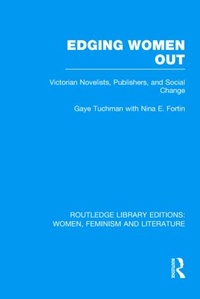
Edging Women Out
Victorian Novelists, Publishers and Social Change
1st Edition
Published on 5. June 2012
Book
Hardback
288 pages
978-0-415-53324-9 (ISBN)
Description
Before about 1840, there was little prestige attached to the writing of novels, and most English novelists were women. By the turn of the twentieth century, "men of letters" acclaimed novels as a form of great literature, and most critically successful novelists were men. In the book, sociologist Gaye Tuchman examines how men succeeded in redefining a form of culture and in invading a white-collar occupation previously practiced mostly by women.
Tuchman documents how men gradually supplanted women as novelists once novel-writing was perceived as potentially profitable, in part because of changes in the system of publishing and rewarding authors. Drawing on unusual data ranging from the archives of Macmillan and company (London) to an analysis of the lives and accomplishments of authors listed in the Dictionary of National Biography, she shows that rising literacy and the centralization of the publishing industry in London after 1840 increased literary opportunities and fostered men's success as novelists. Men redefined the nature of a good novel and applied a double standard in critically evaluating literary works by men and by women. They also received better contracts than women for novels of equivalent quality and sales. They were able to accomplish this, says Tuchman, because they were to a large extent the culture brokers - the publishers, publishers' readers, and reviewers of an elite art form.
Both a sociological study of occupational gender transformation and a historical study of writing and publishing, this book will be a rich resource for students of the sociology of culture, literary criticism, and women's studies.
Tuchman documents how men gradually supplanted women as novelists once novel-writing was perceived as potentially profitable, in part because of changes in the system of publishing and rewarding authors. Drawing on unusual data ranging from the archives of Macmillan and company (London) to an analysis of the lives and accomplishments of authors listed in the Dictionary of National Biography, she shows that rising literacy and the centralization of the publishing industry in London after 1840 increased literary opportunities and fostered men's success as novelists. Men redefined the nature of a good novel and applied a double standard in critically evaluating literary works by men and by women. They also received better contracts than women for novels of equivalent quality and sales. They were able to accomplish this, says Tuchman, because they were to a large extent the culture brokers - the publishers, publishers' readers, and reviewers of an elite art form.
Both a sociological study of occupational gender transformation and a historical study of writing and publishing, this book will be a rich resource for students of the sociology of culture, literary criticism, and women's studies.
More details
Series
Language
English
Place of publication
London
United Kingdom
Publishing group
Taylor & Francis Ltd
Target group
College/higher education
Illustrations
12 s/w Zeichnungen, 32 s/w Tabellen
32 Tables, black and white; 12 Line drawings, black and white
Dimensions
Height: 234 mm
Width: 156 mm
Weight
690 gr
ISBN-13
978-0-415-53324-9 (9780415533249)
Copyright in bibliographic data and cover images is held by Nielsen Book Services Limited or by the publishers or by their respective licensors: all rights reserved.
Schweitzer Classification
Other editions
Additional editions
Book
03/2014
1st Edition
Routledge
€77.03
Shipment within 15-20 days
E-Book
08/2012
1st Edition
Routledge
€64.49
Available for download
E-Book
08/2012
1st Edition
Routledge
€64.49
Available for download
Person
Gaye Tuchman is Professor of Sociology at the University of Connecticut, USA
Content
1. Gender Segregation and the Politics of Culture 2. Writers and the Victorian Publishing System 3. Novel Writing as an Empty Field 4. Edging Women Out: The High-Culture Novel 5. Who Gained from Industrialization? 6. The Invasion, or How Women Wrote More for Less 7. Macmillan's Contracts with Novelists 8. The Critical Double Standard 9. The Case of the Disappearing Lady Novelists. Appendix A: The Samples. Appendix B: Additional Tables. Appendix C: Authors' Contracts and Reviews