

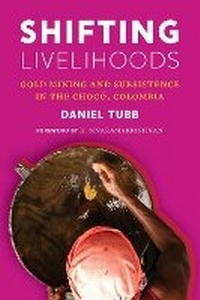
Shifting Livelihoods
Gold Mining and Subsistence in the Choco, Colombia
Published on 30. June 2020
Book
Hardback
250 pages
978-0-295-74752-1 (ISBN)
Description
Honorable Mention for the Society for the Anthropology of Work (SAW) Book Prize
The many dimensions of gold in a shadow economy
People employ various methods to extract gold in the rainforests of the Choco, in northwest Colombia: Rural Afro-Colombian artisanal miners work hillsides with hand tools or dredge mud from river bottoms. Migrant miners level the landscape with excavators, then trap gold with mercury. Canadian mining companies prospect for open-pit mega-mines. Drug traffickers launder cocaine profits by smuggling gold into Colombia and claiming it came from fictitious small-scale mines.
Through an ethnography of gold that examines the movement of people, commodities, and capital, Shifting Livelihoods investigates how resource extraction reshapes a place. In the Choco, gold enables forms of "shift" (rebusque)-a metaphor for the fluid livelihood strategy adopted by forest dwellers and migrant gold miners alike as they seek informal work amid a drug war. Mining's effects on rural people, corporations, and politics are on view in this fine-grained account of daily life in a regional economy dominated by gold and cocaine.
The many dimensions of gold in a shadow economy
People employ various methods to extract gold in the rainforests of the Choco, in northwest Colombia: Rural Afro-Colombian artisanal miners work hillsides with hand tools or dredge mud from river bottoms. Migrant miners level the landscape with excavators, then trap gold with mercury. Canadian mining companies prospect for open-pit mega-mines. Drug traffickers launder cocaine profits by smuggling gold into Colombia and claiming it came from fictitious small-scale mines.
Through an ethnography of gold that examines the movement of people, commodities, and capital, Shifting Livelihoods investigates how resource extraction reshapes a place. In the Choco, gold enables forms of "shift" (rebusque)-a metaphor for the fluid livelihood strategy adopted by forest dwellers and migrant gold miners alike as they seek informal work amid a drug war. Mining's effects on rural people, corporations, and politics are on view in this fine-grained account of daily life in a regional economy dominated by gold and cocaine.
Reviews / Votes
"[O]ffers an engaging, complex account focused on issues concerning the production, accumulation, and transformation of value."(Choice) "Tubb astutely examines the economics of artisal mining in the Choco area, adeptly shifting from the macro to the micro, the global to the local, whilst telling a captivating and compelling story."
(Nokoko) "[A] rich and detailed ethnography."
(American Anthropologist) "This is an exciting time for the anthropological study of mining, and Shifting Livelihoods makes a welcome contribution to the scholarship that is emerging."
(Exertions) "This ethnography is an eloquently written and concise read for multiple audiences interested in discussions about economic anthropology and the anthropology of mining... Shifting Livelihoods is a respectful walk alongside miners in Colombia's Choco region that manages to capture their humanity and dignity - something that journalists and politicians have failed heretofore to do."
(Anthropologica) "The book's proposition of shifting livelihood strategies is especially convincing due to its writing style of ethnographic storytelling...The miners and their rainforest come to life in the book, one muddy page after another."
(Bulletin of Latin American Research) "Tubb writes with sparkling clarity, and he encapsulates big issues in brief biographical vignettes. He is gentle with technical matters, and adept at simplifying complex processes, a reflection of deep immersion in the business of mining (plus hunting, subsistence farming, and petty commerce)."
(The Americas)
More details
Series
Language
English
Place of publication
Seattle
United States
Target group
Professional and scholarly
Illustrations
16 b&w illus., 2 charts, 2 maps
Dimensions
Height: 229 mm
Width: 152 mm
Weight
499 gr
ISBN-13
978-0-295-74752-1 (9780295747521)
Copyright in bibliographic data and cover images is held by Nielsen Book Services Limited or by the publishers or by their respective licensors: all rights reserved.
Schweitzer Classification
Other editions
Additional editions
E-Book
06/2020
1st Edition
University of Washington Press
from
€84.99
Available for download