

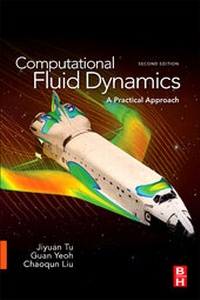
Computational Fluid Dynamics
A Practical Approach
2nd Edition
Published on 27. September 2012
Book
Paperback/Softback
456 pages
978-0-08-098243-4 (ISBN)
Description
Computational Fluid Dynamics, Second Edition, provides an introduction to CFD fundamentals that focuses on the use of commercial CFD software to solve engineering problems. This new edition provides expanded coverage of CFD techniques including discretisation via finite element and spectral element as well as finite difference and finite volume methods and multigrid method.
There is additional coverage of high-pressure fluid dynamics and meshless approach to provide a broader overview of the application areas where CFD can be used. The book combines an appropriate level of mathematical background, worked examples, computer screen shots, and step-by-step processes, walking students through modeling and computing as well as interpretation of CFD results.
It is ideal for senior level undergraduate and graduate students of mechanical, aerospace, civil, chemical, environmental and marine engineering. It can also help beginner users of commercial CFD software tools (including CFX and FLUENT).
There is additional coverage of high-pressure fluid dynamics and meshless approach to provide a broader overview of the application areas where CFD can be used. The book combines an appropriate level of mathematical background, worked examples, computer screen shots, and step-by-step processes, walking students through modeling and computing as well as interpretation of CFD results.
It is ideal for senior level undergraduate and graduate students of mechanical, aerospace, civil, chemical, environmental and marine engineering. It can also help beginner users of commercial CFD software tools (including CFX and FLUENT).
More details
Edition
2nd edition
Language
English
Place of publication
Oxford
United Kingdom
Publishing group
Elsevier Science & Technology
Target group
College/higher education
Senior level undergraduate and graduate students of mechanical, aerospace, civil, chemical, environmental and marine engineering. Beginner users of commercial CFD software tools (including CFX and FLUENT)
Dimensions
Height: 229 mm
Width: 152 mm
Weight
650 gr
ISBN-13
978-0-08-098243-4 (9780080982434)
Copyright in bibliographic data and cover images is held by Nielsen Book Services Limited or by the publishers or by their respective licensors: all rights reserved.
Schweitzer Classification
Other editions
New editions
Book
01/2024
4th Edition
Butterworth-Heinemann
€96.50
Shipment within 15-20 days
Book
01/2018
3rd Edition
Butterworth-Heinemann
€86.65
Shipment within 15-20 days
Additional editions
E-Book
01/2012
2nd Edition
Elsevier
€68.95
Available for download
Previous edition
Book
12/2007
Butterworth-Heinemann
€92.85
Article exhausted; check for reprint
Persons
Jiyuan Tu is Professor and Deputy Head, Research and Innovation, Department of Aerospace, Mechanical and Manufacturing Engineering, at Royal Melbourne Institute of Technology (RMIT) University, Australia. Professor Tu's research interests are in the areas of computational fluid dynamics (CFD) and numerical heat transfer (NHT), computational and experimental modelling of multiphase flows, fluid-structure interaction, optimal design of drug delivery devices, and simulation of blood flow in arteries. Guan Heng Yeoh is a professor at the School of Mechanical and Manufacturing Engineering, UNSW, and a principal research scientist at ANSTO. He is the founder and editor of the Journal of Computational Multiphase Flows and the group leader of Computational Thermal-Hydraulics of OPAL Research Reactor, ANSTO. He has approximately 250 publications including 10 books, 12 book chapters, 156 journal articles and 115 conference papers with an H-index of 33 and over 4490 citations. His research interests are computational fluid dynamics (CFD); numerical heat and mass transfer; turbulence modelling using Reynolds averaging and large eddy simulation; combustion, radiation heat transfer, soot formation and oxidation, and solid pyrolysis in fire engineering; fundamental studies in multiphase flows: free surface, gas-particle, liquid-solid (blood flow and nanoparticles), and gas-liquid (bubbly, slug/cap, churn-turbulent, and subcooled nucleate boiling flows); computational modelling of industrial systems of single-phase and multiphase flows. Dr. Chaoqun Liu received both BS (1968) and MS (1981) from Tsinghua University, Beijing, China and PhD (1989) from University of Colorado at Denver, USA. He is currently the Tenured and Distinguished Professor and the Director of Center for Numerical Simulation and Modeling at University of Texas at Arlington, Arlington, Texas, USA. He has worked on high order direct numerical simulation (DNS) and large eddy simulation (LES) for flow transition and turbulence for over 30 years since 1989. He has published 11 professional books, 120 journal papers and 145 conference papers. He is the founder and major contributor of the third generation of vortex identification methods including the Omega, Liutex/Rortex, Liutex-Omega, Modified Liutex-Omega, Liutex Core Line methods, RS vorticity decomposition and R-NR velocity gradient decomposition.
Author
Professor and Deputy Head, Research and Innovation, Department of Aerospace, Mechanical and Manufacturing Engineering, at Royal Melbourne Institute of Technology (RMIT) University, Australia.
Professor, Mechanical Engineering (CFD), University of New South Wales, Sydney, Australian Nuclear Science and Technology Organisation, University of New South Wales, Australia
Tenured and Distinguished Professor and the Director of Center for Numerical Simulation and Modeling at University of Texas at Arlington, Arlington, Texas, USA.
Content
1. Introduction2. CFD Solution Procedure - A Beginning;3. Governing Equations for CFD - Fundamentals4. CFD Techniques - The Basics5. CFD Solution Analysis - Essentials6. Practical Guidelines for CFD Simulation and Analysis7. Some Applications of CFD with Examples8. Some Advanced Topics in CFD