

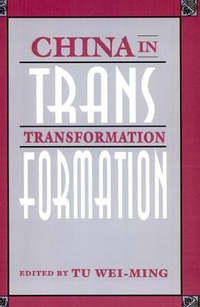
China in Transformation
Published on 1. January 1994
Book
Paperback/Softback
282 pages
978-0-674-11754-9 (ISBN)
Description
What will China look like in 2000? Tectonic forces are at work and its seeming stability has been largely lost after Tiananmen Square. Changing political, social, economic, intellectual, and cultural conditions are transforming China and its neighbors with a majority Chinese population. The authors in this book, taking full advantage of the new freedom of inquiry, shed light on the Chinese experience, elaborating not only on the vast changes sweeping all sectors of Chinese society, but also on the tradition that has persisted. As communism did not erase the past, so new experiences build on the past and tease out newness with great resemblances. Modernity takes many forms, memory repressed for a time may reassert itself; myth, the invention of individuals and collectivities, may be more powerful than prosaic fact. Cultural factors as agents of change appear more important than ever.
This book demonstrates that today Confucian societies have salient features on a restless landscape. The authors confine themselves to enduring questions about today's Sinic societies so that educated readers and scholars of modern China and the Chinese will better understand the more populous half of the world. Contributing authors include William P. Alford, David E. Apter, Myron L. Cohen, Edward Friedman, Tongqi Lin, Perry Link, Andrew J. Nathan, Benjamin I. Schwartz, Tianjian Shi, Helen F. Siu, Wang Gungwu, and Ying-shih Yue.
This book demonstrates that today Confucian societies have salient features on a restless landscape. The authors confine themselves to enduring questions about today's Sinic societies so that educated readers and scholars of modern China and the Chinese will better understand the more populous half of the world. Contributing authors include William P. Alford, David E. Apter, Myron L. Cohen, Edward Friedman, Tongqi Lin, Perry Link, Andrew J. Nathan, Benjamin I. Schwartz, Tianjian Shi, Helen F. Siu, Wang Gungwu, and Ying-shih Yue.
Reviews / Votes
Provides thought-provoking insights into China as it changes-or refuses to change-and should have wide appeal. -- Marjorie Dryburgh * Asian Affairs * China in Transformation is a fascinating and timely book which brings together twelve scholars from very different specialties-philosophy, history, literature, law, sociology, anthropology, political science, and religion-to analyze the complexities and possibilities of China's future... There are many...important themes in this vibrant volume, and I encourage readers to see for themselves what this project contains. -- William A. Callahan * China Review International * As a short-term ideology (writes Professor Perry Link, in [this] insightful eleven chapter symposium...tightly edited by Professor Tu Wei-Ming)...to 'make money' does hold out advantages for China. More wealth might sweeten the bitter lives of the still large peasant population, family enterprise long dormant might once more flourish, parallel freedoms might ensue and so on. Yet to make money, 'can only be a stopgap'...[and] is clearly not the end of the story. -- Malcolm Warner * Asia Pacific Business Review [UK] * These are some astute commentaries on 'whither China' that have sufficient perspective to transcend the limits of daily journalism; for a while at least, they will be helpful guides to a very complex society in transformation. -- Albert Feuerwerker, University of Michigan China in Transformation will appeal to the educated reader interested in modern China, to scholars, and to the many students to whom it will be assigned. The book will have a longer life and, I am certain, a much greater impact than the many other volumes that attempt to chronicle an ever-transforming China. -- William C. Kirby, Harvard UniversityMore details
Language
English
Place of publication
Cambridge, Mass
United States
Target group
College/higher education
Professional and scholarly
Illustrations
illustrations
Dimensions
Height: 229 mm
Width: 152 mm
Thickness: 18 mm
Weight
354 gr
ISBN-13
978-0-674-11754-9 (9780674117549)
Copyright in bibliographic data and cover images is held by Nielsen Book Services Limited or by the publishers or by their respective licensors: all rights reserved.
Schweitzer Classification
Person
Tu Wei-ming is Director of the Institute for Advanced Humanistic Studies, Peking University, and Harvard-Yenching Professor of Chinese History and Philosophy and of Confucian Studies, Emeritus, Harvard University. He directed the Harvard-Yenching Institute from 1996 to 2008.