

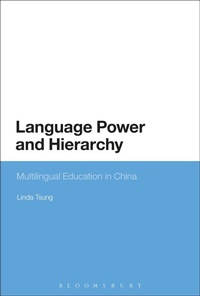
Language Power and Hierarchy
Multilingual Education in China
Published on 23. October 2014
Book
Hardback
264 pages
978-1-4411-4235-1 (ISBN)
Description
Shunning polemicism and fashioning a new agenda for a critically informed yet practically orientated approach, this book explores aspects of multilingual education in the People's Republic of China (PRC). Amongst other issues, it also looks at the challenges associated with bilingual and trilingual education in Xinjiang and Tibet as well as the mediation between religion and culture in multi-ethnic schools, covering these issues from a range of perspectives - Korean, Uyghur, Tibetan, Mongolian and Yi.
The PRC promotes itself as a harmonious, stable multicultural mosaic, with over 50 distinct ethnic groups striving for common prosperity. Beneath this rhetoric, there is also inter-ethnic discord, with scenes of ethnic violence in Lhasa and Urumqi over the last few years.
China has a complex system of multilingual education - with dual-pathway curricula, bilingual and trilingual instruction, specialised ethnic schools. This education system is a lynchpin in the Communist party state's efforts to keep a lid on simmering tensions and transform a rhetoric of harmony into a critical pluralistic harmonious multiculturalism. This book examines this supposed lynchpin.
The PRC promotes itself as a harmonious, stable multicultural mosaic, with over 50 distinct ethnic groups striving for common prosperity. Beneath this rhetoric, there is also inter-ethnic discord, with scenes of ethnic violence in Lhasa and Urumqi over the last few years.
China has a complex system of multilingual education - with dual-pathway curricula, bilingual and trilingual instruction, specialised ethnic schools. This education system is a lynchpin in the Communist party state's efforts to keep a lid on simmering tensions and transform a rhetoric of harmony into a critical pluralistic harmonious multiculturalism. This book examines this supposed lynchpin.
Reviews / Votes
Tsung's book is an important resource, a ground-breaking study that fills a gap in our understanding of multilingualism, language policy, social change and education in China. The country now requires improved multilingual education in order to create a harmonious society, and this book can be a catalyst for change. * Journal of Multilingual and Multicultural Development * In addition to its data-rich survey of Mongolian, Uighur, Tibetan and other minority language instruction across China, Linda Tsung's brilliant new study casts new light on theoretical and practical issues surrounding multilingualism as a global phenomenon and its impact on social, cultural, social and political life in contemporary China. -- Bonnie S. Mcdougall, Visiting Professor in the Department of Chinese Studies, University of Sydney, Australia Linda Tsung's book is a ground-breaking study of the complex issue of multilingualism in contemporary China. Backed by primary sources and years of extensive fieldwork in vast Chinese ethnic minority regions, the author reveals the challenges that all stakeholders must face in negotiating the tension among the diverse forces of globalization, nationalization, language maintenance, social development, among others. It is as theoretically fascinating for linguists as practically valuable for policy makers. -- Hongyin Tao, Professor of Chinese Language and Linguistics, University of California, Los Angeles and (2014) President of the Chinese Language Teachers Association, USA Linda Tsung does what few linguists do well: she takes us into a mysterious world and shows us what the sociolinguistic reality is like there. This is the first book that has empirically and systematically examined the multilingual norms and multilingual education in China, a nation now standing at the crossroads with confusion, and hesitation. -- Hui Li, Associate Professor, Faculty of Education, The University of Hong Kong This book is both an empirically rich account and theoretically significant critique of China's policies and practices of multilingualism and multilingual education Skilfully navigating amongst several different ethnic minority languages and communities in China, Linda Tsung directs us to the opportunities and challenges of multilingualism. The book is of relevance to a wide range of people interested in language policy, education, and social change in China. -- Li Wei, Professor of Applied Linguistics, Birkbeck College, University of London, UKMore details
Language
English
Place of publication
New York
United States
Publishing group
Bloomsbury Publishing Plc
Target group
College/higher education
Professional and scholarly
Dimensions
Height: 240 mm
Width: 161 mm
Thickness: 19 mm
Weight
567 gr
ISBN-13
978-1-4411-4235-1 (9781441142351)
DOI
CBID169494
Copyright in bibliographic data and cover images is held by Nielsen Book Services Limited or by the publishers or by their respective licensors: all rights reserved.
Schweitzer Classification
Other editions
Additional editions
E-Book
10/2014
1st Edition
Bloomsbury Academic USA
€42.99
Available for download
E-Book
10/2014
1st Edition
Bloomsbury Academic USA
€42.99
Available for download
Person
Linda Tsung is an Associate Professor in the Faculty of Arts and Social Sciences, The University of Sydney, Australia.
Content
List of maps and figures
List of tables
Foreword
Preface
Abbreviations
1. Introduction
2. Multilingualism in China: diversity, hierarchy and power
3. Maintaining Mongolian language in Inner Mongolia
4. Becoming bilingual and trilingual in Xinjiang
5. The debate on Tibetan education in Qinghai
6. Harnessing multilingualism: linguistic vitality in Yunnan
7. Rethinking multilingualism: the new literacy in Guangxi
8. Challenges and barriers for multilingualism and multilingual education
Bibliography
Index
List of tables
Foreword
Preface
Abbreviations
1. Introduction
2. Multilingualism in China: diversity, hierarchy and power
3. Maintaining Mongolian language in Inner Mongolia
4. Becoming bilingual and trilingual in Xinjiang
5. The debate on Tibetan education in Qinghai
6. Harnessing multilingualism: linguistic vitality in Yunnan
7. Rethinking multilingualism: the new literacy in Guangxi
8. Challenges and barriers for multilingualism and multilingual education
Bibliography
Index