

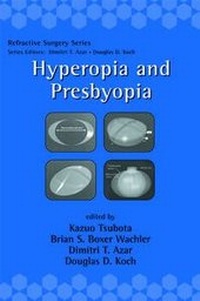
Hyperopia and Presbyopia
1st Edition
Published on 16. May 2003
Book
Hardback
344 pages
978-0-8247-4107-5 (ISBN)
Description
Examining established and emerging treatments for the correction of hyperopia and presbyopia, this reference offers guidance on technologies such as thermal or conductive keratoplasty, corneal implants, laser scleral relaxation, scleral expansion rings, intraocular lenses, and LASIK modifications.
More details
Language
English
Place of publication
Bosa Roca
United States
Publishing group
Taylor & Francis Inc
Target group
College/higher education
Professional and scholarly
Professional and Professional Reference
Dimensions
Height: 254 mm
Width: 178 mm
Weight
861 gr
ISBN-13
978-0-8247-4107-5 (9780824741075)
Copyright in bibliographic data and cover images is held by Nielsen Book Services Limited or by the publishers or by their respective licensors: all rights reserved.
Schweitzer Classification
Other editions
Additional editions
Kazuo Tsubota | Brian S. Boxer Wachler | Dimitri T. Azar
Hyperopia and Presbyopia
E-Book
05/2003
CRC Press
€244.99
Available for download
Kazuo Tsubota | Brian S. Boxer Wachler | Dimitri T. Azar
Hyperopia and Presbyopia
E-Book
05/2003
1st Edition
CRC Press
€244.99
Available for download
Persons
Tsubota, Kazuo ( Ichikawa General Hospital, Japan; Boxer Wachler, Brian S.; Azar, Dimitri T.; Koch, Douglas
Content
Basic optics of hyperopia and presbyopia, Michael K. Smolek; the Helmholtz mechanism of accommodation, Adrian Glasser; Schachar's theory of the mechanisms of accommodation, Jay S. Pepose and Moonyoung S. Chung; ageing and the crystalline lens -review of recent literature (1998-2001), Leo T. Chylack, Jr; hyperopia, Ivo John Dualan and Penny A. Asbell; surgical treatment options for hyperopia and hyperopic astigmatism, Paolo Vinciguerra and Fabrizio I. Camesasca; laser thermokeratoplasty, ShahzadI. Mian and Dimitri T. Azar; conductive keratoplasty for the correction of low-to-moderate hyperopia, Marguerite M. McDonald, Jonathan Davidorf, Robert K. Maloney, Edward E. Manche, Peter Hersh, and George M. Salib; intracorneal segments for hyperopia,Laura Gomez and Arturo Chayet; anterior chamber phakic IOL in hyperopia, Georges Baikoff; hyperopic phakic intraocular lenses, Thanh Hoang-Xuan and Fran ois Male; hyperopia and presbyopia - topographical changes, Stephen D. Klyce, Michael K. Smolek, M.J.Endl, V. Malineni, M.S. Insler, and Marguerite D. McDonald; corneal surface profile after hyperopia surgery, Damien Gatinel; wavefront changes after hyperopia surgery, Maria Regina Chalita and Ronald Krueger; contrast sensitivity changers after hyperopiasurgery, Lavinia C. Coban-Steflea, Tommy S. Korn, and Brian S. Boxer Wachler; wound healing after hyperopic corneal surgery - why there is greater regression in the treatment of hyperopia, Renato Ambrosio, Jr, and Steven E. Wilson; monovision refractivesurgery for presbyopia, Dimitri T. Azar, Margaret Chang, Carolyn E. Kloek, Samiah Zafar, Kimberly C. Sippel, and Sandeep Jain; multifocal corneal approach to treat presbyopia, Janie Ho; scleral relaxation to treat presbyopia, Hideharu Fukashaku; thescleral expansion procedure, Chris B. Phillips and Richard W. Yee; multifocal IOLs for presbyopia, Hiroko Bissen-Miyajima; refractive lens exchange with a multifocal intraocular lens, I. Howard Fine, Richard S. Hoffman, and Mark Packer; the limits ofsimultaneous ametropia correction in phaco-ersatz, Arthur Ho, Fabrice Manns, Viviana Fernandez, Paul Erikson; accommodating and adjustable IOLs, Dimitri T. Azar, Sandeep Jain, and Rasik B. Vajpayee; accommodative amplitude measurements after surgery forpresbyopia, David L. Guyton; complications of hyperopia and presbyopia surgery, Liane Clamen Glazer and Dimitri T. Azar; future developments, Brian S. Boxer Wachler.