

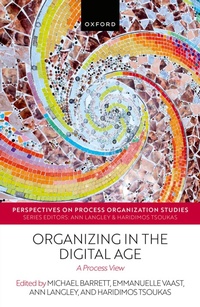
Organizing in the Digital Age
A Process View
Published on 11. July 2024
Book
Hardback
256 pages
978-0-19-889945-7 (ISBN)
Description
Organizing in the Digital Age draws on a process-oriented perspective to understand the pervasiveness of digitalization in organizations, and contemporary society. Ongoing and multiple crises, whether it be the pandemic, the economy, or climate change, have magnified the importance of digital technologies in processes of organizing and accelerated the role of digital transformation in work-life.
The central themes underpinning the chapters in this book concern the becoming of digital work, the conceptualization of agency in digital work, and the role of temporality in contemporary organizing. The increasing entanglement of digital technologies and work (accelerated through the Covid-19 pandemic) have fuelled interest in the need for understanding digital work happening at scale, while also examining and exposing inequalities. The concern with the role of agency in digital work reaches new heights when we consider the rapid and pervasive development and implementation of Artificial Intelligence (AI), and algorithmic control, and raises concerns about the ethical and moral dimension of agency. Methodologically, the book explores the use of digital trace data as a resource in the study of organizing processes. While digital traces offer unprecedented access to temporally evolving activity, they are nevertheless limited in their ability to represent phenomena. In essence, 'processual shadows' visible from digital data traces may be difficult to interpret without in-person observational data such as ethnography. Theoretical approaches around performativity are discussed in terms of the impact (or not) of innovative digital technologies, such as blockchain in organizations, while routine dynamics and pragmatism are drawn on in providing a processual understanding of the why and how of IT computer workarounds within organizational work practices.
The central themes underpinning the chapters in this book concern the becoming of digital work, the conceptualization of agency in digital work, and the role of temporality in contemporary organizing. The increasing entanglement of digital technologies and work (accelerated through the Covid-19 pandemic) have fuelled interest in the need for understanding digital work happening at scale, while also examining and exposing inequalities. The concern with the role of agency in digital work reaches new heights when we consider the rapid and pervasive development and implementation of Artificial Intelligence (AI), and algorithmic control, and raises concerns about the ethical and moral dimension of agency. Methodologically, the book explores the use of digital trace data as a resource in the study of organizing processes. While digital traces offer unprecedented access to temporally evolving activity, they are nevertheless limited in their ability to represent phenomena. In essence, 'processual shadows' visible from digital data traces may be difficult to interpret without in-person observational data such as ethnography. Theoretical approaches around performativity are discussed in terms of the impact (or not) of innovative digital technologies, such as blockchain in organizations, while routine dynamics and pragmatism are drawn on in providing a processual understanding of the why and how of IT computer workarounds within organizational work practices.
More details
Series
Language
English
Place of publication
Oxford
United Kingdom
Target group
Professional and scholarly
Product notice
sewn/stitched
Cloth over boards
Dimensions
Height: 224 mm
Width: 150 mm
Thickness: 23 mm
Weight
522 gr
ISBN-13
978-0-19-889945-7 (9780198899457)
Copyright in bibliographic data and cover images is held by Nielsen Book Services Limited or by the publishers or by their respective licensors: all rights reserved.
Schweitzer Classification
Other editions
Additional editions

E-Book
07/2024
1st Edition
OUP eBook
€98.99
Available for download

E-Book
06/2024
1st Edition
OUP eBook
€98.99
Available for download
Persons
Michael Barrett is Vice Dean and Professor of Information Systems & Innovation Studies at Cambridge Judge Business School (CJBS). He is also Academic Director of Cambridge Digital Innovation . Michael's current research focuses on digital innovation and transformation with a particular interest as to how emerging technologies are enabling new models of healthcare as well as promoting financial and social inclusion in developing countries. Professor Barrett is Editor-in-Chief of Information and Organization and has served as Senior Editor of MIS Quarterly. Michael has served as Director of Research and Head of the Organization Theory and Information Systems group at CJBS.
Ann Langley is Emerita Professor of Management at HEC Montreal, and Distinguished Research Environment Professor at University of Warwick. She obtained her Ph.D. from HEC Montreal in 1987. Her research deals with strategic management processes and practices in complex organizations with an emphasis on qualitative research methods. She is a Member of the Royal Society of Canada and Fellow of the British Academy and of the Academy of Management. She is currently Deputy Editor of Academy of Management Journal.
Haridimos Tsoukas is the Columbia Ship Management Professor of Strategic Management at the University of Cyprus, Cyprus and a Distinguished Research Environment Professor of Organizational Behaviour at Warwick Business School, University of Warwick, UK. He is an Honorary Professor at the University of Sydney Business School and at Queensland University. He obtained his PhD on the sociology of organizations at the Manchester Business School (MBS) and worked at MBS, the University of Essex, the University of Strathclyde, and at the ALBA Graduate Business School (Greece). He has published widely in several leading academic journals of his field.
Emmanuelle Vaast is a Professor of Information Systems at the Desautels Faculty of Management of McGill University. Her research examines how social practices and identities emerge and change with the implementation and use of new technologies. She studies how social and societal changes unfold with the development and use of digital technologies. Her research has been published at MIS Quarterly, Information Systems Research, Organization Science, and Organization Studies, among other outlets. Emmanuelle is a past division chair of the Communication, Technology, and Organization (CTO), (previously Organizational Communication and Information Systems, OCIS) division of the Academy of Management.
Ann Langley is Emerita Professor of Management at HEC Montreal, and Distinguished Research Environment Professor at University of Warwick. She obtained her Ph.D. from HEC Montreal in 1987. Her research deals with strategic management processes and practices in complex organizations with an emphasis on qualitative research methods. She is a Member of the Royal Society of Canada and Fellow of the British Academy and of the Academy of Management. She is currently Deputy Editor of Academy of Management Journal.
Haridimos Tsoukas is the Columbia Ship Management Professor of Strategic Management at the University of Cyprus, Cyprus and a Distinguished Research Environment Professor of Organizational Behaviour at Warwick Business School, University of Warwick, UK. He is an Honorary Professor at the University of Sydney Business School and at Queensland University. He obtained his PhD on the sociology of organizations at the Manchester Business School (MBS) and worked at MBS, the University of Essex, the University of Strathclyde, and at the ALBA Graduate Business School (Greece). He has published widely in several leading academic journals of his field.
Emmanuelle Vaast is a Professor of Information Systems at the Desautels Faculty of Management of McGill University. Her research examines how social practices and identities emerge and change with the implementation and use of new technologies. She studies how social and societal changes unfold with the development and use of digital technologies. Her research has been published at MIS Quarterly, Information Systems Research, Organization Science, and Organization Studies, among other outlets. Emmanuelle is a past division chair of the Communication, Technology, and Organization (CTO), (previously Organizational Communication and Information Systems, OCIS) division of the Academy of Management.
Content
1: Michael Barrett, Emma Vaast, Ann Langley, Haridimos Tsoukas: Organizing in the Digital Age: A Process View: An Introduction
2: Tim Ingold: Creation Beyond Creativity: From The Novelty of Ends to the Renewal of Life
3: Lotta Hultin, Lucas Introna, Magnus Maehring: On Thinking Movement: Theorizing Flows of Organizing in a Digital Age
4: Dubravka Cecez-Kecmanovic: Algorithmic Automation of Knowledge Work - A Sketch for Exploring the Becoming of Knowledge Work
5: Dirk S. Hovorka: Utopias as Borderlands: Reconceptualizing Post-pandemic Future(s). An Image: Post-pandemic Gnosislive
6: Matthew Jones: Physics or archaeology? Process organisation studies in the age of data abundance
7: Brian T. Pentland, Julie Ryan Wolf, Yunna Xie, Inkyu Kim, Kenneth Frank, Alice Pentland: Pentland, B., Wolf, J.R., Xie, Y., Kim, I., Frank, K., Pentland, A. Processual Shadows: What Can We See with Digital Trace Data?
8: Raghu Garud, Arun Kumaraswamy, Philipp Tuertscher: Collaborating Using Digital Technologies: The Role of Generative Memory
9: Moritz J. Kleinaltenkamp, Shaz Ansari: Blockchain and the Performativity of Emerging Technology Theories
10: Bijan Azad, Nelson King: Azad, B., King, N. Computer Workarounds or Expediting Work?
2: Tim Ingold: Creation Beyond Creativity: From The Novelty of Ends to the Renewal of Life
3: Lotta Hultin, Lucas Introna, Magnus Maehring: On Thinking Movement: Theorizing Flows of Organizing in a Digital Age
4: Dubravka Cecez-Kecmanovic: Algorithmic Automation of Knowledge Work - A Sketch for Exploring the Becoming of Knowledge Work
5: Dirk S. Hovorka: Utopias as Borderlands: Reconceptualizing Post-pandemic Future(s). An Image: Post-pandemic Gnosislive
6: Matthew Jones: Physics or archaeology? Process organisation studies in the age of data abundance
7: Brian T. Pentland, Julie Ryan Wolf, Yunna Xie, Inkyu Kim, Kenneth Frank, Alice Pentland: Pentland, B., Wolf, J.R., Xie, Y., Kim, I., Frank, K., Pentland, A. Processual Shadows: What Can We See with Digital Trace Data?
8: Raghu Garud, Arun Kumaraswamy, Philipp Tuertscher: Collaborating Using Digital Technologies: The Role of Generative Memory
9: Moritz J. Kleinaltenkamp, Shaz Ansari: Blockchain and the Performativity of Emerging Technology Theories
10: Bijan Azad, Nelson King: Azad, B., King, N. Computer Workarounds or Expediting Work?