


Friction
An Ethnography of Global Connection
Published on 28. November 2004
Book
Hardback
344 pages
978-0-691-12064-5 (ISBN)
Description
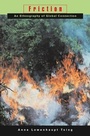
A wheel turns because of its encounter with the surface of the road; spinning in the air it goes nowhere. Rubbing two sticks together produces heat and light; one stick alone is just a stick. In both cases, it is friction that produces movement, action, effect. Challenging the widespread view that globalization invariably signifies a 'clash' of cultures, anthropologist Anna Tsing here develops friction in its place as a metaphor for the diverse and conflicting social interactions that make up our contemporary world. She focuses on one particular 'zone of awkward engagement' - the rainforests of Indonesia - where in the 1980's and the 1990's capitalist interests increasingly reshaped the landscape not so much through corporate design as through awkward chains of legal and illegal entrepreneurs that wrested the land from previous claimants, creating resources for distant markets.In response, environmental movements arose to defend the rainforests and the communities of people who live in them.
Not confined to a village, a province, or a nation, the social drama of the Indonesian rainforest includes local and national environmentalists, international science, North American investors, advocates for Brazilian rubber tappers, UN funding agencies, mountaineers, village elders, and urban students, among others - all combining in unpredictable, messy misunderstandings, but misunderstandings that sometimes work out. Providing a portfolio of methods to study global interconnections, Tsing shows how curious and creative cultural differences are in the grip of worldly encounter, and how much is overlooked in contemporary theories of the global.
Not confined to a village, a province, or a nation, the social drama of the Indonesian rainforest includes local and national environmentalists, international science, North American investors, advocates for Brazilian rubber tappers, UN funding agencies, mountaineers, village elders, and urban students, among others - all combining in unpredictable, messy misunderstandings, but misunderstandings that sometimes work out. Providing a portfolio of methods to study global interconnections, Tsing shows how curious and creative cultural differences are in the grip of worldly encounter, and how much is overlooked in contemporary theories of the global.
Reviews / Votes
Friction is an original, nuanced, and elegant work of ethnography and a significant contribution to the areas of globalization; environment and natural resource wars; the politics of indigenous peoples, NGOs, and development; and the sociology of expert versus local knowledge. -- Michael Goldman American Journal of Sociology By providing generous anecdotes and personal reflections amid more complex, insightful political commentary and social theory, [Tsing] achieves a writing style that is both pleasurable and informative. -- Laura L B Graham Environment & PlanningMore details
Language
English
Place of publication
New Jersey
United States
Target group
Professional and scholarly
College/higher education
Product notice
Trade binding
Illustrations
3 halftones. 2 line illus.
Dimensions
Height: 229 mm
Width: 152 mm
Weight
595 gr
ISBN-13
978-0-691-12064-5 (9780691120645)
Copyright in bibliographic data and cover images is held by Nielsen Book Services Limited or by the publishers or by their respective licensors: all rights reserved.
Schweitzer Classification
Other editions
Additional editions
Book
11/2004
Princeton University Press
€39.62
Article exhausted; check different version
Person
Anna Lowenhaupt Tsing is Professor of Anthropology at the University of California, Santa Cruz. She is the author of "In the Realm of the Diamond Queen" (Princeton).
Content
Preface ix Introduction 1 PART I: Prosperity "Better you had brought me a bomb, so I could blow this place up" 21 Chapter 1: Frontiers of Capitalism 27 "They communicate only in sign language" 51 Chapter 2: The Economy of Appearances 55 PART II: Knowledge "Let a new Asia and a new Africa be born" 81 Chapter 3: Natural Universals and the Global Scale 88 "Dark rays" 113 Chapter 4: Nature Loving 121 "This earth, this island Borneo" 155 Chapter 5: A History of Weediness 171 PART III: Freedom "A hair in the flour" 205 Chapter 6: Movements 213 "Facilities and incentives" 239 Chapter 7: The Forest of Collaborations 245 Coda 269 Notes 273 References 297 Index 313