

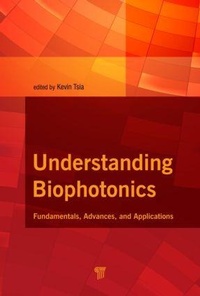
Understanding Biophotonics
Fundamentals, Advances, and Applications
1st Edition
Published on 6. April 2015
Book
Hardback
766 pages
978-981-4411-77-6 (ISBN)
Description
Biophotonics involves understanding how light interacts with biological matter, from molecules and cells, to tissues and even whole organisms. Light can be used to probe biomolecular events, such as gene expression and protein-protein interaction, with impressively high sensitivity and specificity. The spatial and temporal distribution of biochemical constituents can also be visualized with light and, thus, the corresponding physiological dynamics in living cells, tissues, and organisms in real time. Light can also be used to alter the properties and behaviors of biological matter, such as to damage cancerous cells by laser surgery or therapy, and manipulate the neuronal signaling in a brain network. Fueled by the innovations in photonic technologies in the past half century, biophotonics continues to play a ubiquitous role in revolutionizing basic life science studies as well as biomedical diagnostics and therapies.
Advancements in biophotonics in the past few decades can be seen not only in biochemistry and cell/molecular biology, but also in numerous preclinical applications. Researchers around the world are searching for ways to bring biophotonic technologies into real clinical practices, particularly cellular and molecular optical imaging. Meanwhile, emerging technologies, such as laser nanosurgery and nanoplasmonics, have created new insights for understanding, monitoring, and even curing diseases on a molecular basis.
This book presents the essential basics of optics and biophotonics to newcomers (senior undergraduates or postgraduate researchers) who are interested in this multidisciplinary research field. With stellar contributions from leading experts, the book highlights the major advancements in preclinical diagnostics using optical microscopy and spectroscopy, including multiphoton microscopy, super-resolution microscopy, and endomicroscopy. It also introduces a number of emerging techniques and toolsets for biophotonics applications, such as nanoplasmonics, microresonators for molecular detection, and subcellular optical nanosurgery.
Advancements in biophotonics in the past few decades can be seen not only in biochemistry and cell/molecular biology, but also in numerous preclinical applications. Researchers around the world are searching for ways to bring biophotonic technologies into real clinical practices, particularly cellular and molecular optical imaging. Meanwhile, emerging technologies, such as laser nanosurgery and nanoplasmonics, have created new insights for understanding, monitoring, and even curing diseases on a molecular basis.
This book presents the essential basics of optics and biophotonics to newcomers (senior undergraduates or postgraduate researchers) who are interested in this multidisciplinary research field. With stellar contributions from leading experts, the book highlights the major advancements in preclinical diagnostics using optical microscopy and spectroscopy, including multiphoton microscopy, super-resolution microscopy, and endomicroscopy. It also introduces a number of emerging techniques and toolsets for biophotonics applications, such as nanoplasmonics, microresonators for molecular detection, and subcellular optical nanosurgery.
More details
Language
English
Place of publication
Singapore
Singapore
Target group
College/higher education
Professional and scholarly
Academic and Postgraduate
Product notice
sewn/stitched
Cloth over boards
Illustrations
311 s/w Abbildungen, 28 farbige Abbildungen
28 Illustrations, color; 311 Illustrations, black and white
Dimensions
Height: 232 mm
Width: 176 mm
Thickness: 43 mm
Weight
1188 gr
ISBN-13
978-981-4411-77-6 (9789814411776)
Copyright in bibliographic data and cover images is held by Nielsen Book Services Limited or by the publishers or by their respective licensors: all rights reserved.
Schweitzer Classification
Other editions
Additional editions
E-Book
01/2016
Pan Stanford Publishing Pte Ltd
€51.49
Available for download
Person
Kevin Tsia received his B.E. and M.Phil. in electronic and computer engineering from the Hong Kong University of Science and Technology, Hong Kong, in 2003 and 2005, respectively. He obtained his Ph.D. from the Electrical Engineering Department at the University of California, Los Angeles (UCLA), in 2009. He is currently an assistant professor in the Department of Electrical and Electronic Engineering, and the Medical Engineering Program, at the University of Hong Kong.
Prof. Tsia's research interests cover a broad range of topics, including ultrafast real-time spectroscopy and microscopy for biomedical applications, such as imaging flow cytometry and endoscopic laser microsurgery. His research accomplishments, such as energy harvesting in silicon photonics and the world's fastest barcode reader and optical imaging system, have attracted worldwide press coverage and have been featured in many prestigious science and technology review magazines such as MIT Technology Review, EE Times, and Science News. Prof. Tsia was the recipient of a fellowship by the California Nanosystems Institute (CNSI) from 2005 to 2006. He also received the 2009 Harry M. Showman Prize from the UCLA Henry Samueli School of Engineering and Applied Science and the Early Career Award 2012-13 from the Research Grants Council (RGC) in Hong Kong. He is the author or coauthor of over 90 journal articles, conference papers, and book chapters and holds 2 US patents on ultrafast optical imaging technologies.
Prof. Tsia's research interests cover a broad range of topics, including ultrafast real-time spectroscopy and microscopy for biomedical applications, such as imaging flow cytometry and endoscopic laser microsurgery. His research accomplishments, such as energy harvesting in silicon photonics and the world's fastest barcode reader and optical imaging system, have attracted worldwide press coverage and have been featured in many prestigious science and technology review magazines such as MIT Technology Review, EE Times, and Science News. Prof. Tsia was the recipient of a fellowship by the California Nanosystems Institute (CNSI) from 2005 to 2006. He also received the 2009 Harry M. Showman Prize from the UCLA Henry Samueli School of Engineering and Applied Science and the Early Career Award 2012-13 from the Research Grants Council (RGC) in Hong Kong. He is the author or coauthor of over 90 journal articles, conference papers, and book chapters and holds 2 US patents on ultrafast optical imaging technologies.
Content
Essential Basics of Photonics. Essential Basics of Light-Matter Interaction. Optical Coherence Tomography. Optical Scanning Holography. Multiphoton Microscopy. Calcium Imaging of Neuronal Activity. Fluorescence Nanoscopy. Coherent Nonlinear Microscopy. Raman Spectroscopy of Single Cells. Intravital Endomicroscopy. Nanoplasmonic. Subcellular Optical Nanosurgery. Label-Free Detection of Nanoscale Objects Using Resonance Phenomena. Optical Transfection of Mammalian Cells. Optical Tweezers.