

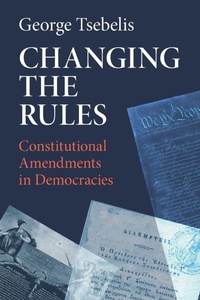
Changing the Rules
Constitutional Amendments in Democracies
Published on 8. May 2025
Book
Paperback/Softback
319 pages
978-1-009-59725-8 (ISBN)
Description
Changing the Rules enters into the debate between theoretical analyses of constitutional amendments (considered the most important part of a constitution) and empirical research (which argues that amendment provisions have little or no significance). George Tsebelis demonstrates how strict provisions are a necessary condition for amendments to have low frequency and significance and provides empirical evidence from case studies and over 100 democracies to corroborate this claim. Examining various cultural theories that dispute these findings, Tsebelis explains why their conclusions have weak foundations. He argues that constitutional rigidity is also a necessary condition for judicial independence and provides theoretical argument and empirical evidence. Tsebelis also establishes a negative correlation between the length of a constitution and problematic indicators such as time inconsistency, low GDP/capita, high corruption, inequality, and lack of innovation. This title is also available as Open Access on Cambridge Core.
Reviews / Votes
'Constitutional amendment processes matter - for the legitimacy and stability of constitutional systems. But they also vary widely in design and difficulty. Changing the Rules offers a magisterial account of this variation - and of how amendment rules, and 'veto players,' influence the rigidity of written constitutions across the globe. Drawing together quantitative and qualitative insights, it makes a compelling case for the importance of institutions and institutional design, but also for how constitutional rigidity can promote values such as judicial independence. This book should be considered compulsory reading for all lawyers and political scientists interested in the importance and dynamics of constitutional change.' Rosalind Dixon, University of New South Wales, Sydney 'Challenging a growing institution-skepticism among constitution scholars, Tsebelis makes a powerful case that institutions matter, rules matter, and procedures matter to political outcomes. This book is a very important contribution to the debate on the relevance of constitutional design, and should be on the reading list of everyone thinking about whether constitutions work, and how they work. Highly recommended.' Tarunabh Khaitan, London School of Economics and Political Science 'Building on veto player theory, in Changing the Rules: Constitutional Amendments in Democracies, George Tsebelis develops a parsimonious approach to understanding the occurrence of constitutional amendments. Empirically, the book shows the range of constitutional amendment procedures in modern democracies and applies the new approach in case studies of both successful and failed amendment processes in countries as different as Chile, Italy, and Mexico. Other chapters build on worldwide comparative data on rules and amendments and relate the new approach to some of the prominent issues in the study of constitutions, such as the rigidity and length of constitutional documents. Changing the Rules: Constitutional Amendments in Democracies is a path-breaking contribution to the study of the politics of constitutional change and provides a framework for empirical studies that take into account the preferences of the actors in the constitutional game.' Wolfgang C. Mueller, University of Vienna 'George Tsebelis deploys his influential theory of institutional veto players to explain constitutional amendments in democratic countries. Tsebelis goes against recent scholarship in constitutional law that emphasizes inertia, culture, or idiosyncratic factors to explain why and when constitutions are reformed. This book will without doubt spark interesting debates on a fundamental topic for democratic governance. Changing the Rules should find an audience not only with social scientists and legal scholars, but also with policy- and constitution-makers.' Julio Rios-Figueroa, ITAM (Mexico City) 'Ten of the most highly anticipated books of 2025' Richard Albert, The LeafletMore details
Language
English
Place of publication
Cambridge
United Kingdom
Product notice
Paperback (trade)
Illustrations
Worked examples or Exercises
Dimensions
Height: 229 mm
Width: 152 mm
Thickness: 17 mm
Weight
466 gr
ISBN-13
978-1-009-59725-8 (9781009597258)
Copyright in bibliographic data and cover images is held by Nielsen Book Services Limited or by the publishers or by their respective licensors: all rights reserved.
Schweitzer Classification
Other editions
Additional editions
Book
05/2025
Cambridge University Press
€105.30
Shipment within 15-20 days
Person
George Tsebelis is the Anatol Rapoport Collegiate Professor of Political Science at the University of Michigan where he works on political institutions. He is a member of the American Academy of Arts and Sciences and has received honorary degrees from the Universities of Athens, Crete and Milan. He is the author (among other books) of Nested Games: Rational Choice in Comparative Politics (1991) and Veto Players: How Political Institutions Work (2002).
Content
Foreword; Introduction; 1. The landscape of constitutional amendments; 2. An institutional approach to constitutional rigidity; 3. Cultural theories of constitutional amendments; 4. Cases of failed amendments: Italy and Chile; 5. A case of successful amendments: Mexico; 6. Constitutional rigidity and amendment rate; 7. Time inconsistency and other correlates of constitutional length; 8. Constitutional rigidity and judicial independence; Conclusions; Bibliography; Appendices.