

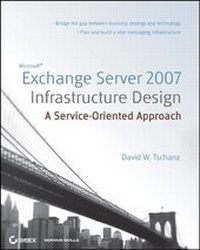
Microsoft Exchange Server 2007 Infrastructure Design
A Service-Oriented Approach
1st Edition
Published on 28. April 2008
Book
Paperback/Softback
426 pages
978-0-470-22446-5 (ISBN)
Description
Meeting the Messaging Needs of Your Business
As a systems administrator, you're expected to respond to the technical requirements of your organization while trying to fit them into its overall business goals. Few IT professionals have the combination of skills needed to pull it off. This unique book bridges that gap. It takes you beyond the routine administration tasks and teaches you how to plan and launch an Exchange Server 2007 enterprise solution that fully integrates the needs of the IT staff, end users, and business managers alike. You'll learn how to assess the enterprise's vital messaging needs and management's expected return on investment (ROI), how to build an effective infrastructure plan to meet those goals, and finally, how to present your business case, win plan approval, and start implementation.
With pages of clear-cut explanations, case studies, and real-world scenarios, this hands-on guide walks you through every phase, from planning to development to deployment, while offering strategic and practical techniques you'll find valuable throughout your professional career.
*
Understand the basic tenets of service-oriented architecture (SOA)
*
Assess your current Exchange infrastructure and capacities
*
Examine management's business goals and forecast for future growth
*
Plan the right infrastructure, including deployment, compliance, anti-spam and anti-virus, security, and mail archiving
*
Explore and establish Exchange Server 2007 server roles, including Edge Transport, Unified Messaging, ActiveSync(r), POP3 and IMAP4, Outlook(r) Web Access, and more
*
Outline objectives, determine resources, set timelines, and create functional documentation for your solutions and processes
*
Present your business case to decision-makers, including cost analysis, expected benefits, and criteria for determining success
As a systems administrator, you're expected to respond to the technical requirements of your organization while trying to fit them into its overall business goals. Few IT professionals have the combination of skills needed to pull it off. This unique book bridges that gap. It takes you beyond the routine administration tasks and teaches you how to plan and launch an Exchange Server 2007 enterprise solution that fully integrates the needs of the IT staff, end users, and business managers alike. You'll learn how to assess the enterprise's vital messaging needs and management's expected return on investment (ROI), how to build an effective infrastructure plan to meet those goals, and finally, how to present your business case, win plan approval, and start implementation.
With pages of clear-cut explanations, case studies, and real-world scenarios, this hands-on guide walks you through every phase, from planning to development to deployment, while offering strategic and practical techniques you'll find valuable throughout your professional career.
*
Understand the basic tenets of service-oriented architecture (SOA)
*
Assess your current Exchange infrastructure and capacities
*
Examine management's business goals and forecast for future growth
*
Plan the right infrastructure, including deployment, compliance, anti-spam and anti-virus, security, and mail archiving
*
Explore and establish Exchange Server 2007 server roles, including Edge Transport, Unified Messaging, ActiveSync(r), POP3 and IMAP4, Outlook(r) Web Access, and more
*
Outline objectives, determine resources, set timelines, and create functional documentation for your solutions and processes
*
Present your business case to decision-makers, including cost analysis, expected benefits, and criteria for determining success
More details
Edition
1., Auflage
Language
English
Place of publication
Chichester
United Kingdom
Publishing group
John Wiley and Sons Ltd
Target group
Professional and scholarly
Illustrations
Illustrations
Dimensions
Height: 23.6 cm
Width: 18.7 cm
Thickness: 23 mm
Weight
662 gr
ISBN-13
978-0-470-22446-5 (9780470224465)
Schweitzer Classification
Other editions
Additional editions
E-Book
04/2008
Sybex
€45.50
Available for download
Person
David W. Tschanz, PhD, MCSE, CIW, has been working with and managing large datasets for four decades. His work includes analysis of population dynamics, voting behavior, and epidemiological data. He has been writing on computer topics for the past several years, producing three books and over 100 articles.
Content
Introduction.
Chapter 1: Mastering the Business-Oriented Approach.
Chapter 2: Determining Business Requirements.
Chapter 3: Planning the Exchange Infrastructure.
Chapter 4: Applying Planning Principles to Exchange Server 2007.
Chapter 5: Planning Server Roles.
Chapter 6: Building the Business Case.
Chapter 7: Developing a Change Management Program.
Chapter 8: Managing User Expectations.
Chapter 9: Setting Up a Change Request Process.
Chapter 10: Deploying Exchange Server 2007.
Chapter 11: Tweaking the Infrastructure.
Chapter 12: So, You Want to Be a Consultant?
Appendix A: Measuring Team Effectiveness.
Appendix B: Sample Business Case Proposal.
Appendix C: Change Request Form.
Appendix D: Operations Checklists.
Appendix E: Lessons Learned Meeting Agenda.
Index.
Chapter 1: Mastering the Business-Oriented Approach.
Chapter 2: Determining Business Requirements.
Chapter 3: Planning the Exchange Infrastructure.
Chapter 4: Applying Planning Principles to Exchange Server 2007.
Chapter 5: Planning Server Roles.
Chapter 6: Building the Business Case.
Chapter 7: Developing a Change Management Program.
Chapter 8: Managing User Expectations.
Chapter 9: Setting Up a Change Request Process.
Chapter 10: Deploying Exchange Server 2007.
Chapter 11: Tweaking the Infrastructure.
Chapter 12: So, You Want to Be a Consultant?
Appendix A: Measuring Team Effectiveness.
Appendix B: Sample Business Case Proposal.
Appendix C: Change Request Form.
Appendix D: Operations Checklists.
Appendix E: Lessons Learned Meeting Agenda.
Index.