

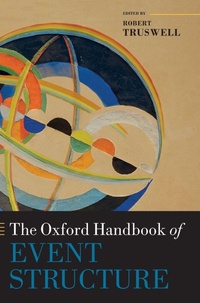
The Oxford Handbook of Event Structure
Published on 26. March 2019
Book
Hardback
736 pages
978-0-19-968531-8 (ISBN)
Description
This handbook deals with research into the nature of events, and how we use language to describe events. The study of event structure over the past 60 years has been one of the most successful areas of lexical semantics, uniting insights from morphology and syntax, lexical and compositional semantics, cognitive science, and artificial intelligence to develop insightful theories of events and event descriptions. This volume provides accessible introductions to major topics and ongoing debates in event structure research, exploring what events are, how we perceive them, how we reason with them, and the role they play in the organization of grammar and discourse. The chapters are divided into four parts: the first covers metaphysical issues related to events; the second is concerned with the relationship between event structure and grammar; the third is a series of crosslinguistic case studies; and the fourth deals with links to cognitive science and artificial intelligence more broadly.
The book is strongly interdisciplinary in nature, with insights from linguistics, philosophy, psychology, cognitive science, and computer science, and will appeal to a wide range of researchers and students from advanced undergraduate level upwards.
The book is strongly interdisciplinary in nature, with insights from linguistics, philosophy, psychology, cognitive science, and computer science, and will appeal to a wide range of researchers and students from advanced undergraduate level upwards.
Reviews / Votes
The Handbook presents a wide-ranging review of the linguistic literature on event structure. As a handbook on this topic, it definitely fulfills its goal * Luana Lopes Amaral, Linguist List * The book contains supporting references and a helpful subject index at the end. Because of its interdisciplinary nature, this book will be of interest to advanced undergraduate students and above in linguistics, philosophy, psychology, cognitive science, and computer science. * G. C. Gamst, CHOICE *More details
Series
Language
English
Place of publication
Oxford
United Kingdom
Target group
College/higher education
Professional and scholarly
Dimensions
Height: 250 mm
Width: 175 mm
Thickness: 44 mm
Weight
1430 gr
ISBN-13
978-0-19-968531-8 (9780199685318)
Copyright in bibliographic data and cover images is held by Nielsen Book Services Limited or by the publishers or by their respective licensors: all rights reserved.
Schweitzer Classification
Other editions
Additional editions
Robert Truswell
The Oxford Handbook of Event Structure
E-Book
03/2019
1st Edition
OUP eBook
€32.99
Available for download
Robert Truswell
The Oxford Handbook of Event Structure
E-Book
03/2019
1st Edition
OUP eBook
€32.99
Available for download
Person
Robert Truswell is Lecturer in Linguistics and English Language at the University of Edinburgh, and Adjunct Professor in Linguistics at the University of Ottawa, where he was Assistant Professor from 2011-14. He works on many aspects of syntax, semantics, and their interface, as well as syntactic and semantic change, and topics related to the evolution of language. His previous publications include the monograph Events, Phrases, and Questions (OUP, 2011), and the edited volumes Syntax and its Limits (OUP, 2014, with Raffaella Folli and Christina Sevdali) and Micro-change and Macro-change in Diachronic Syntax (OUP, 2017, with Eric Mathieu).
Content
1: Robert Truswell: Introduction
Part I: Events and Natural Language Metaphysics
2: Anita Mittwoch: Aspectual classes
3: Claudia Maienborn: Events and states
4: Robert Truswell: Event composition and event individuation
5: Richmond H. Thomason: The semantic representation of causation and agentivity
6: Bridget Copley: Force dynamics
7: Henk J. Verkuyl: Event structure without naive physics
8: Berit Gehrke: Event kinds
Part II: Events in Morphosyntax and Lexical Semantics
9: Nikolas Gisborne and James Donaldson: Thematic roles and events
10: Lisa Levinson: Semantic domains for syntactic word-building
11: Terje Lohndal: Neodavidsonianism in semantics and syntax
12: Gillian Ramchand: Event structure and verbal decomposition
13: Friederike Moltmann: Nominals and event structure
14: Rebekah Baglini and Chris Kennedy: Adjectives and event structure
Part III: Crosslinguistic Perspectives
15: Beth Levin and Malka Rappaport Hovav: Lexicalization patterns
16: Tova Rapoport: Secondary predication
17: Tal Siloni: Event structure and syntax
18: Lisa deMena Travis: Inner aspect crosslinguistically
Part IV: Events, Cognition, and Computation
19: Hans Kamp: Tense and aspect in Discourse Representation Theory
20: Andrew Kehler: Coherence relations
21: Mark Steedman: Form-independent meaning-representation for eventualities
22: Neil Cohn and Martin Paczynski: The neurophysiology of event processing in language and visual events
Part I: Events and Natural Language Metaphysics
2: Anita Mittwoch: Aspectual classes
3: Claudia Maienborn: Events and states
4: Robert Truswell: Event composition and event individuation
5: Richmond H. Thomason: The semantic representation of causation and agentivity
6: Bridget Copley: Force dynamics
7: Henk J. Verkuyl: Event structure without naive physics
8: Berit Gehrke: Event kinds
Part II: Events in Morphosyntax and Lexical Semantics
9: Nikolas Gisborne and James Donaldson: Thematic roles and events
10: Lisa Levinson: Semantic domains for syntactic word-building
11: Terje Lohndal: Neodavidsonianism in semantics and syntax
12: Gillian Ramchand: Event structure and verbal decomposition
13: Friederike Moltmann: Nominals and event structure
14: Rebekah Baglini and Chris Kennedy: Adjectives and event structure
Part III: Crosslinguistic Perspectives
15: Beth Levin and Malka Rappaport Hovav: Lexicalization patterns
16: Tova Rapoport: Secondary predication
17: Tal Siloni: Event structure and syntax
18: Lisa deMena Travis: Inner aspect crosslinguistically
Part IV: Events, Cognition, and Computation
19: Hans Kamp: Tense and aspect in Discourse Representation Theory
20: Andrew Kehler: Coherence relations
21: Mark Steedman: Form-independent meaning-representation for eventualities
22: Neil Cohn and Martin Paczynski: The neurophysiology of event processing in language and visual events