

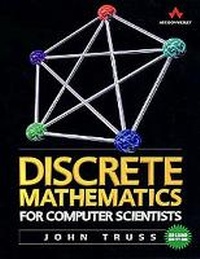
Discrete Mathematics for Computer Scientists
2nd Edition
Published on 27. October 1998
Book
Paperback/Softback
608 pages
978-0-201-36061-5 (ISBN)
Description
This is a new edition of a successful introduction to discrete mathematics for computer scientists, updated and reorganised to be more appropriate for the modern day undergraduate audience. Discrete mathematics forms the theoretical basis for computer science and this text combines a rigorous approach to mathematical concepts with strong motivation of these techniques via practical examples.
More details
Series
Edition
2nd edition
Language
English
Place of publication
Harlow
United Kingdom
Publishing group
Pearson Education Limited
Target group
Professional and scholarly
Dimensions
Height: 233 mm
Width: 172 mm
Thickness: 30 mm
Weight
870 gr
ISBN-13
978-0-201-36061-5 (9780201360615)
Copyright in bibliographic data and cover images is held by Nielsen Book Services Limited or by the publishers or by their respective licensors: all rights reserved.
Schweitzer Classification
Other editions
Previous edition

J. K. Truss
Discrete Mathematics for Computer Scientists
Book
05/1991
Addison Wesley
€30.89
Article exhausted; check for reprint
Person
John Truss has taught at Oxford University, Paisley College of Technology and currently at the University of Leeds. He has been a committee member of the British Logic Colloquium since 1990, and has recently been appointed an editor of the Journal of the London Mathematical Society. He wrote Foundations of Mathematical Analysis in 1997 and has authored 40 research papers.
0201360616AB04062001
0201360616AB04062001
Content
Preface
List of Symbols
The Natural Numbers
Introductory Logic
Sets, Relations and Functions
Algebraic Topics
Combinatorics
Partially Ordered Structures
Further Logic
Graphs
Formal Machines
Analysis of Algorithms and Complexity Theory
Coding Theory
Answers to selected exercises
Bibliography
Index
List of Symbols
The Natural Numbers
Introductory Logic
Sets, Relations and Functions
Algebraic Topics
Combinatorics
Partially Ordered Structures
Further Logic
Graphs
Formal Machines
Analysis of Algorithms and Complexity Theory
Coding Theory
Answers to selected exercises
Bibliography
Index