

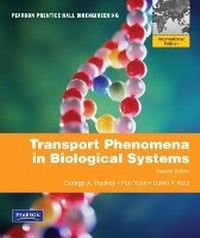
Transport Phenomena in Biological Systems
International Edition
2nd Edition
Published on 2. July 2009
Book
Paperback/Softback
888 pages
978-0-13-513154-1 (ISBN)
Description
For one-semester, advanced undergraduate/graduate courses in Biotransport Engineering.
Presenting engineering fundamentals and biological applications in a unified way, this text provides students with the skills necessary to develop and critically analyze models of biological transport and reaction processes. It covers topics in fluid mechanics, mass transport, and biochemical interactions, with engineering concepts motivated by specific biological problems.
Presenting engineering fundamentals and biological applications in a unified way, this text provides students with the skills necessary to develop and critically analyze models of biological transport and reaction processes. It covers topics in fluid mechanics, mass transport, and biochemical interactions, with engineering concepts motivated by specific biological problems.
More details
Edition
2nd edition
Language
English
Place of publication
United States
Publishing group
Pearson Education (US)
Target group
College/higher education
Dimensions
Height: 236 mm
Width: 211 mm
Thickness: 30 mm
Weight
1446 gr
ISBN-13
978-0-13-513154-1 (9780135131541)
Copyright in bibliographic data and cover images is held by Nielsen Book Services Limited or by the publishers or by their respective licensors: all rights reserved.
Schweitzer Classification
Other editions
Previous edition
George A. Truskey | Fan Yuan | David F. Katz
Transport Phenomena in Biological Systems
Book
01/2004
Pearson
€77.98
Article exhausted; check for reprint
Persons
The authors are faculty members in the Department of Biomedical Engineering at Duke University. The authors are leaders in their respective fields of research and their research has involved various aspects of momentum and mass transport related to biological phenomena and technologies.
Content
Previous Edition TOC
1. Introduction.
A. INTRODUCTION TO PHYSIOLOGICAL FLUID MECHANICS.
2. Conservation and Momentum Balances.
3. Conservation Relations for Fluid Transport, Dimensional Analysis and Scaling.
4. Macroscopic Form of Conservation Relations and Applications of Momentum Transport.
5. Fluid Flow in the Circulation and Tissues.
B. FUNDAMENTALS AND APPLICATIONS OF MASS TRANSPORT.
6. Introduction to Mass Transport.
7. Diffusion with Convection or Electrical Potentials.
8. Transport in Porous Media.
9. Transvascular Transport.
10. Solvent and Solute Transport across the Kidney Glomerulus.
C. THE EFFECT OF MASS TRANSPORT UPON BIOCHEMICAL INTERACTIONS.
11. Mass Transport and Biochemical Interactions.
12. Oxygen Transport from the Lungs to the Tissues.
13. Ligand-Receptor Kinetics on the Cell Surface and Molecular Transport within Cells.
14. Cell Adhesion and Cell Signaling.
15. Transport of Drugs and Macromolecules in Tumors.
16. Transport in Organs and Organisms.
17. Heat Transfer in Biological Systems.
Appendix. Relevant Mathematical Concepts.
1. Introduction.
A. INTRODUCTION TO PHYSIOLOGICAL FLUID MECHANICS.
2. Conservation and Momentum Balances.
3. Conservation Relations for Fluid Transport, Dimensional Analysis and Scaling.
4. Macroscopic Form of Conservation Relations and Applications of Momentum Transport.
5. Fluid Flow in the Circulation and Tissues.
B. FUNDAMENTALS AND APPLICATIONS OF MASS TRANSPORT.
6. Introduction to Mass Transport.
7. Diffusion with Convection or Electrical Potentials.
8. Transport in Porous Media.
9. Transvascular Transport.
10. Solvent and Solute Transport across the Kidney Glomerulus.
C. THE EFFECT OF MASS TRANSPORT UPON BIOCHEMICAL INTERACTIONS.
11. Mass Transport and Biochemical Interactions.
12. Oxygen Transport from the Lungs to the Tissues.
13. Ligand-Receptor Kinetics on the Cell Surface and Molecular Transport within Cells.
14. Cell Adhesion and Cell Signaling.
15. Transport of Drugs and Macromolecules in Tumors.
16. Transport in Organs and Organisms.
17. Heat Transfer in Biological Systems.
Appendix. Relevant Mathematical Concepts.