

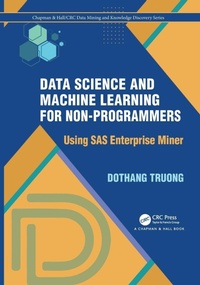
Data Science and Machine Learning for Non-Programmers
Using SAS Enterprise Miner
1st Edition
Will be published approx. on 1. January 2026
Book
Paperback/Softback
577 pages
978-0-367-75196-8 (ISBN)
Description
As data continues to grow exponentially, knowledge of data science and machine learning has become more crucial than ever. Machine learning has grown exponentially; however, the abundance of resources can be overwhelming, making it challenging for new learners. This book aims to address this disparity and cater to learners from various non-technical fields, enabling them to utilize machine learning effectively.
Adopting a hands-on approach, readers are guided through practical implementations using real datasets and SAS Enterprise Miner, a user-friendly data mining software that requires no programming. Throughout the chapters, two large datasets are used consistently, allowing readers to practice all stages of the data mining process within a cohesive project framework. This book also provides specific guidelines and examples on presenting data mining results and reports, enhancing effective communication with stakeholders.
Designed as a guiding companion for both beginners and experienced practitioners, this book targets a wide audience, including students, lecturers, researchers, and industry professionals from various backgrounds.
Adopting a hands-on approach, readers are guided through practical implementations using real datasets and SAS Enterprise Miner, a user-friendly data mining software that requires no programming. Throughout the chapters, two large datasets are used consistently, allowing readers to practice all stages of the data mining process within a cohesive project framework. This book also provides specific guidelines and examples on presenting data mining results and reports, enhancing effective communication with stakeholders.
Designed as a guiding companion for both beginners and experienced practitioners, this book targets a wide audience, including students, lecturers, researchers, and industry professionals from various backgrounds.
More details
Series
Language
English
Place of publication
United Kingdom
Publishing group
Taylor & Francis Ltd
Target group
College/higher education
Professional and scholarly
Adult education, Further/Vocational Education, General, Professional Practice & Development, and Professional Reference
Illustrations
189 farbige Abbildungen, 189 farbige Zeichnungen, 124 s/w Tabellen
143 Tables, black and white; 419 Line drawings, color; 419 Illustrations, color
Dimensions
Height: 254 mm
Width: 178 mm
Thickness: 31 mm
Weight
1094 gr
ISBN-13
978-0-367-75196-8 (9780367751968)
Copyright in bibliographic data and cover images is held by Nielsen Book Services Limited or by the publishers or by their respective licensors: all rights reserved.
Schweitzer Classification
Other editions
Additional editions
E-Book
02/2024
1st Edition
Taylor & Francis
€63.49
Available for download
Book
02/2024
1st Edition
Chapman & Hall/CRC
€119.90
Shipment within 15-20 days
E-Book
02/2024
1st Edition
Taylor & Francis
€63.49
Available for download
Person
Dothang Truong, PhD, is a Professor of Graduate Studies at Embry Riddle Aeronautical University, Daytona Beach, Florida. He has extensive teaching and research experience in machine learning, data analytics, air transportation management, and supply chain management. In 2022, Dr. Truong received the Frank Sorenson Award for outstanding achievement of excellence in aviation research and scholarship.
Content
Part I: Introduction to Data Mining. 1. Introduction to Data Mining and Data Science. 2. Data Mining Processes, Methods, and Software. 3. Data Sampling and Partitioning. 4. Data Visualization and Exploration. 5. Data Modification. Part II: Data Mining Methods. 6. Model Evaluation. 7. Regression Methods. 8. Decision Trees. 9. Neural Networks. 10. Ensemble Modeling. 11. Presenting Results and Writing Data Mining Reports. 12. Principal Component Analysis. 13. Cluster Analysis. Part III: Advanced Data Mining Methods. 14. Random Forest. 15. Gradient Boosting. 16. Bayesian Networks.