

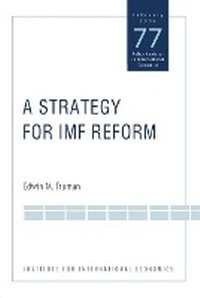
A Strategy for IMF Reform
Will be published approx. on 15. February 2006
Book
Paperback/Softback
124 pages
978-0-88132-398-6 (ISBN)
Description
The International Monetary Fund (IMF) is in eclipse as the preeminent institution promoting international economic and financial stability. Successful reform of the IMF must engage the full spectrum of its members. The IMF should not focus primarily on its low-income members and the challenges of global poverty nor should it focus exclusively on international financial crises affecting a small group of vulnerable emerging-market economies. Instead, it must be engaged with each of its members potentially on the full range of their economic and financial policies and play a central role in shaping global economic performance.
This important new book strongly argues that systemically important countries, starting with the Group of Seven, must support the IMF in this role. Its recommendations cover all key aspects of IMF responsibilities and operations: (1) In the crucial area of governance, the membership of the IMF should promptly address the reallocation of IMF shares (voting power) and the reallocation of chairs (representation on the IMF executive board), and it is time to discard the old conventions and to adopt a merit-based approach to the choice of the IMF's leadership; (2) mechanisms should be put in place to increase the IMF's leverage over systemically important members, and the IMF must act more forcefully in discharging its responsibility to exercise firm surveillance over members' exchange rate policies; (3) the Fund's central role in external financial crises should be reaffirmed; (4) the IMF should narrow and refocus its involvement with its low-income members; (5) the IMF's activities should be updated with respect to members' capital account policies and financial sectors; and (6) the IMF should put in place procedures for borrowing from the market to guard against the possibility that it will not receive timely increases in its quota resources.
This important new book strongly argues that systemically important countries, starting with the Group of Seven, must support the IMF in this role. Its recommendations cover all key aspects of IMF responsibilities and operations: (1) In the crucial area of governance, the membership of the IMF should promptly address the reallocation of IMF shares (voting power) and the reallocation of chairs (representation on the IMF executive board), and it is time to discard the old conventions and to adopt a merit-based approach to the choice of the IMF's leadership; (2) mechanisms should be put in place to increase the IMF's leverage over systemically important members, and the IMF must act more forcefully in discharging its responsibility to exercise firm surveillance over members' exchange rate policies; (3) the Fund's central role in external financial crises should be reaffirmed; (4) the IMF should narrow and refocus its involvement with its low-income members; (5) the IMF's activities should be updated with respect to members' capital account policies and financial sectors; and (6) the IMF should put in place procedures for borrowing from the market to guard against the possibility that it will not receive timely increases in its quota resources.
More details
Language
English
Place of publication
Washington
United States
Target group
College/higher education
Professional and scholarly
Product notice
Paperback (trade)
Dimensions
Height: 229 mm
Width: 152 mm
Thickness: 15 mm
Weight
28 gr
ISBN-13
978-0-88132-398-6 (9780881323986)
Copyright in bibliographic data and cover images is held by Nielsen Book Services Limited or by the publishers or by their respective licensors: all rights reserved.
Schweitzer Classification
Other editions
Additional editions
Edwin Truman
A Strategy for IMF Reform
E-Book
02/2006
Peterson Institute for International Economics
€9.49
Available for download
Person
Edwin M. Truman, nonresident senior fellow since July 2013, joined the Peterson Institute for International Economics as senior fellow in 2001. Previously he served as assistant secretary of the US Treasury for International Affairs from December 1998 to January 2001 and returned as counselor to the secretary March-May 2009. He directed the Division of International Finance of the Board of Governors of the Federal Reserve System from 1977 to 1998. From 1983 to 1998, he was one of three economists on the staff of the Federal Open Market Committee.