

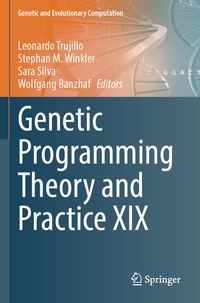
Genetic Programming Theory and Practice XIX
Published on 13. March 2024
Book
Paperback/Softback
XIV, 262 pages
978-981-19-8462-4 (ISBN)
Description
This book brings together some of the most impactful researchers in the field of Genetic Programming (GP), each one working on unique and interesting intersections of theoretical development and practical applications of this evolutionary-based machine learning paradigm. Topics of particular interest for this year´s book include powerful modeling techniques through GP-based symbolic regression, novel selection mechanisms that help guide the evolutionary process, modular approaches to GP, and applications in cybersecurity, biomedicine and program synthesis, as well as papers by practitioner of GP that focus on usability and real-world results. In summary, readers will get a glimpse of the current state of the art in GP research.
More details
Series
Edition
2023 ed.
Language
English
Place of publication
Singapore
Singapore
Target group
Professional and scholarly
Illustrations
11 s/w Abbildungen, 93 farbige Abbildungen
XIV, 262 p. 104 illus., 93 illus. in color.
Dimensions
Height: 235 mm
Width: 155 mm
Thickness: 16 mm
Weight
423 gr
ISBN-13
978-981-19-8462-4 (9789811984624)
DOI
10.1007/978-981-19-8460-0
Schweitzer Classification
Other editions
Additional editions
Leonardo Trujillo | Stephan M. Winkler | Sara Silva
Genetic Programming Theory and Practice XIX
Book
03/2023
Springer
€160.49
Shipment within 3-4 weeks
Content
Chapter 1. Symbolic Regression in Materials Science: Discovering Interatomic Potentials from Data.- Chapter 2. Correlation versus RMSE Loss Functions in Symbolic Regression Tasks.- Chapter 3. GUI-Based, Efficient Genetic Programming and AI Planning For Unity3D.- Chapter 4. Genetic Programming for Interpretable and Explainable Machine Learning.- Chapter 5. Biological Strategies ParetoGP Enables Analysis of Wide and Ill-Conditioned Data from Nonlinear Systems.- Chapter 6. GP-Based Generative Adversarial Models.- Chapter 7. Modelling Hierarchical Architectures with Genetic Programming and Neuroscience Knowledge for Image Classification through InferentialKnowledge.- Chapter 8. Life as a Cyber-Bio-Physical System.- Chapter 9. STREAMLINE: A Simple, Transparent, End-To-End Automated Machine Learning Pipeline Facilitating Data Analysis and Algorithm Comparison.- Chapter 10. Evolving Complexity is Hard.- Chapter 11. ESSAY: Computers Are Useless ... They Only Give Us Answers.