

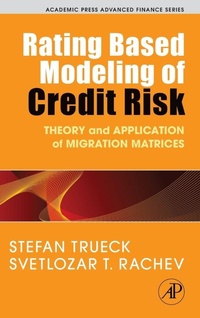
Rating Based Modeling of Credit Risk
Theory and Application of Migration Matrices
Published on 15. January 2009
Book
Hardback
280 pages
978-0-12-373683-3 (ISBN)
Description
In the last decade rating-based models have become very popular in credit risk management. These systems use the rating of a company as the decisive variable to evaluate the default risk of a bond or loan. The popularity is due to the straightforwardness of the approach, and to the upcoming new capital accord (Basel II), which allows banks to base their capital requirements on internal as well as external rating systems. Because of this, sophisticated credit risk models are being developed or demanded by banks to assess the risk of their credit portfolio better by recognizing the different underlying sources of risk. As a consequence, not only default probabilities for certain rating categories but also the probabilities of moving from one rating state to another are important issues in such models for risk management and pricing.
It is widely accepted that rating migrations and default probabilities show significant variations through time due to macroeconomics conditions or the business cycle. These changes in migration behavior may have a substantial impact on the value-at-risk (VAR) of a credit portfolio or the prices of credit derivatives such as collateralized debt obligations (D+CDOs). In Rating Based Modeling of Credit Risk the authors develop a much more sophisticated analysis of migration behavior. Their contribution of more sophisticated techniques to measure and forecast changes in migration behavior as well as determining adequate estimators for transition matrices is a major contribution to rating based credit modeling.
It is widely accepted that rating migrations and default probabilities show significant variations through time due to macroeconomics conditions or the business cycle. These changes in migration behavior may have a substantial impact on the value-at-risk (VAR) of a credit portfolio or the prices of credit derivatives such as collateralized debt obligations (D+CDOs). In Rating Based Modeling of Credit Risk the authors develop a much more sophisticated analysis of migration behavior. Their contribution of more sophisticated techniques to measure and forecast changes in migration behavior as well as determining adequate estimators for transition matrices is a major contribution to rating based credit modeling.
Reviews / Votes
"... an excellent overview of theory and application...." -Frank J. Fabozzi, PhD, CFA, Professor in the Practice of Finance, Yale School of Management, CTMore details
Series
Language
English
Place of publication
San Diego
United States
Publishing group
Elsevier Science Publishing Co Inc
Target group
Professional and scholarly
Primary readership:
Both researchers, practitioners and financial institutions in the area of banking, mathematical finance, risk management, especially credit risk management.
Secondary readership:
The book may also be used as textbook in an advanced course on credit risk or credit risk modelling..
Product notice
Laminated cover
Illustrations
Illustrated
Dimensions
Height: 235 mm
Width: 156 mm
Thickness: 24 mm
Weight
575 gr
ISBN-13
978-0-12-373683-3 (9780123736833)
Copyright in bibliographic data and cover images is held by Nielsen Book Services Limited or by the publishers or by their respective licensors: all rights reserved.
Schweitzer Classification
Other editions
Additional editions
Stefan Trueck | Svetlozar T. Rachev
Rating Based Modeling of Credit Risk
Theory and Application of Migration Matrices
E-Book
01/2009
Academic Press
€66.95
Available for download
Persons
Svetlozar (Zari) Rachev completed his PhD in 1979 from Moscow State University, and his Doctor of Science degree in 1986 from the Steklov mathematical Institute in Moscow. Currently he is Chair-Professor at the University of Karlsruhe in the School of Economics and Business Engineering. He is also Professor Emeritus at the University of California Santa Barbara in the Dept of Statistics and Applied Probability. He has published six monographs and over 230 research articles. He is a Fellow of the Institute of Mathematical Statistics, Elected member of the International statistical Institute, foreign Member of the Russian Academy of Natural Science, and hols an honorary doctorate degree from St. Petersburg Technical University. He is co-founder of Bravo Risk Management Group specializing in financial risk management software. Bravo Group was recently acquired by FinAnalytics for which he currently serves as Chief-Scientist.
Content
1. Introduction: Credit Risk Modeling, Ratings and Migration Matrices
2. Rating and Scoring Techniques
3. The New Basel Capital Accord
4. Rating Based Modeling
5. Migration Matrices and the Markov Chain Approach
6. Stability of Credit Migrations
7. Measures for Comparison of Transition Matrices
8. Real World and Risk-Neutral Transition Matrices
9. Conditional Credit Migrations: Adjustments and Forecasts
10. Dependence Modeling and Credit Migrations
11. Credit Derivatives
2. Rating and Scoring Techniques
3. The New Basel Capital Accord
4. Rating Based Modeling
5. Migration Matrices and the Markov Chain Approach
6. Stability of Credit Migrations
7. Measures for Comparison of Transition Matrices
8. Real World and Risk-Neutral Transition Matrices
9. Conditional Credit Migrations: Adjustments and Forecasts
10. Dependence Modeling and Credit Migrations
11. Credit Derivatives