

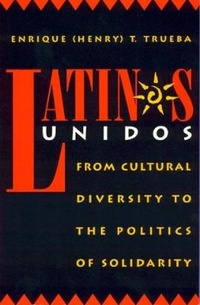
Latinos Unidos
From Cultural Diversity to the Politics of Solidarity
Published on 23. December 1998
Book
Hardback
216 pages
978-0-8476-8728-2 (ISBN)
Description
Latinos Unidos presents an unexpected perspective on Latinos_not only as a highly diverse and rapidly growing population in the United States with distinct social, cultural, and economic features_but as a new political force with a cohesive collective ethnic identity. Indeed, Latinos in this country constitute a new political power coming to grips with their global significance. Within two decades, Latino children will constitute a majority in urban public schools around the country. By the mid-21st century, Latinos (along with African-Americans) will represent half the U.S. population. While much of the literature in the social sciences continues to stereotype Latinos as marginalized, poor, and low-achievers, unable to 'assimilate' and function in mainstream society, Latinos are quietly taking important positions in academic, government, professional organizations, and the international world of economics. Their rapid flow into the U.S. has, to an extent, camouflaged this upward social, educational, and class mobility. Trueba, using his unique vantage point as a Latino immigrant and scholar, explores the vital issues of personal identity and resiliency, adaptive strategies, and successes of Latinos in North America in this pathbreaking book. Among the most fascinating and least known subjects he discusses are binational networks, which describe the bilingual and bicultural capabilities of a new generation of Latinos who can function on both sides of the border with Mexico. Most of all, readers will come away from Latinos Unidos with the growing significance of Latinos in the U.S. and their vital role in shaping the future.
Reviews / Votes
Anyone grappling with the complexities of Latino ethnic identity will find Latinos Unidos compelling. This moving work offers a variety of explanations for the cultural cohesiveness of the broad spectrum of Latino realities. It examines the cultural roots of Latino resilience and offers a roadmap for a 'pedagogy of hope.' Trueba argues convincingly that investing in all levels of education is both morally correct and economically imperative in preparing for the realities of today's (and tomorrow's) multicultural America. -- Carolo and Marcelo Suarez-Orozco, Harvard University Trueba is a master storyteller. . . . This is a wonderfully exciting piece of work. -- Walter G. Secada, University of Wisconsin, Madison Trueba has written a very intersting book about the importance of education not only for Latinos, but also for the future of the U.S. The complexity and the clarity of argument, the detailed research, and the passionate narrative make this book highly recommended for all levels. -- P. Vila, University of Texas at San Antonio * CHOICE, July / August 1999, Vol. 36, No. 11/12 * Latinos Unidos is a landmark essay in the continual struggle to understand the growing Latina/o community at the dawn of the 21st century. Tueba's insight into contemporary political problems and his true passion for education, in its broadest sense, are truly an inspiration to young scholars and teachers. Trueba argues for culturally sensitive and politically sensible education in ways that are both intellectually stimulating and emotionally moving. Latinos Unidos is a must read for anyone interested in education, at any level, in the United States. * Rocky Mountain Review * Trueba?s contribution to the ongoing discussion on Latino identity in the United States attempts to remedy this by offering readers a deeply-researched yet intimate portrait of the 'intriguing and unpredictable' contemporary history of Latinos in the United States. Latinos Unidos offers a passionate narrative, refreshing analysis, and a strong set of arguments underscoring the importance of education for the Latino population and for the future of the United States. I enthusiastically recommend this book to my colleagues in education, anthropology, sociology, and ethnic studies, as well as to university-level instructors of courses in cultural studies, teacher education, cultural diversity, counseling education, and educational administration. This is definitely a must read for anyone interested in education in the United States.. * Anthropology & Education Quarterly * Trueba's contribution to the ongoing discussion on Latino identity in the United States attempts to remedy this by offeringreaders a deeply-researched yet intimate portrait of the 'intriguing and unpredictable' contemporary history of Latinos in the
United States. Latinos Unidos offers a passionate narrative, refreshing analysis, and a strong set of arguments underscoring the importance of education for the Latino population and for the future of the United States. I enthusiastically recommend this book to my colleagues in education, anthropology, sociology, and ethnic studies, as well as to university-level instructors of courses in cultural studies, teacher education, cultural diversity, counseling education, and educational administration. This is definitely a
must read for anyone interested in education in the United States. * Anthropology & Education Quarterly *
More details
Series
Language
English
Place of publication
United States
Publishing group
Bloomsbury Publishing Plc
Target group
College/higher education
Professional and scholarly
Dimensions
Height: 235 mm
Width: 161 mm
Thickness: 17 mm
Weight
445 gr
ISBN-13
978-0-8476-8728-2 (9780847687282)
Copyright in bibliographic data and cover images is held by Nielsen Book Services Limited or by the publishers or by their respective licensors: all rights reserved.
Schweitzer Classification
Person
Enrique T. Trueba is Ruben E. Hinojosa Regents Professor and chair of the Curriculum and Instruction Department, Department of Education at the University of Texas, Austin.
Content
Chapter 1 Series Editor's Foreword Chapter 2 Foreword Part 3 Introduction: The Genesis of This Volume and Its Author Chapter 4 Personal Resilence and Self-Identities Part 5 The Politics of Latino Self-Identity Chapter 6 A Brief Historical Perspective: From a Colonized Mentality to Liberation Chapter 7 The North American People's View of Immigrants Chapter 8 Fear in an Older and Impoverished America Chapter 9 A New Collective Latino Identity: Unexpected High Political Profile Chapter 10 Cultural Roots of Resilency Chapter 11 Religious Foundations of Resilency and Solidarity Chapter 12 Redefinition of the Self and New Leadership Chapter 13 Conclusing Reflections Part 14 Latino Diversity: Demographic, Socioeconomic, Occupational, and Educational Characteristics Chapter 15 Socioeconomic and Demographic Characteristics Chapter 16 Migration and Economic Crises Chapter 17 The Rural-Urban Continuum Chapter 18 The Struggle of Latino Children in Schools Chapter 19 Preparing Teachers for Latino Students Chapter 20 A Deficit View of Latino Students Chapter 21 The Isolation of Latino Students Chapter 22 Student's Cultural and Cognitive Capital Part 23 Race and Ethnicity in Academia: Latinos in High Education Chapter 24 Race, Ethnicity, and Xenophobia Chapter 25 Debate on Affirmative Action Chapter 26 My Personal Experience Chapter 27 Specific Cases of Exclusion Chapter 28 Conflict Resolution Chapter 29 Concluding Thoughts Part 30 Mexican Immigrant Families in California Chapter 31 Soiciopolitical Context of Mexican Farm Labor Chapter 32 Mexican Immigrants in Migrant Town Chapter 33 The Role of Women in the Family Chapter 34 The Case of Consuelo Chapter 35 The Personal and Family Contextual Features of Resilency Chapter 36 Binational Lives Part 37 Critical Ethnography and a Vygotskian Pedagogy of Hope: The Case of Mexican Immigrant Children Chapter 38 What is Critical Ethnography? Chapter 39 Adaptive Responses of Mexican Immigrants Chapter 40 Education and Empowerment of Mexican Immigrants Chapter 41 Mr. Villegas, the Fourth Grade Teacher Chapter 42 From Critical Ethnography to a Vygotskian Pedagogy of Hope Chapter 43 Concluding Thoughts Chapter 44 Ethnic Identity Part 45 Latinos in the Twenty-First Century: The Components of Praxis for a Pedagogy of Hope Chapter 46 Resilency and Latino Identities: A Theoretical Reflection Chapter 47 Praxis for a Pedagogy of Hope Chapter 48 New Educational Leadership Chapter 49 Dreams, Worries, and Borders Chapter 50 Index