

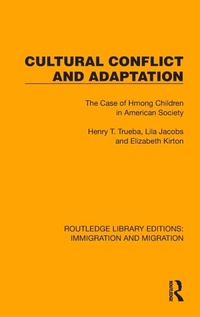
Cultural Conflict and Adaptation
The Case of Hmong Children in American Society
1st Edition
Published on 16. November 2022
Book
Hardback
184 pages
978-1-032-36320-2 (ISBN)
Description
Cultural Conflict and Adaptation (1990) examines the alienation and cultural conflicts faced at school by the children of a small group of Hmong who have settled in La Playa, California. The educational process for these children is an example of cultural conflict and adjustment patterns which may be found in many other populations in the world.
More details
Series
Language
English
Place of publication
London
United Kingdom
Publishing group
Taylor & Francis Ltd
Target group
College/higher education
Postgraduate, Undergraduate Advanced, and Undergraduate Core
Dimensions
Height: 240 mm
Width: 161 mm
Thickness: 15 mm
Weight
452 gr
ISBN-13
978-1-032-36320-2 (9781032363202)
Copyright in bibliographic data and cover images is held by Nielsen Book Services Limited or by the publishers or by their respective licensors: all rights reserved.
Schweitzer Classification
Other editions
Additional editions
Henry T. Trueba | Lila Jacobs | Elizabeth Kirton
Cultural Conflict and Adaptation
The Case of Hmong Children in American Society
Book
04/2024
1st Edition
Routledge
€47.70
Shipment within 10-20 days
Henry T. Trueba | Lila Jacobs | Elizabeth Kirton
Cultural Conflict and Adaptation
The Case of Hmong Children in American Society
E-Book
11/2022
1st Edition
Routledge
€41.99
Available for download
Henry T. Trueba | Lila Jacobs | Elizabeth Kirton
Cultural Conflict and Adaptation
The Case of Hmong Children in American Society
E-Book
11/2022
1st Edition
Routledge
€41.99
Available for download
Persons
Henry T. Trueba, Lila Jacobs and Elizabeth Kirton
Content
1. Culture Conflict and the American Dream 2. Ethnohistory of the Hmong People 3. The Hmong at La Playa 4. Becoming American Through Schooling 5. Seven 'Learning Disabled' Indochinese: Institutional Approach to Children Facing Culture Conflict 6. Culture and Minority Achievement: Implications for Research and Institutional Practice