

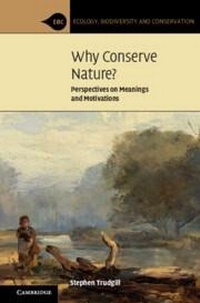
Why Conserve Nature?
Perspectives on Meanings and Motivations
Published on 24. February 2022
Book
Hardback
412 pages
978-1-108-83252-6 (ISBN)
Description
How we view nature transforms the world around us. People rehearse stories about nature which make sense to them. If we ask the question 'why conserve nature?', and the answers are based on myths, then are these good myths to have? Scientific knowledge about the environment is fundamental to ideas about how nature works. It is essential to the conservation endeavour. However, any conservation motivation is nested within a society's meanings of nature and the way society values it. Given the therapeutic and psychological significance of nature for us and our culture, this book considers the meanings derived from the poetic and emotional attachment to a sense of place, which is arguably just as important as scientific evidence. The functional significance of species is important, but so too is the therapeutic value of nature, together with the historic and spiritual meanings entwined in a human feeling for landscape and wildlife.
Reviews / Votes
'... this book will help the ... reader to think through their values and their relationship with nature... I encourage the readers ... to buy this book, let Trudgill's seminars reshape their thinking, and (re)discover for themselves why we should conserve nature.' George Holmes, Oryx '... I found the author's profoundly personal engagement with the material endearing. The volume is littered with references to art, literature, poetry, and philosophy, leaving readers with the impression of a well-read and highly cultured scholar sharing a lifetime of experience and thought with lucky readers. He had clearly thought long and hard about the material, taught it, and wrote about it extensively. The resulting text reflects this personal journey of thinking, teaching, and writing. As I read it, I had the feeling of sitting down with a master in the twilight of his career and hearing what he had learned.' Jonathan A. Newman, The Quarterly Review of BiologyMore details
Series
Language
English
Place of publication
Cambridge
United Kingdom
Target group
College/higher education
Professional and scholarly
Product notice
sewn/stitched
Cloth over boards
Illustrations
Worked examples or Exercises
Dimensions
Height: 236 mm
Width: 157 mm
Thickness: 18 mm
Weight
771 gr
ISBN-13
978-1-108-83252-6 (9781108832526)
Copyright in bibliographic data and cover images is held by Nielsen Book Services Limited or by the publishers or by their respective licensors: all rights reserved.
Schweitzer Classification
Other editions
Additional editions
Book
02/2022
Cambridge University Press
€54.00
Shipment within 15-20 days
E-Book
02/2022
Cambridge University Press
€41.99
Available for download
E-Book
12/2021
Cambridge University Press
€41.99
Available for download
Person
Stephen Trudgill is an Honorary Vice-President of the Field Studies Council and an Emeritus Fellow in Geography at Robinson College, Cambridge University, where he is Chair of the Gardens Committee and member of the Visual Arts Committee. . He formerly lectured on the social engagement with nature, biogeography, soils, nature conservation and environmental management in the Department of Geography at Cambridge University. He has experience of Nature Reserve Management Committees in Slapton Ley National Nature Reserve, Devon and community conservation near Cambridge. He has written, edited and co-edited seven books to date. He was also a contributor to the recently published Cambridge book, Curious About Nature (Burt and Thompson, EBC, 2019).
Content
Part I. The Experience of Nature: 1. The experience of nature; 2. Climate change; Part II. Nature Imagined: 3. Nature in ecological science: explanations, emotions and motivations; 4. Nature in literature and art; Part III. Nature, Self and Place: 5. Personal meanings of nature; 6. Places for nature; Part IV. Why Conserve Nature?: 7. Possibilities.