

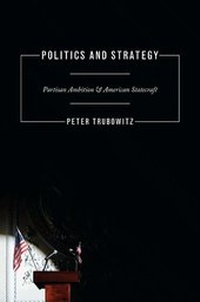
Politics and Strategy
Partisan Ambition and American Statecraft
Published on 3. April 2011
Book
Hardback
200 pages
978-0-691-14957-8 (ISBN)
Description
Why do some national leaders pursue ambitious grand strategies and adventuresome foreign policies while others do not? When do leaders boldly confront foreign threats and when are they less assertive? "Politics and Strategy" shows that grand strategies are Janus-faced: their formulation has as much to do with a leader's ability to govern at home as it does with maintaining the nation's security abroad. Drawing on the American political experience, Peter Trubowitz reveals how variations in domestic party politics and international power have led presidents from George Washington to Barack Obama to pursue strategies that differ widely in international ambition and cost. He considers why some presidents overreach in foreign affairs while others fail to do enough. Trubowitz pushes the understanding of grand strategy beyond traditional approaches that stress only international forces or domestic interests. He provides insights into how past leaders responded to cross-pressures between geopolitics and party politics, and how similar issues continue to bedevil American statecraft today.
He suggests that the trade-offs shaping American leaders' foreign policy choices are not unique - analogous trade-offs confront Chinese and Russian leaders as well. Combining innovative theory and historical analysis, "Politics and Strategy" answers classic questions of statecraft and offers new ideas for thinking about grand strategies and the leaders who make them.
He suggests that the trade-offs shaping American leaders' foreign policy choices are not unique - analogous trade-offs confront Chinese and Russian leaders as well. Combining innovative theory and historical analysis, "Politics and Strategy" answers classic questions of statecraft and offers new ideas for thinking about grand strategies and the leaders who make them.
Reviews / Votes
One of Choice's Outstanding Academic Titles for 2011: Top 25 Books "Trubowitz has written an impressive book with a modest thesis. He makes the case that both the distribution of power around the world and domestic politics influence strategic decisions in U.S. foreign policy... Trubowitz captures the complexity of these decisions with theoretical sophistication, an unusual breadth of historical examples, and an impressive clarity of argument. This is an important book."--Choice "Scholars of American politics and international relations alike will find a strong theoretical foundation along with extensive empirical material in this work for exploring such topics."--Meena Bose, Political Science QuarterlyMore details
Series
Language
English
Place of publication
New Jersey
United States
Target group
College/higher education
Professional and scholarly
Product notice
Trade binding
Illustrations
3 line illus. 11 tables.
Dimensions
Height: 229 mm
Width: 152 mm
Weight
425 gr
ISBN-13
978-0-691-14957-8 (9780691149578)
Copyright in bibliographic data and cover images is held by Nielsen Book Services Limited or by the publishers or by their respective licensors: all rights reserved.
Schweitzer Classification
Other editions
Additional editions
Book
04/2011
Princeton University Press
€28.60
Shipment within 10-20 days
Person
Peter Trubowitz is professor of government at the University of Texas, Austin. He is the author of "Defining the National Interest".
Content
List of Tables and Figures xi Preface and Acknowledgments xiii Chapter One: Introduction 1 Statesmen, Partisans, and Geopolitics The Two Faces of Grand Strategy 2 Statesmen as Strategic Politicians 4 Grand Strategy Past and Present 7 Chapter Two: Grand Strategy's Microfoundations 9 Variations in Grand Strategy 9 A Model of Executive Choice 16 Determinants of Grand Strategy 31 Research Design and Outline 37 Chapter Three: Why States Appease Their Foes 44 The Appeasement Puzzle 44 George Washington and the Appeasement of Britain 46 Abraham Lincoln, Britain, and the Confederacy 55 Franklin Roosevelt, Hitler, and Appeasement, 1936-1939 64 Appeasement Reconsidered 74 Chapter Four: When States Expand 77 Theories of Expansionism 77 James Monroe, Republican Factionalism, and the Monroe Doctrine 79 William McKinley, Cuba, and the Threat of Domestic Populism 90 George W. Bush, September 11, and the Promise of Party Realignment 97 Expansionism: Necessity or Choice? 104 Chapter Five: Why States Underreach 106 Strategies of Restraint 107 Jacksonian Fissures and Martin Van Buren's Strategic Adjustment 108 Herbert Hoover, Republican Sectarianism, and Strategic Retrenchment 114 Bill Clinton, the Democrats, and Selective Engagement 120 The Paradox of Strategic "Underextension" 127 Chapter Six: Conclusion 129 Statecraft's Twin Engines American Balancing in Historical Perspective 130 Geopolitics and Partisan Politics: Managing Cross-Pressure 132 Secondary Powers and Nondemocracies 139 Barack Obama and Grand Strategy 145 References 151 Index 177