

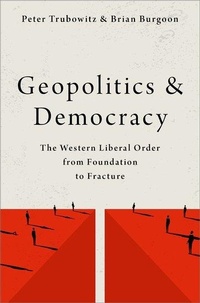
Geopolitics and Democracy
The Western Liberal Order from Foundation to Fracture
Published on 6. July 2023
Book
Paperback/Softback
264 pages
978-0-19-753541-7 (ISBN)
Description
A large and widening gap has opened between Western democracies' international ambitions and their domestic political capacity to support them. On issues ranging from immigration and international trade to national security, new political parties on the left and the right are rejecting the core foreign policy principles that Western governments have championed for over half a century. Much of the debate over the weakening of the Western liberal order has focused on recent changes: Donald Trump's presidency, Britain's vote to leave the European Union, and the surge of nationalist sentiment in France, Germany, and other Western democracies. In Geopolitics and Democracy, Peter Trubowitz and Brian Burgoon provide a powerful new explanation for the rise of anti-globalism in the West.
Combining a novel theoretical framework and empirical strategy, Trubowitz and Burgoon show that support for globalism has been receding for 30 years in Western parties and legislatures. They trace the anti-globalist backlash to foreign policy decisions that mainstream parties and party elites made after the end of the Cold War. These decisions sought to globalize markets and pool sovereignty at the supranational level while applying neoliberal reforms to social protections and guarantees at home--a combination of policies that succeeded in expanding the Western liberal order, but at the cost of mounting public discontent and political fragmentation.
At a time when problems of great power rivalry, spheres of influence, and reactionary nationalism have returned, Geopolitics and Democracy reveals how domestic support for international engagement during the long East-West geopolitical contest was contingent upon social protections within Western democracies. In the absence of a renewed commitment to those social purposes, Western democracies will struggle to find a collective grand strategy that their domestic publics will support.
Combining a novel theoretical framework and empirical strategy, Trubowitz and Burgoon show that support for globalism has been receding for 30 years in Western parties and legislatures. They trace the anti-globalist backlash to foreign policy decisions that mainstream parties and party elites made after the end of the Cold War. These decisions sought to globalize markets and pool sovereignty at the supranational level while applying neoliberal reforms to social protections and guarantees at home--a combination of policies that succeeded in expanding the Western liberal order, but at the cost of mounting public discontent and political fragmentation.
At a time when problems of great power rivalry, spheres of influence, and reactionary nationalism have returned, Geopolitics and Democracy reveals how domestic support for international engagement during the long East-West geopolitical contest was contingent upon social protections within Western democracies. In the absence of a renewed commitment to those social purposes, Western democracies will struggle to find a collective grand strategy that their domestic publics will support.
Reviews / Votes
Timely and compelling, Geopolitics and Democracy argues that since the end of the Cold War, government leaders in the West broke the social contract underpinning the liberal international order they built. By focusing their efforts on market globalization and the pooling sovereignty at the international level, while reducing social protections at home, Western government leaders overstretched public support for their actions, paving the way for growing anti-globalization sentiment. The book is a model for how to bridge insights from international relations and domestic politics, and does an exceptional job of marshalling a wealth of available evidence to make nuanced arguments about the state and future of the Western-led liberal order. I strongly encourage everyone to read it. * Catherine E. De Vries, Professor of Political Science, Bocconi University * In this tour de force, Trubowitz and Burgoon offer a new and compelling portrait of the shifting and fraught domestic foundations of Western democracy and its postwar leadership of the liberal world order. Beautifully written and deeply researched, Geopolitics and Democracy chronicles the decades-in-the-making erosion of support for liberal internationalism in Western societies-and points to ways in which liberal democracies might once again bring their ambitions and capacities back into line. * G. John Ikenberry, Albert G. Milbank Professor of Politics and International Affairs, Princeton University * Trubowitz and Burgoon offer a highly readable and persuasive argument about the interaction between populism and the unraveling of the liberal international order. A notable contribution helping us understand our politics today. * Kathleen R. McNamara, Professor of Government and Foreign Service, Georgetown University * This ambitious book synthesizes existing scholarship and also breaks new ground, theoretically and empirically. The authors argue convincingly that the embrace of 'globalism' by Western political elites has been accompanied by domestic reforms that have undermined public support for the liberal international order. A must-read for students of comparative welfare-state politics as well as international political economy and international relations. * Jonas Pontusson, Professor of Comparative Politics, Universite de Geneve * Geopolitics and Democracy is essential reading for everyone who wants to grasp the root causes of the anti-globalist pressures in today's liberal democracies and the resulting crisis of the liberal international order. Based on a rigorous analysis of a wealth of data, Trubowitz and Burgoon challenge standard accounts of liberal internationalism's decline and show how trade liberalization and neoliberal governance have contributed to the widening gap between governments and voters in the West. * Wolfgang Wagner, Professor of International Security, Vrije Universiteit Amsterdam * Geopolitics and Democracy is a thought-provoking book that studies the challenges to the liberal international order from a broad perspective. Drawing on insights from different subfields that are usually studied in isolation, paying attention to different levels of analysis, and presenting a vast array of empirical findings, this book provides a provocative new perspective on why the Western liberal world order has come under pressure and what could be done to change this. * Stefanie Walter, Professor of International Relations and Political Economy, University of Zurich * A big, grand sweeping and important argument. Geopolitics and Democracy makes a powerful case that Western governments got well ahead of what their populations would support when they decided to deepen and broaden the liberal international order after 1990. * William C. Wohlforth, Daniel Webster Professor of Government, Dartmouth College * [A] groundbreaking study * Foreign Affairs * This book is easy to read and highly recommended for college and university libraries and larger public library systems. More importantly, political leaders and policy professionals would do well to heed its findings and recommendations. * Choice * Geopolitics and Democracy constitutes a seminal contribution to the scholarly discourse on global politics. Its incisive analysis and thought-provoking insights make it a valuable resource for scholars and practitioners grappling with the complexities of contemporary geopolitics ... the book's overarching thesis provides a compelling framework for understanding the multifaceted challenges facing Western democracies in an era of geopolitical uncertainty and ideological polarisation. * Mahmoud Javadi, European Political Science * In their interesting, carefully crafted book on the problems facing liberal international order, Peter Trubowitz and Brian Burgoon argue that, for Western states, their geopolitical predicament is premised on their domestic politics. * Professor George Lawson, Australian Outlook * In their interesting, carefully crafted book on the problems facing liberal international order, Peter Trubowitz and Brian Burgoon argue that, for Western states, their geopolitical predicament is premised on their domestic politics. * Professor George Lawson, Australian Outlook * Geopolitics and Democracy indeed provides a great and novel scholarship with a holistic view through acknowledging the what, why, and how to restore the wounds of liberal world order without over-exaggerating the inclusiveness of the West through critical assessment. * Monika, Indian Institute of Technology Indore, India, Democratization * Geopolitics and Democracy constitutes a seminal contribution to the scholarly discourse on global politics. Its incisive analysis and thought-provoking insights make it a valuable resource for scholars and practitioners grappling with the complexities of contemporary geopolitics. * Mahmoud Javadi, AI Governance Researcher at Erasmus University Rotterdam (EUR) * Geopolitics and Democracy offers a valuable and innovative academic perspective that takes into account the causes, reasons, and methods of addressing the challenges facing the liberal world order. * Mohammad Imtiyaz, LSE Review of Books * This book is an important addition to the burgeoning literature on the crisis of the so-called liberal international order (LIO) ... What sets this book apart is the innovative way in which the authors comprehensively quantify the trends that so many have already identified. The book features 34 figures and an extensive appendix that provide data on 24 western countries and more than 400 political parties, across seven decades. Drawing on databases and indicators that measure party policy positions, military spending and support for economic openness, Trubowitz and Burgoon correlate this data to show trends in the relationship between partnership and power (the dynamics of support for international cooperation and military spending). * Hubert Zimmermann, International Affairs *More details
Language
English
Place of publication
New York
United States
Target group
Professional and scholarly
Dimensions
Height: 231 mm
Width: 158 mm
Thickness: 20 mm
Weight
469 gr
ISBN-13
978-0-19-753541-7 (9780197535417)
Copyright in bibliographic data and cover images is held by Nielsen Book Services Limited or by the publishers or by their respective licensors: all rights reserved.
Schweitzer Classification
Other editions
Additional editions
Peter Trubowitz | Brian Burgoon
Geopolitics and Democracy
The Western Liberal Order from Foundation to Fracture
Book
03/2023
Oxford University Press Inc
€84.32
Shipment within 15-20 days
Peter Trubowitz | Brian Burgoon
Geopolitics and Democracy
The Western Liberal Order from Foundation to Fracture
E-Book
04/2021
OUP eBook
€18.49
Available for download
Peter Trubowitz | Brian Burgoon
Geopolitics and Democracy
The Western Liberal Order from Foundation to Fracture
E-Book
04/2021
OUP eBook
€18.49
Available for download
Persons
Peter Trubowitz is Professor of International Relations and Director of the Phelan United States Center at the London School of Economics and Political Science, and Associate Fellow at Chatham House, the Royal Institute of International Affairs. His research focuses on international security, domestic politics and foreign policy, and party politics. His published work includes Politics and Strategy: Partisan Ambition and American Statecraft and Defining the National Interest: Conflict and Change in American Foreign Policy, which won the American Political Science Association's J. David Greenstone Prize for best book on politics and history.
Brian Burgoon is Professor of International and Comparative Political Economy at the University of Amsterdam, Director of the Amsterdam Centre for European Studies (ACES), and the former Academic Director of the Amsterdam Institute for Social Science Research (AISSR). His research focuses on the politics of economic globalization, immigration,
inequality, and welfare and labor-market policy. His work has been published in leading journals in political science, economics, sociology, European studies, and international relations.
Brian Burgoon is Professor of International and Comparative Political Economy at the University of Amsterdam, Director of the Amsterdam Centre for European Studies (ACES), and the former Academic Director of the Amsterdam Institute for Social Science Research (AISSR). His research focuses on the politics of economic globalization, immigration,
inequality, and welfare and labor-market policy. His work has been published in leading journals in political science, economics, sociology, European studies, and international relations.
Content
List of Figures
Preface and Acknowledgments
Chapter 1: The Solvency Gap
Chapter 2: A Widening Gyre
Chapter 3: Roots of Insolvency
Chapter 4: Reaping the Whirlwind
Chapter 5: Bridging the Gap
Appendices
References
Index
Preface and Acknowledgments
Chapter 1: The Solvency Gap
Chapter 2: A Widening Gyre
Chapter 3: Roots of Insolvency
Chapter 4: Reaping the Whirlwind
Chapter 5: Bridging the Gap
Appendices
References
Index