

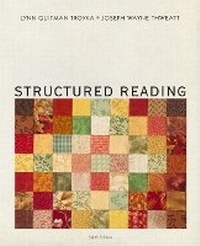
Structured Reading Plus NEW MyReadingLab -- Access Card Package
8th Edition
Published on 28. August 2012
Book
Mixed media product
448 pages
978-0-321-84135-3 (ISBN)
Description
ALERT: Before you purchase, check with your instructor or review your course syllabus to ensure that you select the correct ISBN. Several versions of Pearson's MyLab & Mastering products exist for each title, including customized versions for individual schools, and registrations are not transferable. In addition, you may need a CourseID, provided by your instructor, to register for and use Pearson's MyLab & Mastering products.
Packages
Access codes for Pearson's MyLab & Mastering products may not be included when purchasing or renting from companies other than Pearson; check with the seller before completing your purchase.
Used or rental books
If you rent or purchase a used book with an access code, the access code may have been redeemed previously and you may have to purchase a new access code.
Access codes
Access codes that are purchased from sellers other than Pearson carry a higher risk of being either the wrong ISBN or a previously redeemed code. Check with the seller prior to purchase.
--
Structured Reading is grounded in the theory that students learn best from guided, hands-on experience with complete, not partial, reading selections. This text approaches students with detailed instruction in the separate skills areas that assure movement to college-level reading abilities, followed by extensive, repeated practice found in a variety of essays from books, magazines, and texts. ISBN 0321841352 /9780321841353 Structured Reading Plus NEW MyReadingLab -- Access Card Package, 8/e
Package Contains:
0205244653 / 9780205244652 Structured Reading
0205869262 / 9780205869268 NEW MyReadingLab -- Valuepack Access Card
Packages
Access codes for Pearson's MyLab & Mastering products may not be included when purchasing or renting from companies other than Pearson; check with the seller before completing your purchase.
Used or rental books
If you rent or purchase a used book with an access code, the access code may have been redeemed previously and you may have to purchase a new access code.
Access codes
Access codes that are purchased from sellers other than Pearson carry a higher risk of being either the wrong ISBN or a previously redeemed code. Check with the seller prior to purchase.
--
Structured Reading is grounded in the theory that students learn best from guided, hands-on experience with complete, not partial, reading selections. This text approaches students with detailed instruction in the separate skills areas that assure movement to college-level reading abilities, followed by extensive, repeated practice found in a variety of essays from books, magazines, and texts. ISBN 0321841352 /9780321841353 Structured Reading Plus NEW MyReadingLab -- Access Card Package, 8/e
Package Contains:
0205244653 / 9780205244652 Structured Reading
0205869262 / 9780205869268 NEW MyReadingLab -- Valuepack Access Card
More details
Edition
8th edition
Language
English
Place of publication
New Jersey
United States
Publishing group
Pearson Education (US)
Target group
College/higher education
ISBN-13
978-0-321-84135-3 (9780321841353)
Copyright in bibliographic data is held by Nielsen Book Services Limited or its licensors: all rights reserved.
Schweitzer Classification
Other editions
Previous edition
Lynn Quitman Troyka | Joe Wayne Thweatt
Structured Reading (with MyReadingLab Student Access Code Card)
Book
01/2010
7th Edition
Longman Inc
€106.16
Article exhausted; check for reprint
Content
Preface
Part 1 Skills for Reading
Chapter 1 What Is Your Personal Reading HISTory?
Chapter 2 What Is the Reading Process?
Chapter 3 What Is the Role of "SQ3R" When Reading to Study?
Chapter 4 How Can I Improve My Vocabulary?
Chapter 5 What Are "Central Theme" and "Main Ideas"?
Chapter 6 What Are "Major Details"?
Chapter 7 How Can Maps, Outlines, and Visuals Help with Reading?
Chapter 8 What Are "Inferences"?
Chapter 9 What Is "Critical Reading"?
Chapter 10 Critical Reading: What Are "The Author's Strategies"?
Chapter 11 Critical Reading: What Is a "Summary"?
Chapter 12 What Is "Reader's Response"?
Answers to Activities in Part One
Part 2
Selection 1 A Real Loss by Fern Kupfer
Vocabulary list with dictionary entries
Exercises:
1A Vocabulary
1B Central Theme and Main Ideas
1C Major Details
1D Inferences
1E Critical Reading: Fact or Opinion
1F Critical Reading: The Author's Strategies
1G Reader's Process: Summarizing Your Reading
1H Reader's Response: To Discuss or to Write About
Selection 2 To Catch a Thief by Stephen Holt
*Selection 3 Freegans Salvage Food from the City's Bountiful Garbage by Eliabeth Giegerich
Selection 4 SeoulSearching by Rick Reilly
Selection 5 Darkness at Noon by Harold Krents
*Selection 6 Ugly and Lovable by Larry Levin
Part 3
Selection 7 Summer by Jonathan Schwartz
Selection 8 Brains the Ultimate Sex Appeal by Wendi C. Thomas
Selection 9 The Girl with the Large Eyes by Julius LesterGenes and Behavior: A Twin Legacy by Constance Holden
*Selection 10 Divorcing Couples Seek Solace in Ring-Smashing Ceremonies by Sandra BarronFlour Children by Lexine Alpert
Selection 11 The Magic Words Are "Will You Help Me?" by Michael Ryan187Flour Children Lexine Alpert
*Selection 12 The Magic Words Are "Will You Help Me?" by Michael RyanFamily and Friends Share Pain and Questions by Erin Sullivan
Part 4
Selection 13 How to Stay Alive by Art Hoppe
*Selection 14 Genes and Behavior: A Twin Legacy by Constance HoldenWaging War on Wrinkles by Jessica Dye
*The Danger of Hoarding by Joyce CohenEscaping the Daily Grind for Life as a House Father by Rick Greenberg
Selection 16 Forty Acres and a Holiday by Lisa Jones
Selection 17 My Mother's Blue Bowl by Alice Walker
Selection 18 From In Search of Bernabe by Graciela Limon
Part 1 Skills for Reading
Chapter 1 What Is Your Personal Reading HISTory?
Chapter 2 What Is the Reading Process?
Chapter 3 What Is the Role of "SQ3R" When Reading to Study?
Chapter 4 How Can I Improve My Vocabulary?
Chapter 5 What Are "Central Theme" and "Main Ideas"?
Chapter 6 What Are "Major Details"?
Chapter 7 How Can Maps, Outlines, and Visuals Help with Reading?
Chapter 8 What Are "Inferences"?
Chapter 9 What Is "Critical Reading"?
Chapter 10 Critical Reading: What Are "The Author's Strategies"?
Chapter 11 Critical Reading: What Is a "Summary"?
Chapter 12 What Is "Reader's Response"?
Answers to Activities in Part One
Part 2
Selection 1 A Real Loss by Fern Kupfer
Vocabulary list with dictionary entries
Exercises:
1A Vocabulary
1B Central Theme and Main Ideas
1C Major Details
1D Inferences
1E Critical Reading: Fact or Opinion
1F Critical Reading: The Author's Strategies
1G Reader's Process: Summarizing Your Reading
1H Reader's Response: To Discuss or to Write About
Selection 2 To Catch a Thief by Stephen Holt
*Selection 3 Freegans Salvage Food from the City's Bountiful Garbage by Eliabeth Giegerich
Selection 4 SeoulSearching by Rick Reilly
Selection 5 Darkness at Noon by Harold Krents
*Selection 6 Ugly and Lovable by Larry Levin
Part 3
Selection 7 Summer by Jonathan Schwartz
Selection 8 Brains the Ultimate Sex Appeal by Wendi C. Thomas
Selection 9 The Girl with the Large Eyes by Julius LesterGenes and Behavior: A Twin Legacy by Constance Holden
*Selection 10 Divorcing Couples Seek Solace in Ring-Smashing Ceremonies by Sandra BarronFlour Children by Lexine Alpert
Selection 11 The Magic Words Are "Will You Help Me?" by Michael Ryan187Flour Children Lexine Alpert
*Selection 12 The Magic Words Are "Will You Help Me?" by Michael RyanFamily and Friends Share Pain and Questions by Erin Sullivan
Part 4
Selection 13 How to Stay Alive by Art Hoppe
*Selection 14 Genes and Behavior: A Twin Legacy by Constance HoldenWaging War on Wrinkles by Jessica Dye
*The Danger of Hoarding by Joyce CohenEscaping the Daily Grind for Life as a House Father by Rick Greenberg
Selection 16 Forty Acres and a Holiday by Lisa Jones
Selection 17 My Mother's Blue Bowl by Alice Walker
Selection 18 From In Search of Bernabe by Graciela Limon