

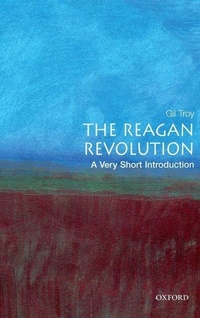
The Reagan Revolution
A Very Short Introduction
Published on 3. December 2009
Book
Paperback/Softback
168 pages
978-0-19-531710-7 (ISBN)
Description
"They called it the Reagan revolution," Ronald Reagan noted in his Farewell Address. "Well, I'll accept that, but for me it always seemed more like the great rediscovery, a rediscovery of our values and our common sense."
Nearly two decades after that 1989 speech, debate continues to rage over just how revolutionary those Reagan years were. The Reagan Revolution: A Very Short Introduction identifies and tackles some of the controversies and historical mysteries that continue to swirl around Reagan and his legacy, while providing an illuminating look at some of the era's defining personalities, ideas, and accomplishments. Gil Troy, a well-known historian who is a frequent commentator on contemporary politics, sheds much light on the phenomenon known as the Reagan Revolution, situating the reception of Reagan's actions within the contemporary liberal and conservative political scene. While most conservatives refuse to countenance any criticism of their hero, an articulate minority laments that he did not go far enough. And while some liberals continue to mourn just how far he went in changing America, others continue to mock him as a disengaged, do-nothing dunce. Nevertheless, as Troy shows, two and a half decades after Reagan's 1981 inauguration, his legacy continues to shape American politics, diplomacy, culture, and economics. Both Bill Clinton and George W. Bush modeled much of their presidential leadership styles on Reagan's example, while many of the debates of the '80s about the budget, tax cutting, defense-spending, and American values still rage.
Love him or hate him, Ronald Reagan remains the most influential president since Franklin D. Roosevelt, and one of the most controversial. This marvelous book places the Reagan Revolution in the broader context of postwar politics, highlighting the legacies of these years on subsequent presidents and on American life today.
ABOUT THE SERIES: The Very Short Introductions series from Oxford University Press contains hundreds of titles in almost every subject area. These pocket-sized books are the perfect way to get ahead in a new subject quickly. Our expert authors combine facts, analysis, perspective, new ideas, and enthusiasm to make interesting and challenging topics highly readable.
Nearly two decades after that 1989 speech, debate continues to rage over just how revolutionary those Reagan years were. The Reagan Revolution: A Very Short Introduction identifies and tackles some of the controversies and historical mysteries that continue to swirl around Reagan and his legacy, while providing an illuminating look at some of the era's defining personalities, ideas, and accomplishments. Gil Troy, a well-known historian who is a frequent commentator on contemporary politics, sheds much light on the phenomenon known as the Reagan Revolution, situating the reception of Reagan's actions within the contemporary liberal and conservative political scene. While most conservatives refuse to countenance any criticism of their hero, an articulate minority laments that he did not go far enough. And while some liberals continue to mourn just how far he went in changing America, others continue to mock him as a disengaged, do-nothing dunce. Nevertheless, as Troy shows, two and a half decades after Reagan's 1981 inauguration, his legacy continues to shape American politics, diplomacy, culture, and economics. Both Bill Clinton and George W. Bush modeled much of their presidential leadership styles on Reagan's example, while many of the debates of the '80s about the budget, tax cutting, defense-spending, and American values still rage.
Love him or hate him, Ronald Reagan remains the most influential president since Franklin D. Roosevelt, and one of the most controversial. This marvelous book places the Reagan Revolution in the broader context of postwar politics, highlighting the legacies of these years on subsequent presidents and on American life today.
ABOUT THE SERIES: The Very Short Introductions series from Oxford University Press contains hundreds of titles in almost every subject area. These pocket-sized books are the perfect way to get ahead in a new subject quickly. Our expert authors combine facts, analysis, perspective, new ideas, and enthusiasm to make interesting and challenging topics highly readable.
Reviews / Votes
"In this brief account, Gil Troy captures Ronald Reagan in all his complexity, neatly reconciling the surface contradictions within both his public and private personas. A shrewd and readable analysis of the man and his administration, this is a triumph of interpretive scholarship."--Alonzo L. Hamby, author of Man of the People: A Life of Harry S. Truman"Very useful for the casual reader as well as highly flexible for classroom use. It's hard to imagine another book serving such a function any better than this...Remarkable." --History News Network
More details
Series
Language
English
Place of publication
New York
United States
Product notice
Paperback (trade)
Unsewn / adhesive bound
Illustrations
10 maps & halftones
Dimensions
Height: 175 mm
Width: 111 mm
Thickness: 17 mm
Weight
145 gr
ISBN-13
978-0-19-531710-7 (9780195317107)
Copyright in bibliographic data and cover images is held by Nielsen Book Services Limited or by the publishers or by their respective licensors: all rights reserved.
Schweitzer Classification
Other editions
Additional editions
E-Book
07/2009
OUP eBook
€5.49
Available for download
E-Book
07/2009
OUP eBook
€5.49
Available for download
Person
Gil Troy is Professor of History at McGill University and a Visiting Scholar at the Bipartisan Policy Center in Washington, DC. A frequent media commentator, his writings have appeared in the Washington Post, Newsday, the New York Times Book Review, the National Post, and other publications. He is the author of Morning in America: How Ronald Reagan Invented the 1980s and Leading from the Center: Why Moderates Make the Best Presidents.