

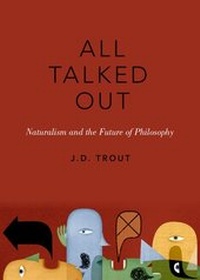
All Talked Out
Naturalism and the Future of Philosophy
Published on 8. February 2018
Book
Hardback
188 pages
978-0-19-068680-2 (ISBN)
Description
In All Talked Out J.D. Trout exemplifies the power of science in the hands of a philosopher, and the result is a timely and urgent argument about the future of philosophy. Based on his 2013 Phi Beta Kappa Romanell Lectures, Trout here presents a novel and positive view of intellectual advancements with respect to traditional topics in philosophy, and explains why these achievements occurred despite the archaic and often retrograde influence of philosophical doctrine and method.
Together, these lines of inquiry lead to a conclusion that while foundational reflection remains as necessary as ever philosophy, as it is conceived in the halls of academia, no longer adds anything distinctively useful. At its best, philosophy is a place to grow new ideas. But many other disciplines can provide such incubation. At the same time, however, Trout argues that we don't have to kill philosophy; we just have to figure out what is worth preserving from it.
Following a spirited introduction, the first lecture takes stock of the growing field of evidence-based approaches to reasoning, and in light of these scientific developments, criticizes important failures in epistemology as it is currently practiced in the English speaking world. The second lecture examines the psychological impulse to explain, the resulting sense of understanding, and the natural limits of cognitively appreciating the subject we have explained. The final lecture presents the proper reaction to the idea that scientific evidence matters to responsible governance.
Together, these lines of inquiry lead to a conclusion that while foundational reflection remains as necessary as ever philosophy, as it is conceived in the halls of academia, no longer adds anything distinctively useful. At its best, philosophy is a place to grow new ideas. But many other disciplines can provide such incubation. At the same time, however, Trout argues that we don't have to kill philosophy; we just have to figure out what is worth preserving from it.
Following a spirited introduction, the first lecture takes stock of the growing field of evidence-based approaches to reasoning, and in light of these scientific developments, criticizes important failures in epistemology as it is currently practiced in the English speaking world. The second lecture examines the psychological impulse to explain, the resulting sense of understanding, and the natural limits of cognitively appreciating the subject we have explained. The final lecture presents the proper reaction to the idea that scientific evidence matters to responsible governance.
Reviews / Votes
... Trout's book is an enlightening and enjoyable read that demonstrates the significance of empirical science to sound philosophical methodology and the power of scientifically informed philosophy to contribute meaningfully to public debate. * Keith Harris, Metascience * Trout is engaging with issues related to meta-philosophy (especially, with issues related to how we should engage in epistemology and the philosophy of science) at a very high level, and his voice is well worth hearing in these debates. * Stephen Grimm, Fordham University * Trout is right that for philosophy to survive i.e. maintaining departments in universities philosophers have to pursue productive projects that keep their work relevant both to researchers in other disciplines and to society as a whole... I think that his work continues the tradition of Dewey, who strove to make philosophy relevant in nearly all of his work. * Steve Downes, University of Utah *More details
Series
Language
English
Place of publication
New York
United States
Target group
Professional and scholarly
Dimensions
Height: 132 mm
Width: 180 mm
Thickness: 25 mm
Weight
249 gr
ISBN-13
978-0-19-068680-2 (9780190686802)
Copyright in bibliographic data and cover images is held by Nielsen Book Services Limited or by the publishers or by their respective licensors: all rights reserved.
Schweitzer Classification
Other editions
Additional editions
E-Book
12/2017
OUP eBook
€12.49
Available for download
E-Book
12/2017
OUP eBook
€15.49
Available for download
Person
J.D. Trout is Professor and John and Mae Calamos Endowed Chair of Philosophy, Illinois Institute of Technology, Chicago, IL.
Content
Chapter 1: Introduction: The Shape of Evidence-Based Epistemology
Where We Are: An Overview
Naturalism as a Hypothesis
How Did We Get Here?
A Better Alternative: Strategic Reliabilism?
Ameliorative Psychology and Better Reasoning
Conclusion
Chapter 2: Good Reasoning and Evidence-Based Epistemology
The Limits of Reasoning
Standard Analytic Epistemology and Professional Philosophy
The Failure of Constructive Philosophy
The Department of Things I Find Really Cool to Think About
Strategic Reliabilism: Philosophy as Coach
Conclusion
Chapter 3: The Natural Limits of Explanation
Owning up to Human Limitations
The Delicate Feeling of Explaining
Understanding and the "Aha!" Moment
The Romanticized View of Insight
Creepy Truths and Estrangement: Fluency, Narrative Coherence and Explanation
Conclusion
Chapter 4: Taking People as We Find Them: Philosophy and Evidence--Based Policy
Introduction
Do Inheritors Deserve their Bequests? Inheritance and the Luck Subsidy
The Science of Happiness and a Utilitarian Argument for Redistribution
A Modest Proposal: Getting Rid of the House Committee on Science, Space, and Technology
Outside Strategies and the Dangers of Complicated Rules: The Index of Honesty
Conclusion
Where We Are: An Overview
Naturalism as a Hypothesis
How Did We Get Here?
A Better Alternative: Strategic Reliabilism?
Ameliorative Psychology and Better Reasoning
Conclusion
Chapter 2: Good Reasoning and Evidence-Based Epistemology
The Limits of Reasoning
Standard Analytic Epistemology and Professional Philosophy
The Failure of Constructive Philosophy
The Department of Things I Find Really Cool to Think About
Strategic Reliabilism: Philosophy as Coach
Conclusion
Chapter 3: The Natural Limits of Explanation
Owning up to Human Limitations
The Delicate Feeling of Explaining
Understanding and the "Aha!" Moment
The Romanticized View of Insight
Creepy Truths and Estrangement: Fluency, Narrative Coherence and Explanation
Conclusion
Chapter 4: Taking People as We Find Them: Philosophy and Evidence--Based Policy
Introduction
Do Inheritors Deserve their Bequests? Inheritance and the Luck Subsidy
The Science of Happiness and a Utilitarian Argument for Redistribution
A Modest Proposal: Getting Rid of the House Committee on Science, Space, and Technology
Outside Strategies and the Dangers of Complicated Rules: The Index of Honesty
Conclusion