

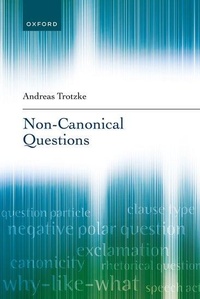
Non-Canonical Questions
Published on 16. November 2023
Book
Hardback
224 pages
978-0-19-287228-9 (ISBN)
Description
This book is the first to present a comprehensive theory of non-canonical questions, those question types that do not (only) request information from the addressee, but rather (additionally) tell us something about the speaker's epistemic and/or emotional state, such as can't-find-the-value questions, echo questions, rhetorical questions, and surprise questions. While much recent research has explored the formal semantics and the phonetics and phonology of both canonical and non-canonical questions, the literature is still lacking a comprehensive account from a syntax-pragmatics perspective that brings together the multiple findings and strands of research from the last twenty years.
The standard view in the syntax-pragmatics literature is that most special interpretations of non-canonical questions involve syntactic projections at or even above the level of illocutionary force. In this work, Andreas Trotzke argues that this approach is a mistake, and proposes a new alternative theory of non-canonical questions in which both their special pragmatics and their syntax, as well as in many cases their emotive component, can be derived solely from propositional-level operators that do not affect the illocutionary level of utterances and can be found across illocutionary forces. This account dramatically simplifies the syntactic analysis of non-canonical questions and is also able to capture some previously unobserved data in the discourse behavior of those question types.
The standard view in the syntax-pragmatics literature is that most special interpretations of non-canonical questions involve syntactic projections at or even above the level of illocutionary force. In this work, Andreas Trotzke argues that this approach is a mistake, and proposes a new alternative theory of non-canonical questions in which both their special pragmatics and their syntax, as well as in many cases their emotive component, can be derived solely from propositional-level operators that do not affect the illocutionary level of utterances and can be found across illocutionary forces. This account dramatically simplifies the syntactic analysis of non-canonical questions and is also able to capture some previously unobserved data in the discourse behavior of those question types.
Reviews / Votes
Adopting a syntactic approach, Andreas Trotzke provides a detailed account of all the main types of non-canonical questions - in situ questions, declarative questions, exclamatory questions - from a crosslinguistic perspective. Teasing apart emphasis and illocutionary force, he generalizes the role of emotional intensity and views emphatic word order as the expression of a propositional attitude that does not affect the illocutionary level. Interestingly, his demonstration encompasses the discourse effects of non-canonical questions, which are possibly used either as first moves or as second moves via pragmatic inferences. The book is a valuable addition to the literature on questions and non-canonicity, providing a wealth of information on indirect and mixed speech acts, and on the syntax-pragmatics interface. * Agnes Celle, Universite de Paris * This book offers a fresh, comprehensive, and crosslinguistically well-grounded analysis of non-canonical questions, providing an in-depth investigation of both the syntactic and the pragmatic factors involved; the author also sketches a new framework encompassing the defining properties of non-canonical questions at the syntax-pragmatics interface by exploring the role of emotional intensity and expressivity and their linguistic encoding. This work represents a significant contribution to our understanding of the grammatical representation of the pragmatic dimension of human language, with interesting implications for the theory of speech acts. * Nicola Munaro, Ca' Foscari University of Venice * The proposal in this monograph and many of the proposals for high left-peripheral speech act syntax proposals do complementary work. This, I feel, is one of the true contributions of the monograph-that it highlights different levels at which speaker perspective can be introduced in the syntax, an observation from which we can buildtypologies of how speaker perspective is expressed and also make predictions about how different aspects of speaker perspective interact with prosody, pragmatic interpretation and even gesture. Another clear strength of the work is its careful use of experimental work to supportclaims made about the use in context of different utterances to inform the line drawn between syntax and pragmatics, which feeds the proposal of clause-level expressive projections. * Rebecca Woods, English Language and Linguistics *More details
Language
English
Place of publication
Oxford
United Kingdom
Target group
College/higher education
Product notice
sewn/stitched
Cloth over boards
Dimensions
Height: 229 mm
Width: 160 mm
Thickness: 28 mm
Weight
476 gr
ISBN-13
978-0-19-287228-9 (9780192872289)
Copyright in bibliographic data and cover images is held by Nielsen Book Services Limited or by the publishers or by their respective licensors: all rights reserved.
Schweitzer Classification
Other editions
Additional editions
Andreas Trotzke
Non-Canonical Questions
E-Book
10/2023
1st Edition
OUP eBook
€74.99
Available for download
Person
Andreas Trotzke is Professor in the Department of Linguistics at the University of Konstanz. His areas of expertise include syntax, pragmatics, and language education. He has been awarded several Invited Professorships and Visiting Scholarships, among them a 1-year scholarship at Stanford University (2016-2017), the prestigious Chair 2017 Empirical Foundations of Linguistics at Universite Sorbonne Paris Cite/CNRS, and an IDEX Professorship (1re classe) at the Universite de Bordeaux. He is the co-editor, with Xavier Villalba, of Expressive Meanings Across Linguistic Levels and Frameworks (OUP, 2021).
Content
Part I. Introduction to non-canonical questions
1: Introduction
2: Key concepts in the study of questions
3: A typology of non-canonical questions
Part II. The syntax of non-canonical questions
4: Non-canonical word order
5: Non-canonical wh-elements
6: Non-canonicity via modal particles
Part III. The pragmatics of non-canonical questions
7: Non-canonical questions as first moves in a dialogue
8: Non-canonical questions as second moves in a dialogue
Part IV. A new framework for non-canonical questions
9: Emotional intensities in non-canonical questions
10: Non-canonical questions, expressivity, and the model of communication
References
Index
1: Introduction
2: Key concepts in the study of questions
3: A typology of non-canonical questions
Part II. The syntax of non-canonical questions
4: Non-canonical word order
5: Non-canonical wh-elements
6: Non-canonicity via modal particles
Part III. The pragmatics of non-canonical questions
7: Non-canonical questions as first moves in a dialogue
8: Non-canonical questions as second moves in a dialogue
Part IV. A new framework for non-canonical questions
9: Emotional intensities in non-canonical questions
10: Non-canonical questions, expressivity, and the model of communication
References
Index