

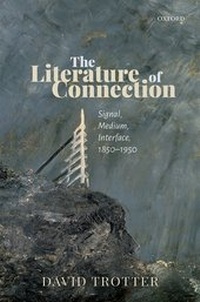
The Literature of Connection
Signal, Medium, Interface, 1850-1950
Published on 11. June 2020
Book
Hardback
294 pages
978-0-19-885047-2 (ISBN)
Description
This book is about some of the ways in which the world got ready to be connected, long before the advent of the technologies and the concentrations of capital necessary to implement a global 'network society'. It investigates the prehistory not of the communications 'revolution' brought about by advances in electronic digital computing from 1950 onwards, but of the principle of connectivity which was to provide that revolution with its justification and rallying-cry. Connectivity's core principle is that what matters most in any act of telecommunication, and sometimes all that matters, is the fact of its having happened. During the nineteenth century, the principle gained steadily increasing traction by means not only of formal systems such as the telegraph, but of an array of improvised methods and signalling devices. These methods and devices fulfilled not just an ever more urgent need, but a fundamental recurring desire, for near-instantaneous real-time communication at a distance. Connectivity became an end in itself: a complex, vivid, unpredictable romance woven through the enduring human desire and need for remote intimacy. Its magical enhancements are the stuff of tragedy, comedy, satire, elegy, lyric, melodrama, and plain description; of literature, in short.
The book develops the concepts of signal, medium, and interface to offer, in its first part, an alternative view of writing in Britain from George Eliot and Thomas Hardy to D.H. Lawrence, Hope Mirrlees, and Katherine Mansfield; and, in its second, case-studies of European and African-American fiction, and of interwar British cinema, designed to open the topic up for further enquiry.
The book develops the concepts of signal, medium, and interface to offer, in its first part, an alternative view of writing in Britain from George Eliot and Thomas Hardy to D.H. Lawrence, Hope Mirrlees, and Katherine Mansfield; and, in its second, case-studies of European and African-American fiction, and of interwar British cinema, designed to open the topic up for further enquiry.
Reviews / Votes
[T]his is a fascinating examination of how we communicate with Trotter's humour and the chapters on signalling being the stand-out aspects of this work. * H-F Dessain, Bristish Association for Victorian Students * Dazzling in its command of both history and literature, The Literature of Connection accomplishes its purpose, which, as Trotter writes in the conclusion, is "to demonstrate that the world was ready-indeed eager-to be connected long before the arrival of the technologies" needed to accomplish a "culture of connectivity" (p. 235). Symbols of restriction and freedom, from signal fires and semaphore on English coasts to airplanes conveying Black airmen, communicate through untold miles and through spaces measured only by human voices speaking face-to-face. * L. A. Brewer, CHOICE *More details
Language
English
Place of publication
Oxford
United Kingdom
Target group
Professional and scholarly
Illustrations
7 Illustrations
Dimensions
Height: 241 mm
Width: 164 mm
Thickness: 24 mm
Weight
622 gr
ISBN-13
978-0-19-885047-2 (9780198850472)
Copyright in bibliographic data and cover images is held by Nielsen Book Services Limited or by the publishers or by their respective licensors: all rights reserved.
Schweitzer Classification
Other editions
Additional editions
E-Book
06/2020
1st Edition
OUP eBook
€19.49
Available for download
E-Book
06/2020
1st Edition
OUP eBook
€20.99
Available for download
Person
David Trotter is an Emeritus Professor of English literature at the University of Cambridge, and Fellow of the British Academy. He has written widely about nineteenth- and twentieth-century literature and culture, and about the history of theory of media.
Content
Introduction
Part I: British Literature: Victorian to Modernist
1: The Telegraphic Principle in Nineteenth-Century Fiction
2: The Interface as Cultural Form: Conrad's Sea Captains
3: After Electromagnetism
4: Starry Sky: Wyndham Lewis and Mina Loy
5: Giving the Sign: Katherine Mansfield's Stories
Part II: Case-Studies
6: Kafka's Strindberg
7: Women Spies
8: Flying Africans, Black Pilots
Conclusion
Part I: British Literature: Victorian to Modernist
1: The Telegraphic Principle in Nineteenth-Century Fiction
2: The Interface as Cultural Form: Conrad's Sea Captains
3: After Electromagnetism
4: Starry Sky: Wyndham Lewis and Mina Loy
5: Giving the Sign: Katherine Mansfield's Stories
Part II: Case-Studies
6: Kafka's Strindberg
7: Women Spies
8: Flying Africans, Black Pilots
Conclusion