

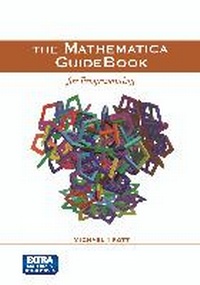
The Mathematica GuideBook for Programming
1st Edition
Published on 2. January 2014
Book
Paperback/Softback
XXXVIII, 1028 pages
978-1-4612-6421-7 (ISBN)
Description
This comprehensive, detailed reference provides readers with both a working knowledge of Mathematica in general and a detailed knowledge of the key aspects needed to create the fastest, shortest, and most elegant implementations possible. It gives users a deeper understanding of Mathematica by instructive implementations, explanations, and examples from a range of disciplines at varying levels of complexity. The three volumes -- Programming, Graphics, and Mathematics, total 3,000 pages and contain more than 15,000 Mathematica inputs, over 1,500 graphics, 4,000+ references, and more than 500 exercises.
This first volume begins with the structure of Mathematica expressions, the syntax of Mathematica, its programming, graphic, numeric and symbolic capabilities. It then covers the hierarchical construction of objects out of symbolic expressions, the definition of functions, the recognition of patterns and their efficient application, program flows and program structuring, and the manipulation of lists.
An indispensible resource for students, researchers and professionals in mathematics, the sciences, and engineering.
This first volume begins with the structure of Mathematica expressions, the syntax of Mathematica, its programming, graphic, numeric and symbolic capabilities. It then covers the hierarchical construction of objects out of symbolic expressions, the definition of functions, the recognition of patterns and their efficient application, program flows and program structuring, and the manipulation of lists.
An indispensible resource for students, researchers and professionals in mathematics, the sciences, and engineering.
Reviews / Votes
From the reviews: "This volume is the first one in a series of four books on the Mathematica programming language. It is best suited for those who ... want to learn the sophisticated tricks of the advanced programming and to use Mathematica up to its full capacity. ... The book addresses many features of human-computer interaction. ... This book is one of the most valuable sources for the advanced users of Mathematica. ... all the science/engineering/computer science/mathematics libraries should have this book and its companion volumes." (Matti Vuorinen, Zentralblatt MATH, Vol. 1080, 2006) "The Mathematica GuideBook for Programming provided this reviewer with insights into solving and visualizing problems by using Mathematica ... . Its wealth of exercises, annotated solutions and integrated bibliographic references should make this set a valuable part of the library of any Mathematica user. I highly recommend it." (Marvin Schaefer, MathDL, August, 2006) "On the whole, the programming GuideBook provides a comprehensive, step-by-step development of Mathematica programming capabilities and contains an impressive collection of examples and worked exercises. Key Mathematica functions are discussed in detail, using interesting examples and put to the test in real programs." (Willy Hereman, SIAM Review, Vol. 47 (4), 2005)More details
Product info
Paperback
Edition
2004
Language
English
Place of publication
New York, NY
United States
Target group
Professional/practitioner
Illustrations
biography
Dimensions
Height: 256 mm
Width: 174 mm
Thickness: 60 mm
Weight
1866 gr
ISBN-13
978-1-4612-6421-7 (9781461264217)
DOI
10.1007/978-1-4419-8503-3
Schweitzer Classification
Other editions
Additional editions
Michael Trott
The Mathematica GuideBook for Programming
E-Book
12/2013
Springer
€69.54
Available for download
Michael Trott
The Mathematica GuideBook for Programming
Book
10/2004
1st Edition
Springer
€96.29
Shipment within 5-7 days
Content
I Introduction: *Remarks *Basics of Mathematica as a Programming Language *Introductory Examples *What Computer Algebra and Mathematica 4.0 Can and Cannot Do Exercises Solutions References
II Structure of Mathematica Expressions: *Remarks *Expressions *Simple Expressions *Nested Expressions *Manipulating numbers Exercises Solutions References
III Definitions and Properties of Functions: *Remarks *Definition and clearing of simple functions *Options and Defaults *Attributes of Functions *Downvalues and Upvalues *Functions that Remember Their Values *Functions in the x-Calculus *Repeated Application of Functions *Functions of Functions Exercises Solutions References
IV Meta-Mathematica: *Remarks *Information on Commands *Control over Running Calculations and Resources *The $-Commands *Communication and Interaction with the Outside *Debugging *Localization of Variable Names *The Process of Calculation Exercises Solutions References
V Replacement Rules and Related Matters: *Remarks *Boolean Functions *Patterns *Replacement Rules Exercises Solutions References
VI Operations on List, and Linear Algebra: *Remarks *Creating Lists * Representation of Lists *Manipulating on Single Lists *Operations with Several Lists or with Nested Lists *Mathematical Operations with Matrices *Top-ten Built-in Commands Exercises Solutions References Index
II Structure of Mathematica Expressions: *Remarks *Expressions *Simple Expressions *Nested Expressions *Manipulating numbers Exercises Solutions References
III Definitions and Properties of Functions: *Remarks *Definition and clearing of simple functions *Options and Defaults *Attributes of Functions *Downvalues and Upvalues *Functions that Remember Their Values *Functions in the x-Calculus *Repeated Application of Functions *Functions of Functions Exercises Solutions References
IV Meta-Mathematica: *Remarks *Information on Commands *Control over Running Calculations and Resources *The $-Commands *Communication and Interaction with the Outside *Debugging *Localization of Variable Names *The Process of Calculation Exercises Solutions References
V Replacement Rules and Related Matters: *Remarks *Boolean Functions *Patterns *Replacement Rules Exercises Solutions References
VI Operations on List, and Linear Algebra: *Remarks *Creating Lists * Representation of Lists *Manipulating on Single Lists *Operations with Several Lists or with Nested Lists *Mathematical Operations with Matrices *Top-ten Built-in Commands Exercises Solutions References Index