

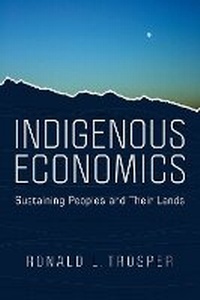
Indigenous Economics
Sustaining Peoples and Their Lands
Published on 23. August 2022
Book
Paperback/Softback
272 pages
978-0-8165-3345-9 (ISBN)
Description
What does "development" mean for Indigenous peoples? Indigenous Economics lays out an alternative path showing that conscious attention to relationships among humans and the natural world creates flourishing social-ecological economies.
Economist Ronald L. Trosper draws on examples from North and South America, Aotearoa/New Zealand, and Australia to argue that Indigenous worldviews centering care and good relationships provide critical and sustainable economic models in a world under increasing pressure from biodiversity loss and climate change. He explains the structure of relational Indigenous economic theory, providing principles based on his own and others' work with tribal nations and Indigenous communities. Trosper explains how sustainability is created at every level when relational Indigenous economic theory is applied-micro, meso, and macro.
Good relationships support personal and community autonomy, replacing the individualism/collectivism dichotomy with relational leadership and entrepreneurship. Basing economies on relationships requires changing governance from the top-down approaches of nation-states and international corporations; instead, each community creates its own territorial relationships, creating plurinational relational states. This book offers an important alternative to classic economic theory. In Indigenous Economics, support for Indigenous communities' development and Indigenous peoples' well-being go hand-in-hand.
Economist Ronald L. Trosper draws on examples from North and South America, Aotearoa/New Zealand, and Australia to argue that Indigenous worldviews centering care and good relationships provide critical and sustainable economic models in a world under increasing pressure from biodiversity loss and climate change. He explains the structure of relational Indigenous economic theory, providing principles based on his own and others' work with tribal nations and Indigenous communities. Trosper explains how sustainability is created at every level when relational Indigenous economic theory is applied-micro, meso, and macro.
Good relationships support personal and community autonomy, replacing the individualism/collectivism dichotomy with relational leadership and entrepreneurship. Basing economies on relationships requires changing governance from the top-down approaches of nation-states and international corporations; instead, each community creates its own territorial relationships, creating plurinational relational states. This book offers an important alternative to classic economic theory. In Indigenous Economics, support for Indigenous communities' development and Indigenous peoples' well-being go hand-in-hand.
More details
Language
English
Place of publication
Tucson
United States
Target group
Professional and scholarly
Illustrations
8 tables
Dimensions
Height: 229 mm
Width: 152 mm
Thickness: 17 mm
Weight
363 gr
ISBN-13
978-0-8165-3345-9 (9780816533459)
Copyright in bibliographic data and cover images is held by Nielsen Book Services Limited or by the publishers or by their respective licensors: all rights reserved.
Schweitzer Classification
Other editions
Additional editions
E-Book
08/2022
1st Edition
University of Arizona Press
€81.99
Available for download
Content
Contents
Preface and Acknowledgments
1. Living Well by Developing Relationships
2. Relationships and Persons
3. Relationships Build Indigenous Identity
4. Territory
5. Common Pool and Public Goods
6. Sustainability and Relational Leadership
7. Relational Entrepreneurship
Afterword: Two Approaches to Economics
References
Index
Preface and Acknowledgments
1. Living Well by Developing Relationships
2. Relationships and Persons
3. Relationships Build Indigenous Identity
4. Territory
5. Common Pool and Public Goods
6. Sustainability and Relational Leadership
7. Relational Entrepreneurship
Afterword: Two Approaches to Economics
References
Index