

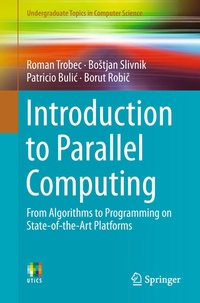
Introduction to Parallel Computing
Description
Advancements in microprocessor architecture, interconnection technology, and software development have fueled rapid growth in parallel and distributed computing. However, this development is only of practical benefit if it is accompanied by progress in the design, analysis and programming of parallel algorithms.
This concise textbook provides, in one place, three mainstream parallelization approaches, Open MPP, MPI and OpenCL, for multicore computers, interconnected computers and graphical processing units. An overview of practical parallel computing and principles will enable the reader to design efficient parallel programs for solving various computational problems on state-of-the-art personal computers and computing clusters.
Many examples and exercises support the exposition.
More details
Other editions
Additional editions
Persons
Other Springer titles by the same authors include The Foundations of Computability Theory, Application and Multidisciplinary Aspects of Wireless Sensor Networks: Concepts, Integration, and Case Studies, and Parallel Computing: Numerics, Applications, and Trends.
Content
Why Do We Need Parallel Programming
Overview of Parallel Systems
Part II: Programming
Programming Multi-Core and Shared Memory Multiprocessors Using OpenMP
MPI Processes and Messaging
OpenCL for Massively Parallel Graphic Processors
Part III: Engineering
Engineering: Parallel Computation of the Number p
Engineering: Parallel Solution of 1-D Heat Equation
Engineering: Parallel Implementation of Seam Carving
Final Remarks and Perspectives
Appendix A: Hints for Making Your Computer a Parallel Machine