

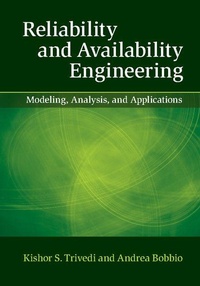
Reliability and Availability Engineering
Modeling, Analysis, and Applications
Published on 3. August 2017
Book
Hardback
726 pages
978-1-107-09950-0 (ISBN)
Description
Do you need to know what technique to use to evaluate the reliability of an engineered system? This self-contained guide provides comprehensive coverage of all the analytical and modeling techniques currently in use, from classical non-state and state space approaches, to newer and more advanced methods such as binary decision diagrams, dynamic fault trees, Bayesian belief networks, stochastic Petri nets, non-homogeneous Markov chains, semi-Markov processes, and phase type expansions. Readers will quickly understand the relative pros and cons of each technique, as well as how to combine different models together to address complex, real-world modeling scenarios. Numerous examples, case studies and problems provided throughout help readers put knowledge into practice, and a solutions manual and Powerpoint slides for instructors accompany the book online. This is the ideal self-study guide for students, researchers and practitioners in engineering and computer science.
Reviews / Votes
'This book should be on the desk of any university teacher, any engineer and anybody studying the dependability of complex computing systems or communication networks. It is about 700 pages and is quite complete since it covers all the aspects of the dependability evaluation of such systems ... There are not only numerous examples and problems but a part of the book is dedicated to case studies providing the modeling of several real-life systems. Moreover all the chapters contain a quite interesting section for further reading. It is, to the best of my knowledge, the only book dealing so thoroughly and in detail with this wide subject.' Bruno Sericola, Reliability Engineering and System Safety 'The authors have produced an impressive volume, which consists of all existing methods of reliability and availability modeling with complete mathematical details and relevant algorithms. As one would expect from these authors, all mathematical concepts are illustrated using numerous examples and some examples are continued through multiple chapters to show the application of different techniques on the same basic example. Many (unsolved) problems are provided to allow readers to practice on their own ... It can be used as a textbook for a course on reliability and as a reference book for researchers and practicing engineers.' Veena Mendiratta, INFORMS 'This is a very thorough and worthwhile book that can assist engineers and researchers to assess system reliability and availability and can serve as a valuable resource to educators in the field.' Ilias Iliadis, Statistics in Society Series A '... Reliability and Availability Engineering is an excellent book that puts all the aspects of the dependability engineering, particularly, theoretical models, analysis methods, and practical applications, in one place. It is bound to become an indispensable guide and reference for a broad range of students, researchers, and practicing engineers interested in scientific studies and the practice of dependability engineering.' Xiwei Qiu and Yuanshun Dai, International Journal of Performability EngineeringMore details
Language
English
Place of publication
Cambridge
United Kingdom
Target group
Professional and scholarly
Dimensions
Height: 250 mm
Width: 175 mm
Thickness: 43 mm
Weight
1417 gr
ISBN-13
978-1-107-09950-0 (9781107099500)
Copyright in bibliographic data and cover images is held by Nielsen Book Services Limited or by the publishers or by their respective licensors: all rights reserved.
Schweitzer Classification
Other editions
Additional editions
E-Book
08/2017
Cambridge University Press
€67.99
Available for download
Kishor S. Trivedi | Andrea Bobbio
Reliability and Availability Engineering
Modeling, Analysis, and Applications
E-Book
07/2017
Cambridge University Press
€79.99
Available for download
Persons
Kishor S. Trivedi is a Professor of Electrical and Computer Engineering at Duke University, North Carolina, and a Life Fellow of the Institute of Electrical and Electronics Engineers (IEEE) and a recipient of the IEEE Computer Society's Technical Achievement Award. Andrea Bobbio is Professor of Computer Science in the Dipartimento di Scienze e Innovazione Tecnologica at the Universit... degli Studi del Piemonte Orientale, Italy, and a senior member of Institute of Electrical and Electronics Engineers (IEEE).
Content
Part I. Introduction: 1. Introduction; 2. Dependability evaluation; 3. Dependability metrics defined on a single unit; Part II. Non-State-Space Models (Combinatorial Models): 4. Reliability block diagram; 5. Network reliability; 6. Fault tree analysis; 7. State enumeration; 8. Dynamic redundancy; Part III. State-Space Models with Exponential Distributions: 9. Continuous time Markov chain: availability models; 10. Continuous time Markov chain: reliability models; 11. Continuous time Markov chain: queueing systems; 12. Petri nets; Part IV. State-Space Models with Non-Exponential Distributions: 13. Non-homogeneous CTMC; 14. Semi-Markov and Markov regenerative models; 15. Phase type expansion; Part V. Multi-Level Models; 16. Hierarchical models; 17. Fixed-point iteration; Part VI. Case Studies: 18. Case studies.