

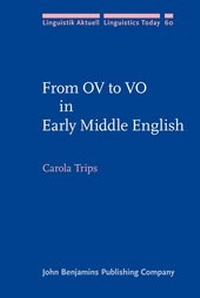
From OV to VO in Early Middle English
Published on 13. December 2002
Book
Hardback
359 pages
978-90-272-2781-2 (ISBN)
Description
This monograph answers the question of why English changed from an OV to a VO language on the assumption that this change is due to intensive language contact with Scandinavian. It shows for the first time that the English language was much more heavily influenced by Scandinavian than assumed before, i.e., northern Early Middle English texts clearly show Scandinavian syntactic patterns like stylistic fronting that can only be found today in the Modern Scandinavian languages. Thus, it sheds new light on the force of language contact in that it shows that a language can be heavily influenced through contact with another language in such a way that it affects deeper levels of language. It further gives an introduction to working with the Penn-Helsinki-Parsed Corpus of Middle English II (PPCMEII). It discusses the texts included in the corpus, it describes the format of the texts, and it explains how to search the corpus with the tool called Corpus Search. The book targets researchers in diachronic syntax, comparative syntax and in general linguists working in the field of generative syntax. It can further be used as an introduction to working with the PPCMEII.
More details
Series
Language
English
Place of publication
Amsterdam
Netherlands
Target group
Professional and scholarly
Dimensions
Height: 245 mm
Width: 164 mm
Weight
825 gr
ISBN-13
978-90-272-2781-2 (9789027227812)
Copyright in bibliographic data and cover images is held by Nielsen Book Services Limited or by the publishers or by their respective licensors: all rights reserved.
Schweitzer Classification
Other editions
Additional editions
Carola Trips
From OV to VO in Early Middle English
E-Book
12/2002
1st Edition
John Benjamins Publishing Company
€162.99
Available for download
Person
Content
1. Language abbreviations; 2. Acknowledgments; 3. 1. Introduction; 4. 2. The dialects of Middle English; 5. 3. Syntactic change; 6. 4. Word order change in Early Middle English; 7. 5. Object movement; 8. 6. V2 and cliticisation of subject pronouns; 9. 7. Stylistic fronting; 10. 8. Summary and conclusions; 11. Appendices; 12. References; 13. Index