

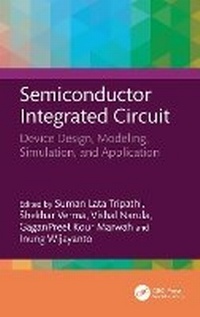
Semiconductor Integrated Circuit
Device Design, Modeling, Simulation, and Application
1st Edition
Will be published approx. on 6. November 2026
Book
Hardback
424 pages
978-1-041-08218-7 (ISBN)
Description
This book covers advanced techniques and tools for electronic design automation, low-power integrated circuit design techniques, Internet of Things-enabled energy systems, and analog and radio frequency applications.
Features:
Discusses advanced fabrication methods, nanofabrication techniques, and the use of novel materials like graphene, and carbon nanotubes in electronic systems.
Covers efficient design algorithms, integrated techniques, and tools for designing innovative devices for future technologies and applications.
Illustrates thrust areas of semiconductor integrated circuit design such as low-power logic, analog circuits, interconnects, bulk memories, and energy harvesting devices.
Explains low-power energy harvesting techniques, their applications, and efficient design of optoelectronic and energy harvesting devices.
Illustrates power reduction techniques using algorithms, and the use of 2D materials for the design of low-power devices.
The text is primarily written for senior undergraduates, graduate students, and academic researchers in electrical engineering, electronics and communication engineering, integrated circuits, semiconductor devices, and computer engineering.
Features:
Discusses advanced fabrication methods, nanofabrication techniques, and the use of novel materials like graphene, and carbon nanotubes in electronic systems.
Covers efficient design algorithms, integrated techniques, and tools for designing innovative devices for future technologies and applications.
Illustrates thrust areas of semiconductor integrated circuit design such as low-power logic, analog circuits, interconnects, bulk memories, and energy harvesting devices.
Explains low-power energy harvesting techniques, their applications, and efficient design of optoelectronic and energy harvesting devices.
Illustrates power reduction techniques using algorithms, and the use of 2D materials for the design of low-power devices.
The text is primarily written for senior undergraduates, graduate students, and academic researchers in electrical engineering, electronics and communication engineering, integrated circuits, semiconductor devices, and computer engineering.
More details
Language
English
Place of publication
London
United Kingdom
Publishing group
Taylor & Francis Ltd
Target group
College/higher education
Professional and scholarly
Academic, Postgraduate, and Undergraduate Advanced
Illustrations
133 s/w Abbildungen, 13 s/w Photographien bzw. Rasterbilder, 120 s/w Zeichnungen, 39 s/w Tabellen
39 Tables, black and white; 120 Line drawings, black and white; 13 Halftones, black and white; 133 Illustrations, black and white
Dimensions
Height: 234 mm
Width: 156 mm
ISBN-13
978-1-041-08218-7 (9781041082187)
Copyright in bibliographic data and cover images is held by Nielsen Book Services Limited or by the publishers or by their respective licensors: all rights reserved.
Schweitzer Classification
Other editions
Additional editions
Suman Lata Tripathi | Shekhar Verma | Vishal Narula
Semiconductor Integrated Circuit
Device Design, Modeling, Simulation, and Application
E-Book
approx. 11/2026
CRC Press
€238.99
Not yet available
Suman Lata Tripathi | Shekhar Verma | Vishal Narula
Semiconductor Integrated Circuit
Device Design, Modeling, Simulation, and Application
E-Book
approx. 11/2026
CRC Press
€238.99
Not yet available
Persons
Suman Lata Tripathi is working as Professor in Department of Electronics and Telecommunication Engineering, Symbiosis Institute of Technology, Symbiosis International (Deemed University), Pune. Her area of expertise includes microelectronics device modelling and characterization, low power VLSI circuit design, VLSI design of testing, and advanced FET design for IoT, Embedded System Design, reconfigurable architecture with FPGAs and biomedical applications.
Shekhar Verma is working as an Associate Professor at Lovely Professional University and has more than thirteen years of experience in academics. His main research interest includes Modelling and Simulation of semiconductor devices & Modelling, designing and simulation of Low power VLSI Digital & Analog based circuits.
Vishal Narula is working as an Assistant Professor in the Department of Centre for Research Degree Programmes with Parent discipline as VLSI Design at Lovely Professional University, Phagwara, Punjab, India. His main research interest includes Modelling and Simulation of semiconductor devices & Modelling, designing and simulation of Low power VLSI Digital & Analog based circuits.
GaganPreet Kaur Marwah is working as an Associate Professor in the Department of Centre for Research Degree Programmes, Lovely Professional University, Phagwara, Punjab, India. Her research areas include Embedded Systems, IoT, IIoT, Wireless Communications, Artificial Intelligence and Machine Learning.
Inung Wijayanto is working as an Associate Professor at Telkom University and has 14 years of experience in academics and research. His current research interest includes biomedical signal and image processing and analysis, EEG and ECG signals processing, audio and image processing, computer vision, and medical instrumentation.
Shekhar Verma is working as an Associate Professor at Lovely Professional University and has more than thirteen years of experience in academics. His main research interest includes Modelling and Simulation of semiconductor devices & Modelling, designing and simulation of Low power VLSI Digital & Analog based circuits.
Vishal Narula is working as an Assistant Professor in the Department of Centre for Research Degree Programmes with Parent discipline as VLSI Design at Lovely Professional University, Phagwara, Punjab, India. His main research interest includes Modelling and Simulation of semiconductor devices & Modelling, designing and simulation of Low power VLSI Digital & Analog based circuits.
GaganPreet Kaur Marwah is working as an Associate Professor in the Department of Centre for Research Degree Programmes, Lovely Professional University, Phagwara, Punjab, India. Her research areas include Embedded Systems, IoT, IIoT, Wireless Communications, Artificial Intelligence and Machine Learning.
Inung Wijayanto is working as an Associate Professor at Telkom University and has 14 years of experience in academics and research. His current research interest includes biomedical signal and image processing and analysis, EEG and ECG signals processing, audio and image processing, computer vision, and medical instrumentation.
Content
1. Introduction to TFET Design & Simulation. 2. Optimization of Circuit Designing by Using Machine Learning Techniques. 3. FinFET Technology: Device Physics, Fabrication, and Performance Evaluation. 4. Machine Learning-Driven Optimization of Circuit Design: Techniques and Applications. 5. Analyzing the Performance of Carry Select Adder & Vedic Multiplier using Reversible Gates. 6. Exploring GAAFET Technologies for High-Performance Counter Design. 7. The Future of Electronics: 2D-FET with TMDs and Black Phosphorus. 8. Smart Memory Architecture with Built-in Fault Tolerance for Reliable Distributed Systems. 9. Eco-friendly semiconductor device design for sustainable systems: Low-waste architectures with degradable components. 10. Low-power energy harvesting techniques and its applications. 11. Advancing Microwave and RF Devices for Enhanced Sustainability via Cognitive Radio and Dynamic Spectrum Sharing. 12. IoT-Enabled Low-Cost Data Acquisition System Using STM32 and LabVIEW Visualization. 13. Machine Learning Techniques in Circuit Design & Optimisation. 14. Electronic Devices for Healthcare IoT Platforms. 15. Electronic Devices for Healthcare and IoT Application. 16. IoT-enabled Energy Systems: Integration and Optimization for Sustainable Solutions. 17. Power Optimization for Dynamic CMOS Tristate Buffer Using Dual Threshold Voltage Technique and Keeper Circuit with 18nm FinFET