

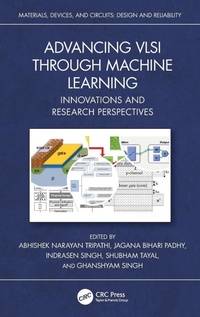
Advancing VLSI through Machine Learning
Innovations and Research Perspectives
1st Edition
Published on 30. March 2025
Book
Hardback
254 pages
978-1-032-77428-2 (ISBN)
Description
This book explores the synergy between very large-scale integration (VLSI) and machine learning (ML) and its applications across various domains. It investigates how ML techniques can enhance the design and testing of VLSI circuits, improve power efficiency, optimize layouts, and enable novel architectures.
This book bridges the gap between VLSI and ML, showcasing the potential of this integration in creating innovative electronic systems, advancing computing capabilities, and paving the way for a new era of intelligent devices and technologies. Additionally, it covers how VLSI technologies can accelerate ML algorithms, enabling more efficient and powerful data processing and inference engines. It explores both hardware and software aspects, covering topics like hardware accelerators, custom hardware for specific ML tasks, and ML-driven optimization techniques for chip design and testing.
This book will be helpful for academicians, researchers, postgraduate students, and those working in ML-driven VLSI.
This book bridges the gap between VLSI and ML, showcasing the potential of this integration in creating innovative electronic systems, advancing computing capabilities, and paving the way for a new era of intelligent devices and technologies. Additionally, it covers how VLSI technologies can accelerate ML algorithms, enabling more efficient and powerful data processing and inference engines. It explores both hardware and software aspects, covering topics like hardware accelerators, custom hardware for specific ML tasks, and ML-driven optimization techniques for chip design and testing.
This book will be helpful for academicians, researchers, postgraduate students, and those working in ML-driven VLSI.
More details
Series
Language
English
Place of publication
London
United Kingdom
Publishing group
Taylor & Francis Ltd
Target group
College/higher education
Professional and scholarly
General, Postgraduate, Professional Reference, and Undergraduate Advanced
Illustrations
141 s/w Abbildungen, 17 s/w Photographien bzw. Rasterbilder, 124 s/w Zeichnungen, 27 s/w Tabellen
27 Tables, black and white; 124 Line drawings, black and white; 17 Halftones, black and white; 141 Illustrations, black and white
Dimensions
Height: 240 mm
Width: 161 mm
Thickness: 19 mm
Weight
567 gr
ISBN-13
978-1-032-77428-2 (9781032774282)
Copyright in bibliographic data and cover images is held by Nielsen Book Services Limited or by the publishers or by their respective licensors: all rights reserved.
Schweitzer Classification
Other editions
Additional editions
Abhishek Narayan Tripathi | Jagana Bihari Padhy | Indrasen Singh
Advancing VLSI through Machine Learning
Innovations and Research Perspectives
Book
approx. 07/2026
1st Edition
CRC Press
€66.00
Not yet published
Abhishek Narayan Tripathi | Jagana Bihari Padhy | Indrasen Singh
Advancing VLSI through Machine Learning
Innovations and Research Perspectives
E-Book
03/2025
1st Edition
CRC Press
€73.99
Available for download
Abhishek Narayan Tripathi | Jagana Bihari Padhy | Indrasen Singh
Advancing VLSI through Machine Learning
Innovations and Research Perspectives
E-Book
03/2025
1st Edition
CRC Press
€73.99
Available for download
Persons
Dr. Abhishek Narayan Tripathi is currently an Assistant Professor in the Department of Micro and Nanoelectronics, School of Electronics Engineering, Vellore Institute of Technology, Vellore, Tamil Nadu, India. He holds a Ph.D. in ECE with a specialization in VLSI Design and Embedded Technology from MANIT, Bhopal. His research work includes the development of methodologies for dynamic power and leakage power estimation in FPGA and ASIC-based implementations, VLSI system design, AI, deep learning, and microprocessor architecture.
Dr. Jagana Bihari Padhy is an Assistant Professor in the Department of Embedded Technology, School of Electronics Engineering, Vellore Institute of Technology, Vellore, Tamil Nadu, India. He holds a Ph.D. in ECE with a specialization in optical wireless system design from IIIT Bhubaneswar. His research work includes the development of optical system design both in wired and wireless methodologies for the next generation of communication 5G and beyond.
Dr. Indrasen Singh is an Assistant Professor (Sr. Grade-2) in the Department of Embedded Technology, School of Electronics Engineering, Vellore Institute of Technology, Vellore, Tamil Nadu, India. His research interests are in the areas of cooperative communication, stochastic geometry, modelling of wireless networks, heterogeneous networks, millimetre wave communications, device-to-device communication, and 5G/6G communication.
Dr. Shubham Tayal is an Assistant Professor in the Department of Electronics and Communication Engineering, SR University, Warangal, India. He has more than 6 years of academic/research experience in teaching at the UG and PG levels. He received his Ph.D. in Microelectronics and VLSI Design from the National Institute of Technology, Kurukshetra; M.Tech. (VLSI Design) from YMCA University of Science and Technology, Faridabad; and B.Tech. (Electronics and Communication Engineering) from MDU, Rohtak. His research interests include simulation and modelling of multi-gate semiconductor devices, device-circuit co-design in digital/analogue domain, ML, and Internet of Things.
Prof. Ghanshyam Singh received a Ph.D. degree in Electronics Engineering from the Indian Institute of Technology, Banaras Hindu University, Varanasi, India, in 2000. At present, he is a full Professor with the Department of Electrical and Electronics Engineering, APK Campus, University of Johannesburg, South Africa. His research and teaching interests include RF/microwave engineering, millimetre/THz wave antennas and their applications in communication and imaging, next-generation communication systems (OFDM and cognitive radio), and nanophotonics. He has more than 19 years of teaching and research experience in electromagnetic/microwave engineering, wireless communication, and nanophotonics.
Dr. Jagana Bihari Padhy is an Assistant Professor in the Department of Embedded Technology, School of Electronics Engineering, Vellore Institute of Technology, Vellore, Tamil Nadu, India. He holds a Ph.D. in ECE with a specialization in optical wireless system design from IIIT Bhubaneswar. His research work includes the development of optical system design both in wired and wireless methodologies for the next generation of communication 5G and beyond.
Dr. Indrasen Singh is an Assistant Professor (Sr. Grade-2) in the Department of Embedded Technology, School of Electronics Engineering, Vellore Institute of Technology, Vellore, Tamil Nadu, India. His research interests are in the areas of cooperative communication, stochastic geometry, modelling of wireless networks, heterogeneous networks, millimetre wave communications, device-to-device communication, and 5G/6G communication.
Dr. Shubham Tayal is an Assistant Professor in the Department of Electronics and Communication Engineering, SR University, Warangal, India. He has more than 6 years of academic/research experience in teaching at the UG and PG levels. He received his Ph.D. in Microelectronics and VLSI Design from the National Institute of Technology, Kurukshetra; M.Tech. (VLSI Design) from YMCA University of Science and Technology, Faridabad; and B.Tech. (Electronics and Communication Engineering) from MDU, Rohtak. His research interests include simulation and modelling of multi-gate semiconductor devices, device-circuit co-design in digital/analogue domain, ML, and Internet of Things.
Prof. Ghanshyam Singh received a Ph.D. degree in Electronics Engineering from the Indian Institute of Technology, Banaras Hindu University, Varanasi, India, in 2000. At present, he is a full Professor with the Department of Electrical and Electronics Engineering, APK Campus, University of Johannesburg, South Africa. His research and teaching interests include RF/microwave engineering, millimetre/THz wave antennas and their applications in communication and imaging, next-generation communication systems (OFDM and cognitive radio), and nanophotonics. He has more than 19 years of teaching and research experience in electromagnetic/microwave engineering, wireless communication, and nanophotonics.
Content
Chapter 1. Optimizing Circuit Synthesis: Integrating Neural Networks and Evolutionary Algorithms for Increased Design Efficiency
Chapter 2. Study of Physical Processes Analysis and Phenomena of Insights of Trapping in the Performance Degradation in AlGaN/GaN HEMTs
Chapter 3. Framework for Design and Performance Evaluation of Memory using Memristor
Chapter 4. Innovative Design and Optimization of High-Power Amplifiers: A Comparative Study with GaN HEMT and CMOS Technologies
Chapter 5. Exploring FPGA Architecture Designs for Matrix Multiplication in Machine Learning
Chapter 6. Silicon Chip Design and Testing
Chapter 7. A Novel Deep Learning Approach for Early Brain Tumour Detection
Chapter 8. TCAD Augmented Machine Learning for the Prediction of Device Behavior and Failure Analysis
Chapter 9. Opportunities and Challenges for ML-Based FPGA Backend Flow
Chapter 10. Role of Machine Learning Applications in VLSI Design
Chapter 11. Application of Artificial Intelligence/Machine Learning in VLSI Design
Chapter 12. FinFET-Based 9T SRAM for Enhanced Performance in AI/ML Applications
Chapter 13. Power Consumption and SNM Analysis of 6T and 7T SRAM using 90nm Technology
Chapter 14. Transforming Electronics: An Extensive Analysis of Hyper-FET Technological Developments and Utilisation
Chapter 15. VLSI Realization of Smart Systems using Blockchain and Fog Computing
Chapter 2. Study of Physical Processes Analysis and Phenomena of Insights of Trapping in the Performance Degradation in AlGaN/GaN HEMTs
Chapter 3. Framework for Design and Performance Evaluation of Memory using Memristor
Chapter 4. Innovative Design and Optimization of High-Power Amplifiers: A Comparative Study with GaN HEMT and CMOS Technologies
Chapter 5. Exploring FPGA Architecture Designs for Matrix Multiplication in Machine Learning
Chapter 6. Silicon Chip Design and Testing
Chapter 7. A Novel Deep Learning Approach for Early Brain Tumour Detection
Chapter 8. TCAD Augmented Machine Learning for the Prediction of Device Behavior and Failure Analysis
Chapter 9. Opportunities and Challenges for ML-Based FPGA Backend Flow
Chapter 10. Role of Machine Learning Applications in VLSI Design
Chapter 11. Application of Artificial Intelligence/Machine Learning in VLSI Design
Chapter 12. FinFET-Based 9T SRAM for Enhanced Performance in AI/ML Applications
Chapter 13. Power Consumption and SNM Analysis of 6T and 7T SRAM using 90nm Technology
Chapter 14. Transforming Electronics: An Extensive Analysis of Hyper-FET Technological Developments and Utilisation
Chapter 15. VLSI Realization of Smart Systems using Blockchain and Fog Computing