

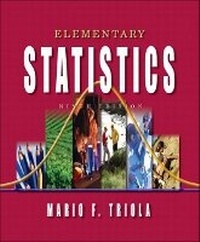
Elementary Statistics
United States Edition
9th Edition
Published on 18. June 2003
Book
Mixed media product
864 pages
978-0-201-77570-9 (ISBN)
Description
Elementary Statistics has been written for the introductory statistics course and students majoring in any field. Although the use of algebra is minimal, students should have completed at least an elementary algebra course. In many cases, underlying theory is included, but this book does not stress the mathematical rigor more suitable for mathematics majors. Triola is the #1 best seller in the market long recognized for its student-friendly pedagogy and wealth of exercises using real data. The ninth edition offers new large and small data sets, a greater emphasis on interpreting results, and improved flexible technology coverage with many examples and exercises covering a wide variety of different and interesting statistical applications.
More details
Edition
9th edition
Language
English
Place of publication
United States
Publishing group
Pearson Education (US)
Target group
Professional and scholarly
Dimensions
Height: 260 mm
Width: 262 mm
Thickness: 32 mm
Weight
1961 gr
ISBN-13
978-0-201-77570-9 (9780201775709)
Copyright in bibliographic data and cover images is held by Nielsen Book Services Limited or by the publishers or by their respective licensors: all rights reserved.
Schweitzer Classification
Other editions
New editions
Book
04/2003
9th Edition
Pearson
€59.55
Article is exhausted; no reprint
Previous edition
Mario F. Triola
Elementary Statistics
Book
07/2000
8th Edition
Pearson
€59.55
Article exhausted; check for reprint
Person
Mario F. Triola is a Professor Emeritus of Mathematics at Dutchess Community College, where he has taught statistics for over 30 years. Marty is the author of Essentials of Statistics, Elementary Statistics Using Excel, Mathematics in the Modern World, andSurvey of Mathematics. He is a co(author of Statistical Reasoning for Everyday Life, Business Statistics, and Introduction to Technical Mathematics. He designed the original STATDISK statistical software package, and he has written several manuals and workbooks for technology supporting statistics education. Outside of the classroom, Marty's consulting work includes the mathematical design of casino slot machines and fishing rods, and he has worked with attorneys in determining probabilities in paternity lawsuits, identifying salary inequities based on gender, and analyzing disputed election results. Marty has testified as an expert witness in New York State Supreme Court for an election dispute involving a former student. Marty was a recent writing team member of the Project Coalition with NASA and the American Mathematics Association of Two(Year Colleges.
When he's not working, Marty enjoys travel, golf, tennis, running, hiking, and anything that flies. He has a commercial pilot's license with an instrument rating, and has flown airplanes, helicopters, sail planes, hang gliders, and hot air balloons. His passion for flying has included parachute jumps, flying in a Goodyear blimp, and parasailing.
The Text and Academic Authors Association has awarded Mario F. Triola a "Texty" for Excellence for his work on Elementary Statistics.
When he's not working, Marty enjoys travel, golf, tennis, running, hiking, and anything that flies. He has a commercial pilot's license with an instrument rating, and has flown airplanes, helicopters, sail planes, hang gliders, and hot air balloons. His passion for flying has included parachute jumps, flying in a Goodyear blimp, and parasailing.
The Text and Academic Authors Association has awarded Mario F. Triola a "Texty" for Excellence for his work on Elementary Statistics.
Content
1. Introduction to Statistics.
Overview.
The Nature of Data.
Uses and Abuses of Statistics.
Design of Experiments.
2. Describing, Exploring, and Comparing Data.
Overview.
Summarizing Data with Frequency Tables.
Pictures of Data.
Measures of Center.
Measures of Variation.
Measures of Position.
Exploratory Data Analysis (EDA).
3. Probability.
Overview.
Fundamentals.
Addition Rule.
Multiplication Rule: Basics.
Multiplication Rule: Complements and Conditional Probability.
Probabilities Through Simulations.
Counting.
4. Probability Distributions.
Overview.
Random Variables.
Binomial Probability Distributions.
Mean, Variance, and Standard Deviation for the Binomial Distribution.
The Poisson Distribution.
5. Normal Probability Distributions.
Overview.
The Standard Normal Distribution.
Nonstandard Normal Distributions: Finding Probabilities.
Nonstandard Normal Distributions: Finding Values.
The Central Limit Theorem.
Normal Distribution as Approximation to Binomial Distribution.
Determining Normality.
6. Estimates and Sample Sizes.
Overview.
Estimating a Population Mean: Large Samples.
Estimating a Population Mean: Small Samples.
Determining Sample Size.
Estimating a Population Proportion.
Estimating a Population Variance.
7. Hypothesis Testing.
Overview.
Fundamentals of Hypothesis Testing.
Testing a Claim about a Mean: Large Samples.
Testing a Claim about a Mean: Small Samples.
Testing a Claim about a Proportion.
Testing a Claim about a Standard Deviation or Variance.
8. Inferences from Two Samples.
Overview.
Inferences about Two Means: Independent and Large Samples.
Inferences about Two Means: Matched Pairs.
Inferences about Two Proportions.
Comparing Variation in Two Samples.
Inferences about Two Means: Independent and Small Samples.
9. Correlation and Regression.
Overview.
Correlation.
Regression.
Variation and Prediction Intervals.
Multiple Regression.
Modeling.
10 Multinomial Experiments and Contingency Tables.
Overview.
Multinomial Experiments: Goodness-0f-Fit.
Contingency Tables: Independence and Homogeneity.
11. Analysis of Variance.
Overview.
One-Way ANOVA.
Two-Way ANOVA.
12. Nonparametric Statistics.
Overview.
Sign Test.
Wilcoxon Signed-Ranks Test for Matched Pairs.
Wilcoxon Rank-Sum Test for Two Independent Samples.
Kruskal-Wallis Test.
Rank Correlation.
Runs Test for Randomness.
13. Statistical Process Control.
Overview.
Control Charts for Variation and Mean.
Control Charts for Attributes.
14. Projects, Procedures, Perspectives.
Projects.
Procedure.
Perspective.
Appendices.
Appendix A: Tables.
Appendix B: Data Sets.
Appendix C: TI-83 Plus Reference.
Appendix D: Glossary.
Appendix E: Bibliography.
Appendix F: Answers to Odd-Numbered Exercises (and All Review Exercises and All Cumulative Review Exercises).
Credits.
Overview.
The Nature of Data.
Uses and Abuses of Statistics.
Design of Experiments.
2. Describing, Exploring, and Comparing Data.
Overview.
Summarizing Data with Frequency Tables.
Pictures of Data.
Measures of Center.
Measures of Variation.
Measures of Position.
Exploratory Data Analysis (EDA).
3. Probability.
Overview.
Fundamentals.
Addition Rule.
Multiplication Rule: Basics.
Multiplication Rule: Complements and Conditional Probability.
Probabilities Through Simulations.
Counting.
4. Probability Distributions.
Overview.
Random Variables.
Binomial Probability Distributions.
Mean, Variance, and Standard Deviation for the Binomial Distribution.
The Poisson Distribution.
5. Normal Probability Distributions.
Overview.
The Standard Normal Distribution.
Nonstandard Normal Distributions: Finding Probabilities.
Nonstandard Normal Distributions: Finding Values.
The Central Limit Theorem.
Normal Distribution as Approximation to Binomial Distribution.
Determining Normality.
6. Estimates and Sample Sizes.
Overview.
Estimating a Population Mean: Large Samples.
Estimating a Population Mean: Small Samples.
Determining Sample Size.
Estimating a Population Proportion.
Estimating a Population Variance.
7. Hypothesis Testing.
Overview.
Fundamentals of Hypothesis Testing.
Testing a Claim about a Mean: Large Samples.
Testing a Claim about a Mean: Small Samples.
Testing a Claim about a Proportion.
Testing a Claim about a Standard Deviation or Variance.
8. Inferences from Two Samples.
Overview.
Inferences about Two Means: Independent and Large Samples.
Inferences about Two Means: Matched Pairs.
Inferences about Two Proportions.
Comparing Variation in Two Samples.
Inferences about Two Means: Independent and Small Samples.
9. Correlation and Regression.
Overview.
Correlation.
Regression.
Variation and Prediction Intervals.
Multiple Regression.
Modeling.
10 Multinomial Experiments and Contingency Tables.
Overview.
Multinomial Experiments: Goodness-0f-Fit.
Contingency Tables: Independence and Homogeneity.
11. Analysis of Variance.
Overview.
One-Way ANOVA.
Two-Way ANOVA.
12. Nonparametric Statistics.
Overview.
Sign Test.
Wilcoxon Signed-Ranks Test for Matched Pairs.
Wilcoxon Rank-Sum Test for Two Independent Samples.
Kruskal-Wallis Test.
Rank Correlation.
Runs Test for Randomness.
13. Statistical Process Control.
Overview.
Control Charts for Variation and Mean.
Control Charts for Attributes.
14. Projects, Procedures, Perspectives.
Projects.
Procedure.
Perspective.
Appendices.
Appendix A: Tables.
Appendix B: Data Sets.
Appendix C: TI-83 Plus Reference.
Appendix D: Glossary.
Appendix E: Bibliography.
Appendix F: Answers to Odd-Numbered Exercises (and All Review Exercises and All Cumulative Review Exercises).
Credits.