

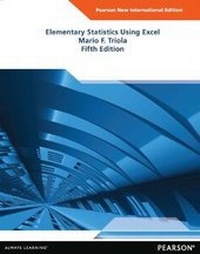
Elementary Statistics Using Excel: Pearson New International Edition
5th Edition
Published on 1. November 2013
Book
Mixed media product
912 pages
978-1-292-04176-6 (ISBN)
Description
From SAT scores to job search methods, statistics influences and shapes the world around us. Marty Triola's text continues to be the bestseller because it helps students understand the relationship between statistics and the world, bringing life to the theory and methods. Elementary Statistics raises the bar with every edition by incorporating an unprecedented amount of real and interesting data that will help instructors connect with students today, and help them connect statistics to their daily lives. The Twelfth Edition contains more than 1,800 exercises, 89% of which use real data and 85% of which are new. Hundreds of examples are included, 91% of which use real data and 84% of which are new. New coverage of Ethics in Statistics highlights new guidelines that have been established in industry. The accompanying MyStatLab(TM) online course provides users with countless opportunities to practice, plus learning tools that enhance their experience and comprehension. Instructions and displays for StatCrunch(R), Pearson's powerful online statistical software, are now integrated into the text as well as the MyStatLab course.
Elementary Statistics is part of a series that also includes an Essentials version as well as technology-specific texts, Elementary Statistics Using the TI 83/84 Calculator and Elementary Statistics Using Excel. Data sets and other resources for this series are available at our website.
Elementary Statistics is part of a series that also includes an Essentials version as well as technology-specific texts, Elementary Statistics Using the TI 83/84 Calculator and Elementary Statistics Using Excel. Data sets and other resources for this series are available at our website.
More details
Edition
5th edition
Language
English
Place of publication
Harlow
United Kingdom
Target group
College/higher education
Dimensions
Height: 276 mm
Width: 216 mm
Thickness: 34 mm
Weight
1994 gr
ISBN-13
978-1-292-04176-6 (9781292041766)
Copyright in bibliographic data and cover images is held by Nielsen Book Services Limited or by the publishers or by their respective licensors: all rights reserved.
Schweitzer Classification
Other editions
Additional editions
Mario F. Triola
Elementary Statistics Using Excel: Pearson New International Edition
Pearson New International Edition
E-Book
10/2013
1st Edition
Pearson Education Limited
€42.80
Available for download
Content
Chapter 1 Introduction to Statistics
1.1 Review and Preview
1.2 Statistical Thinking and Critical Thinking
1.3 Types of Data
1.4 Collecting Sample Data
1.5 Introduction to Excel
Chapter 2 Summarizing and Graphing
2.1 Review and Preview
2.2 Frequency Distributions
2.3 Histograms
2.4 Graphs that Enlighten and Graphs that Deceive
Chapter 3 Statistics for Describing, Exploring, and Comparing
3.1 Review and Preview
3.2 Measures of Center
3.3 Measures of Variation
3.4 Measures of Relative Standing & Boxplots
Chapter 4 Probability
4.1 Review and Preview
4.2 Basic Concepts of Probability
4.3 Addition Rule
4.4 Multiplication Rule: Basics
4.5 Multiplication Rule: Complements and Conditional Probability
4.6 Counting
4.7 Probabilities Through Simulations (on CD)
4.8 Bayes' Theorem (on CD)
Chapter 5 Discrete Probability Distributions
5.1 Review and Preview
5.2 Probability Distributions
5.3 Binomial Probability Distributions
5.4 Parameters for Binomial Distributions
5.5 Poisson Probability Distributions
Chapter 6 Normal Probability Distributions
6.1 Review and Preview
6.2 The Standard Normal Distribution
6.3 Applications of Normal Distributions
6.4 Sampling Distributions and Estimators
6.5 Central Limit Theorem
6.6 Assessing Normality
6.7 Normal as Approximation to Binomial
Chapter 7 Estimates and Sample Sizes
7.1 Review and Preview
7.2 Estimating a Population Proportion
7.3 Estimating Population Mean
7.4 Estimating Population Standard Deviation or Variance
Chapter 8 Hypothesis Testing
8.1 Review and Preview
8.2 Basics of Hypothesis Testing
8.3 Testing a Claim About a Proportion
8.4 Testing a Claim About a Mean
8.5 Testing a Claim About a Standard Deviation or Variance
Chapter 9 Inferences from Two Samples
9.1 Review and Preview
9.2 Two Proportions
9.3 Two Means: Independent Samples
9.4 Two Dependent Samples (Matched Pairs)
9.5 Two Variances or Standard Deviations
Chapter 10 Correlation and Regression
10.1 Review and Preview
10.2 Correlation
10.3 Regression
10.4 Prediction Intervals and Variation
10.5 Multiple Regression
10.6 Nonlinear Regression
Chapter 11 Goodness-of-Fit and Contingency Tables
11.1 Review and Preview
11.2 Goodness-of-Fit
11.3 Contingency Tables
Chapter 12 Analysis of Variance
12.1 Review and Preview
12.2 One-Way ANOVA
12.3 Two-Way ANOVA
Chapter 13 Nonparametric Tests
13.1 Review and Preview
13.2 Sign Test
13.3 Wilcoxon Signed Ranks Test for Matched Pairs
13.4 Wilcoxon Rank-Sum Test for Two Independent Samples
13.5 Kruskal-Wallis Test
13.6 Rank Correlation
13.7 Runs Test for Randomness
Chapter 14 Statistical Process Control
14.1 Review and Preview
14.2 Control Charts for Variation and Mean
14.3 Control Charts for Attributes
1.1 Review and Preview
1.2 Statistical Thinking and Critical Thinking
1.3 Types of Data
1.4 Collecting Sample Data
1.5 Introduction to Excel
Chapter 2 Summarizing and Graphing
2.1 Review and Preview
2.2 Frequency Distributions
2.3 Histograms
2.4 Graphs that Enlighten and Graphs that Deceive
Chapter 3 Statistics for Describing, Exploring, and Comparing
3.1 Review and Preview
3.2 Measures of Center
3.3 Measures of Variation
3.4 Measures of Relative Standing & Boxplots
Chapter 4 Probability
4.1 Review and Preview
4.2 Basic Concepts of Probability
4.3 Addition Rule
4.4 Multiplication Rule: Basics
4.5 Multiplication Rule: Complements and Conditional Probability
4.6 Counting
4.7 Probabilities Through Simulations (on CD)
4.8 Bayes' Theorem (on CD)
Chapter 5 Discrete Probability Distributions
5.1 Review and Preview
5.2 Probability Distributions
5.3 Binomial Probability Distributions
5.4 Parameters for Binomial Distributions
5.5 Poisson Probability Distributions
Chapter 6 Normal Probability Distributions
6.1 Review and Preview
6.2 The Standard Normal Distribution
6.3 Applications of Normal Distributions
6.4 Sampling Distributions and Estimators
6.5 Central Limit Theorem
6.6 Assessing Normality
6.7 Normal as Approximation to Binomial
Chapter 7 Estimates and Sample Sizes
7.1 Review and Preview
7.2 Estimating a Population Proportion
7.3 Estimating Population Mean
7.4 Estimating Population Standard Deviation or Variance
Chapter 8 Hypothesis Testing
8.1 Review and Preview
8.2 Basics of Hypothesis Testing
8.3 Testing a Claim About a Proportion
8.4 Testing a Claim About a Mean
8.5 Testing a Claim About a Standard Deviation or Variance
Chapter 9 Inferences from Two Samples
9.1 Review and Preview
9.2 Two Proportions
9.3 Two Means: Independent Samples
9.4 Two Dependent Samples (Matched Pairs)
9.5 Two Variances or Standard Deviations
Chapter 10 Correlation and Regression
10.1 Review and Preview
10.2 Correlation
10.3 Regression
10.4 Prediction Intervals and Variation
10.5 Multiple Regression
10.6 Nonlinear Regression
Chapter 11 Goodness-of-Fit and Contingency Tables
11.1 Review and Preview
11.2 Goodness-of-Fit
11.3 Contingency Tables
Chapter 12 Analysis of Variance
12.1 Review and Preview
12.2 One-Way ANOVA
12.3 Two-Way ANOVA
Chapter 13 Nonparametric Tests
13.1 Review and Preview
13.2 Sign Test
13.3 Wilcoxon Signed Ranks Test for Matched Pairs
13.4 Wilcoxon Rank-Sum Test for Two Independent Samples
13.5 Kruskal-Wallis Test
13.6 Rank Correlation
13.7 Runs Test for Randomness
Chapter 14 Statistical Process Control
14.1 Review and Preview
14.2 Control Charts for Variation and Mean
14.3 Control Charts for Attributes