

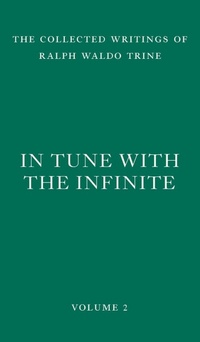
In Tune with the Infinite
Fullness of Peace, Power, and Plenty
Published on 25. March 2022
Book
Hardback
202 pages
978-1-956796-13-1 (ISBN)
Description
"Within yourself lies the cause of whatever enters into your life. To come into the full realization of your own awakened interior powers, is to be able to condition your life in exact accord with what you would have it." These words set the keynote of Trine's message in In Tune with the Infinite, in which he sets forth with simplicity and clearness the application to practical life those spiritual laws that make for the "fullness of peace, power, and plenty."
More details
Series
Language
English
Product notice
sewn/stitched
Cloth over boards
Dimensions
Height: 209 mm
Width: 132 mm
Thickness: 16 mm
Weight
340 gr
ISBN-13
978-1-956796-13-1 (9781956796131)
Copyright in bibliographic data and cover images is held by Nielsen Book Services Limited or by the publishers or by their respective licensors: all rights reserved.
Schweitzer Classification
Person
Ralph Waldo Trine (1866-1958) was an American philosophical writer associated with the New Thought movement, whose work occupies a formative place in the development of modern mind-body and spiritual philosophy. Educated at Johns Hopkins University, Trine drew upon a range of intellectual influences, including Transcendentalism, Christian ethical thought, and emerging metaphysical traditions concerned with the relationship between consciousness and lived reality.His writings are marked by a deliberate and reflective tone, emphasizing inward discipline, ethical awareness, and the ordering of thought as central to human development. Works such as In Tune with the Infinite achieved wide readership in the early twentieth century and contributed to the broader dissemination of New Thought ideas in both American and European contexts. Trine's influence can be traced in later philosophical and spiritual literature concerned with consciousness, intentionality, and the shaping power of mental life, and he remains a significant figure in the historical study of New Thought and its philosophical foundations.