

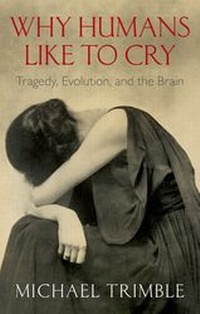
Why Humans Like to Cry
Tragedy, Evolution, and the Brain
1st Edition
Published on 22. November 2012
Book
Hardback
240 pages
978-0-19-969318-4 (ISBN)
Description
Human beings are the only species to have evolved the trait of emotional crying. We weep at tragedies in our lives and in those of others - remarkably even when they are fictional characters in film, opera, music, novels, and theatre. Why have we developed art forms - most powerfully, music - which move us to sadness and tears? This question forms the backdrop to Michael Trimble's discussion of emotional crying, its physiology, and its evolutionary implications. His exploration examines the connections with other distinctively human features: the development of language, self-consciousness, religious practices, and empathy. Neuroanatomy and neurophysiology of the brain have uncovered unique human characteristics; mirror neurones, for example, explain why we unconsciously imitate actions and behaviour. Whereas Nietzsche argued that artistic tragedy was born with the ancient Greeks, Trimble places its origins far earlier. His neurophysiological and evolutionary insights shed fascinating light onto this enigmatic part of our humanity.
Reviews / Votes
Trimble ambitiously cracks the surface of a complex human process. Scientific American This is a stimulating adventurous book. Daily Telegraph Trimble earned my respect for his erudition and ambition ... an engaging storyteller. Randolph Cornelius, New Scientist Fascinating volume ... an insightful account ... offers a profound glimpse into the human heart as well as deep insight into the role of art in our lives. GuardianMore details
Language
English
Place of publication
Oxford
United Kingdom
Target group
College/higher education
Professional and scholarly
The topic of emotional crying is an area that is growing in interest among brain researchers. This book should be of interest to those fascinated by human emotional development, and more generally by how the arts might have evolved in the human lineage.
Illustrations
Approx 15 black and white illustrations
Dimensions
Height: 217 mm
Width: 150 mm
Thickness: 24 mm
Weight
416 gr
ISBN-13
978-0-19-969318-4 (9780199693184)
Copyright in bibliographic data and cover images is held by Nielsen Book Services Limited or by the publishers or by their respective licensors: all rights reserved.
Schweitzer Classification
Other editions
Additional editions
Book
08/2014
Oxford University Press
€24.20
Shipment within 15-20 days
E-Book
11/2012
1st Edition
OUP Oxford
€39.39
Available for download
E-Book
10/2012
1st Edition
OUP Oxford
€4.49
Available for download
Person
Professor Trimble is emeritus professor of Behavioural Neurology at the Institute of Neurology, Queen Square, London. His research for many years has been on the behavioural consequences of neurological disorders, especially epilepsy and movement disorders. He has a lifelong research interest in neuroanatomy, hence his ability to explore the neuroanatomical basis of crying. However, he is also a psychiatrist with much clinical experience of mood disorders, and had investigated the latter in patients using neurological techniques, such as brain imaging. He is the author of The Soul in the Brain (Johns Hopkins, 2007).
Content
Preface ; 1. The Birth of Tragedy ; 2. Crying ; 3. The Neuroanatomy and Neurophysiology of Crying ; 4. Tragedy and Tears ; 5. Tearful Logic ; 6. Why Do We Get Pleasure Crying at the Theatre? ; Appendix 1: Neuroanatomy ; Appendix 2: Glossary