

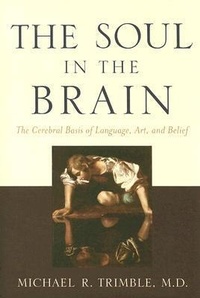
The Soul in the Brain
The Cerebral Basis of Language, Art, and Belief
Published on 12. June 2007
Book
Hardback
304 pages
978-0-8018-8481-8 (ISBN)
Description
In this provocative study, Michael R. Trimble, M.D., tackles the interrelationship between brain function, language, art-especially music and poetry-and religion. By examining the breakdown of language in several neuropsychiatric disorders, neuroscientists have identified brain circuits that are involved with metaphor, poetry, music, and religious experiences. Drawing on this body of evidence, Trimble argues that religious experiences and beliefs are explicable biologically and relate to brain function, especially of the nondominant hemisphere. Inspired by the writings and reflections of his patients-many of whom have epilepsy, psychosis, or affective disorders-Trimble asks how the human species, so enamored of its own logic and critical facilities, has held from the dawn of civilization strong religious beliefs and a reverence for the arts. He explores topics such as the phenomena of hypergraphia and hyper-religiosity, how religious experiences and poetic expression are neurologically linked with our capacity to respond to music, and how neuropsychiatric disorders influence behaviors related to artistic expression and religiosity by disturbing brain function.
With the sensitivity of a dedicated doctor and the curiosity of an accomplished scholar, Trimble offers an insightful analysis of how the study of people with paradigmatical neuropsychiatric conditions can be the cornerstone to unraveling some of the mysteries of the cerebral representations of our highest cultural experiences.
With the sensitivity of a dedicated doctor and the curiosity of an accomplished scholar, Trimble offers an insightful analysis of how the study of people with paradigmatical neuropsychiatric conditions can be the cornerstone to unraveling some of the mysteries of the cerebral representations of our highest cultural experiences.
Reviews / Votes
This book exists... to explain matters of the heart using our knowledge of the mind... A host of professional students, clinicians, educators, and other well-read individuals will find this worthy of a close and careful read. -- Mark H. Fleisher JAMA 2007 Perfect for either college-level collections strong in science, health, or social science and for public lending collections alike... An intriguing, lively survey. Midwest Book Review 2007 A highly thought-provoking excursion. Scientific American Mind 2007 This scholarly, yet provocative, book from an insightful, observant neurologist... is rich with thought-provoking ideas. -- Chris McManus British Journal of Psychiatry 2008More details
Language
English
Place of publication
Baltimore, MD
United States
Target group
Professional and scholarly
Product notice
sewn/stitched
Paper over boards
With dust jacket
Illustrations
12 s/w Photographien bzw. Rasterbilder, 7 s/w Zeichnungen
7 Line drawings, black and white; 12 Halftones, black and white
Dimensions
Height: 234 mm
Width: 163 mm
Thickness: 25 mm
Weight
562 gr
ISBN-13
978-0-8018-8481-8 (9780801884818)
DOI
10.1353/book.3325
Copyright in bibliographic data and cover images is held by Nielsen Book Services Limited or by the publishers or by their respective licensors: all rights reserved.
Schweitzer Classification
Other editions
Additional editions
Book
02/2014
Johns Hopkins University Press
€40.50
Article not available at the moment
E-Book
06/2007
Johns Hopkins University Press
€24.99
Available for download
Person
Michael R. Trimble, M.D., is a professor of behavioral neurology at the Institute of Neurology, University of London.
Content
Acknowledgments
Introduction
1. Where Did It All Begin?
2. The Neuroanatomy of Emotion
3. Language and the Human Brain
4. The Other Way of Using Language
5. The Breakdown of Language
6. Music and the Brain
7. Neurotheology I: Epilepsy
8. Neurotheology II: Other Neurological Conditions
9. God, Music, and the Poetry of the Brain
Epilogue
Appendix I: Brief Biographies of Some Poets with Bipolar Disorder
Appendix II: Some Notable Religious Poets
Notes
References
Index
Introduction
1. Where Did It All Begin?
2. The Neuroanatomy of Emotion
3. Language and the Human Brain
4. The Other Way of Using Language
5. The Breakdown of Language
6. Music and the Brain
7. Neurotheology I: Epilepsy
8. Neurotheology II: Other Neurological Conditions
9. God, Music, and the Poetry of the Brain
Epilogue
Appendix I: Brief Biographies of Some Poets with Bipolar Disorder
Appendix II: Some Notable Religious Poets
Notes
References
Index